
Anti-Drilling/Fossil Fuel | Energy Services | Industrywide Issues | Lancaster County | Litigation | Pennsylvania | Pipelines | Transco | Williams
End of the Road for Sisters of the Corn re Atlantic Sunrise Pipe
 The Sisters of the Corn (our name for the a group of leftist nuns in Lancaster County, PA) asked the U.S. Supreme Court to hear a case in which they claim their religious freedom has been trampled by Williams running a pipeline (Atlantic Sunrise) across their property. The case came up for consideration with the Supremes and they declined to hear it, meaning it’s the end of the road for the Sisters and the green group backing them.
Read More “End of the Road for Sisters of the Corn re Atlantic Sunrise Pipe”
 Yesterday our favorite government agency, the U.S. Energy Information Administration, issued our favorite monthly report, the Drilling Productivity Report. The DPR is a forecast of oil and gas production in the country’s seven major shale plays for the coming month, made by the expert number crunchers at EIA.
 Earlier this month MDN brought you the news that one of two active LNG export projects in Nova Scotia had agreed to pay (off) an undisclosed amount of money to the The Mi’kmaq (pronounced mic-mac) indigenous peoples of Nova Scotia (i.e. Indians), a payment of which means the Indians will leave them alone so they can build their facility and not face endless lawsuits (see
  Last November Encino Acquisition Partners (i.e. Encino Energy) completed its purchase of all of Chesapeake Energy’s Ohio Utica Shale assets for $2 billion (see
  Last November MDN brought you the exciting news that New Fortress Energy is planning to build an LNG (liquefied natural gas) liquefaction EXPORT plant in landlocked Wyalusing (Bradford County), PA (see
  Earlier this month MDN told you about a DC Circuit Court of Appeals decision that gives both the Constitution Pipeline and Northern Access Pipeline projects reason for hope (see
  We won’t pretend to understand the wacky math Pennsylvania Gov. Tom Wolf is attempting to perpetrate on the good citizens of PA. The state Dept. of Environmental Protection (DEP) wants to raise permit fees on Marcellus Shale drillers by 250% in order to help fund the agency, claiming the oil and gas program loses $800,000 per month (see
  The State of Connecticut’s “Siting Council” has changed its mind. In 2016, NTE Energy proposed building a 650-megawatt natural gas-fired electric plant in Killingly. The Siting Council said NTE couldn’t justify the plant and refused to issue a certificate. That was then, this is now. The Siting Council is once again actively considering the project. What changed?
 We spotted an article based on the research done for a graduate thesis by a Massachusetts Institute of Technology (MIT) graduate student. The thesis and article look at the reality of our country’s energy supply and concludes that unless we can find a way to reduce our reliance on natural gas (not likely), we need more new pipelines, and we need to repair and upgrade old/existing pipelines. In short, we have a pipeline problem in this country.
 UK oil and gas giant BP recently released its 2019 edition of their BP Energy Outlook. As they do each year, BP predicts renewable energy sources will continue to grow. However, the inescapable conclusion you get from this latest report is that LNG (liquefied natural gas) will play a staring role in the energy picture over the next 20 years. Not only that, but LNG coming from the U.S. is will receive the best actor award.
 Is this really the depths to which we’ve now descended? If you disagree with a legitimate, legal business and their right to engage in a legitimate, legal practice (but you don’t like it), you bastardize the legal system and launch a criminal investigation?
 In 2013 Eureka Resources built a Marcellus Shale wastewater treatment facility near Towanda (Bradford County), PA with a capacity to treat up to 10,000 barrels of wastewater per day (see
  Last week Equitrans Midstream (formerly EQT Midstream) released their fourth quarter and full year 2018 update (see
  “OK Republicans, time to put up or shut up” (so says the wacky left-wing fringe of the Democrat Party). “You don’t like the Dem’s Green New Deal? You think it’s certifiably crazy (which it is)? Tell us what *your* plan is to save the environment.” Glad you asked! Republicans have one, and it’s called switching to natural gas. Republicans propose to replace Communist-inspired Green New Deal with a Blue Real Deal.
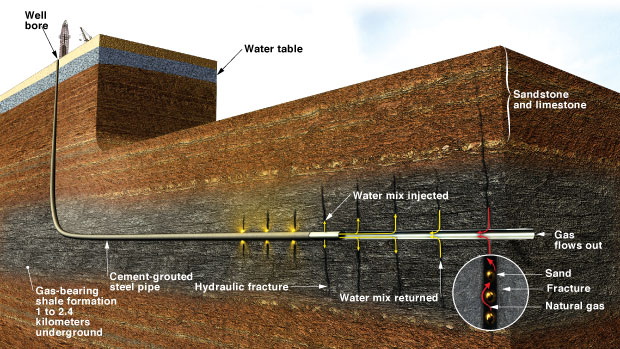 A drilling team with experience drilling more than 1,000 Marcellus shale wells in Pennsylvania with laterals from 1,500 feet to 11,000 feet recently published a research paper looking at best practices and what it will take to routinely drill wells with laterals longer than 18,000 feet.