
U.S. Supreme Court Stops Climate Lawsuit by 21 Kids, Temporarily
 On Friday we told you that the Trump Dept. of Justice had petitioned the U.S. Supreme Court to temporarily stop a court case from advancing to trial next week (see DOJ Asks Supreme Court to Stop Climate Lawsuit by 21 Kids). Lawyers representing a group of 21 children filed a lawsuit in 2015 that aims to force the end of using all fossil fuels in the United States, to address so called man-made global warming. That case survived numerous challenges and was set to go to trial Oct. 29 in U.S. District Court for the District of Oregon. But on Friday, U.S. Supreme Court Chief Justice John Roberts slapped a halt on the case and ordered both sides to give him information by Wednesday of this week. So, we have progress. Still not reason to celebrate, but moving in the right direction.
Read More “U.S. Supreme Court Stops Climate Lawsuit by 21 Kids, Temporarily”
 A recurring theme (broken record) over the past few months has been, “Natural gas storage is too low, far lower than last year and far below the five-year average–prices will have to skyrocket any day now!” That’s been the meme by traders and industry watchers. We keep saying things have fundamentally changed–that drillers can open the spigots any time they want and let it flow. Don’t believe us? Then maybe you will believe the American Gas Association.
 Once again it seems environmentalists in Kentucky have won–stopping yet another NGL (natural gas liquids) pipeline. On Wednesday Kinder Morgan, one of (perhaps the) largest pipeline companies in North America, announced it is canceling plans to convert part of its Tennessee Gas Pipeline (TGP) that currently flows natural gas from the Gulf Coast to the northeast, to reverse the pipeline and flow natural gas liquids (NGLs) from the Marcellus/Utica region to the Gulf Coast. The project, called Utica Marcellus Texas Pipeline (UMTP), would have cost $4 billion. Instead, Kinder says it will still seek to reverse a big portion of TGP, but will instead flow M-U natgas south, instead of NGLs.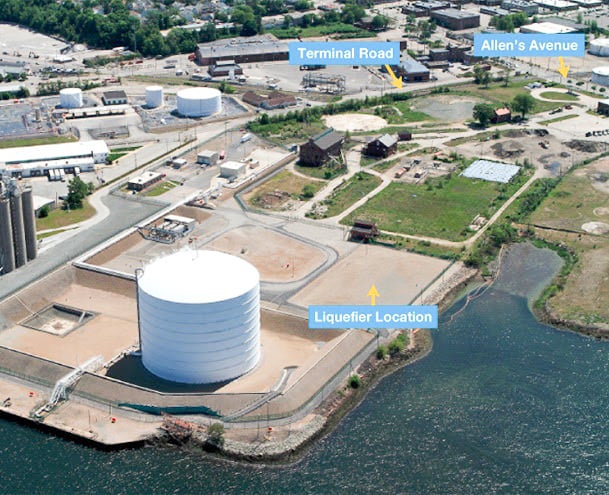
 Energy Transfer is, on paper, several different companies. Energy Transfer Equity (ETE) is the mother ship–the main holding company. Energy Transfer Partners (ETP) is and has been (for us) the main company, builder of Rover Pipeline, among other projects. Nearly two years ago Sunoco Logistics Partners, a subsidiary of ETE, was merged into ETP (see
 Year after year New England sees historic price spikes and shortages of natural gas during the winter. It got so bad last year that several LNG cargoes from Russia were delivered (see
  Lawyers representing a group of 21 children filed a lawsuit in 2015 that aims to force the end using all fossil fuels in the United States, to address so called man-made global warming (see
  The East Coast’s second LNG export plant to come online, after Cove Point in Maryland, will be Elba Island in Georgia. In July, Kinder Morgan, the builder and primary sponsor of the project, pushed back startup for the plant from the third until fourth quarter of this year (see
  In July MDN told you that Dominion Energy had decided, at least unofficially, to abandon a plan to build a compressor station across the Potomac River from Mount Vernon–the home and estate of our illustrious first president, George Washington (see
  Last Friday three county commissioners from Belmont County, OH took a field trip to visit Beaver County, PA, touring the Shell ethane cracker site and talking with Beaver County officials about how the project has impacted that area. Tuesday night, a member of the Potter Township (PA) Board of Supervisors came to a meeting of local leaders in Belmont County, to talk about the Shell cracker project and what such a project in Belmont could do for the Ohio Valley. PTT Global Chemical is supposedly close to making a final investment decision on building a cracker in Belmont. The interesting comment coming from Tuesday’s meeting was about the timing of a decision to build the PTT cracker: “It [the decision] will be revealed by the end of the year.” So says Belmont officials.
 PJM Interconnection is a regional transmission organization (RTO) operating the electric grid in all or parts of 13 states and the District of Columbia, including PA, OH and WV. It is the largest competitive wholesale electricity market in the U.S. (second largest in the world), with more than 1,000 companies (1,376 generation sources) as members, serving 65 million customers with 177 gigawatts of generating capacity. It’s yuge! EIA published numbers yesterday quantifying natural gas-fired generation in PJM. The upshot: natural gas has eclipsed coal in electric generation in PJM, and PJM uses more natgas plants in both raw numbers and as a percentage of electricity generated, than any other power grid.
 It seems that universities in states outside the Marcellus region are fascinated with the Marcellus. They love to “study” it. Or at least, the Marcellus is a goldmine for them in research grants. The latest outsider to study the Marcellus is the University of Tennessee at Knoxville. Using a National Science Foundation grant, researchers from UT “will look at how aquatic microbial communities are impacted by biocides associated with hydraulic fracking.” That is, they’re studying whether or not fracking, because it has a low presence of chemicals, is creating superbugs that are resistant to antibiotics. Will fracking cause a new Black Plague?
 Some of the best frac sand to be found–the finest particles–come from Wisconsin sand mines. Once upon a time Wisconsin was the primary frac sand producing state, for both the northeast and the southwest. But then Texas oil frackers began experimenting with Texas sand and found they could use it. No, the Texas sand is not quite as fine (or good) as Wisconsin sand, but it works. And it’s cheap, because transportation costs are low. Shipping sand from Wisconsin to Texas by rail costs big bucks. The northeast is not blessed with its own sand mines for fracking, so we still depend on places like Wisconsin. And now, increasingly, Wisconsin depends on us.
 Que the music with dramatic drums, cymbals and trumpets. Camera A, zoom in on Secretary McDonnell. The whole state is watching. It’s time for the Pennsylvania Dept. of Environmental Protection (DEP) to announce the winners of PA’s Hunger Games-style contest to grab a piece of the $12.6 million “fine” paid by Sunoco Logistics Partners for “permit violations related to the construction of the Mariner East 2 pipeline project” (see