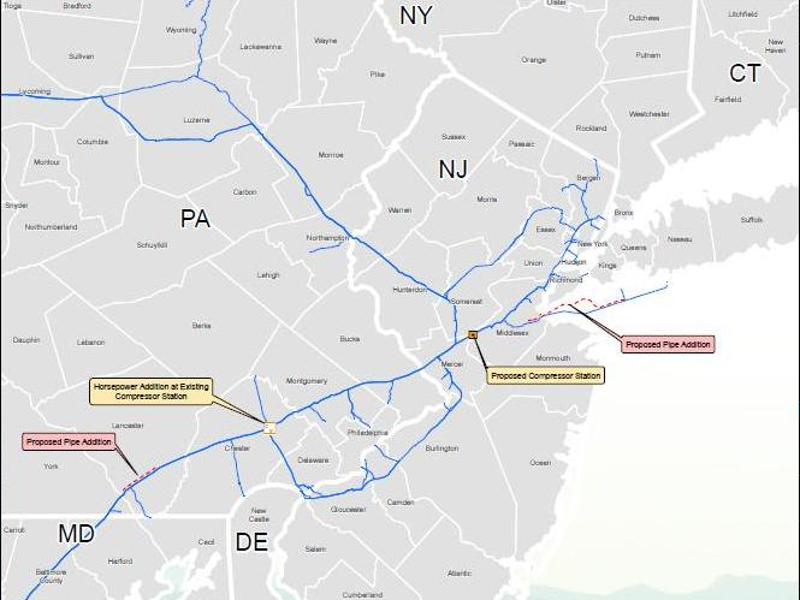
National Grid Threatens New Gas Customer Moratorium on Long Island
 Utility giant National Grid, which services Long Island (part of New York City) with natural gas service, is threatening New York State that if the state does not approve Williams’ Northeast Supply Enhancement (NESE) pipeline project by May 15th, they will, as Consolidated Edison has just done in Westchester County, impose a no-new-natural gas customers moratorium for the New York City area. Which would block development of the new $1 billion Belmont Park Arena.
Read More “National Grid Threatens New Gas Customer Moratorium on Long Island”
 The pressure is mounting on New York Gov. Andrew Cuomo with regard to blocking natural gas pipelines. Except now the pressure is coming from the adults in the room who see through Cuomo’s sleazy politics. None other than the editorial board of the Wall Street Journal has ripped into Cuomo, calling his blockade of new pipelines the equivalent of a “cold weather tax”–not only on New Yorkers, but also those living in New England.
 A huge crack of sunshine has just shown through the court system with respect to pipeline projects. A case decided on Jan. 25 in the DC Circuit Court of Appeals which technically has nothing to do with either the Williams Constitution Pipeline project nor the National Fuel Gas Company Northern Access Pipeline project (both being blocked by New York State), may be the one court decision to break open the logjam and allow both projects to begin construction.
 Speaking of National Fuel Gas Company’s Northern Access Pipeline project, NFG asked the Federal Energy Regulatory Commission (FERC) last November to extend the project timeline by an extra three years, to give them more time to fight with Cuomo in court and actually get the pipeline built once lawsuits from the state are exhausted (see
  In November, Dominion Energy said that their 600-mile Atlantic Coast Pipeline (ACP) would be delayed, with a partial startup in 2019 and full startup for everything else in mid-2020 (see
 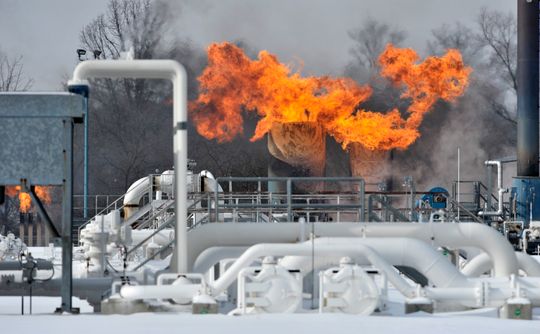 Last week a pipeline at a single Michigan compressor station caught fire and exploded (see
  Tallgrass Energy, builder and operator of the mighty Rockies Express (REX) pipeline which is a critical link that flows Marcellus/Utica gas to Midwestern markets, dropped a bombshell announcement yesterday. The company said that investment firm Blackstone is buying a “controlling” interest in the company. Which raises the question, will Blackstone indeed “control” the company?
 Canadian pipeline giant TransCanada, which owns the Columbia Pipeline system here in the U.S., blames the Marcellus/Utica for a huge drop in volumes flowing through its Canadian Mainline from Western Canada to Ontario and Quebec.
 Equitrans’ (EQT Midstream) 300-mile Mountain Valley Pipeline (MVP) is now 70% built (see
  It seems the rather thick-headed governors from New England have finally woken up and understand their resistance to new natural gas pipelines has placed them in a pickle. The region, when it gets really cold (like over the next few days), gets really short on natural gas. Prices soar, supplies diminish, and people not only pay high natgas prices, but high prices for electricity, which gets generated by natgas. The govs have a plan to slap a Band Aid on the problem.
 This post is about a pipeline project we’ve written quite a bit about over the past few years–Dominion Energy’s New Market project that ever-so-modestly expands an existing pipeline in Upstate New York. But at its heart, the issue is much deeper. Anti-fossil fuel radicals are challenging this project, in court, as a way to force the government to consider man-made global warming when approving such projects.
 This is fun to watch. The monied interests in Westchester County, NY (suburb of New York City) are outraged that beginning in March Consolidated Edison will no longer accept new natural gas customers (see
  A 30-inch segment of Enbridge’s Texas Eastern Transmission Company (Tetco) interstate natural gas pipeline exploded one week ago today, sending two people to the hospital and destroying two nearby homes when fires from the blast spread (see