
Mountain Valley Pipeline Files FERC Appl, Now Just Matter of Time
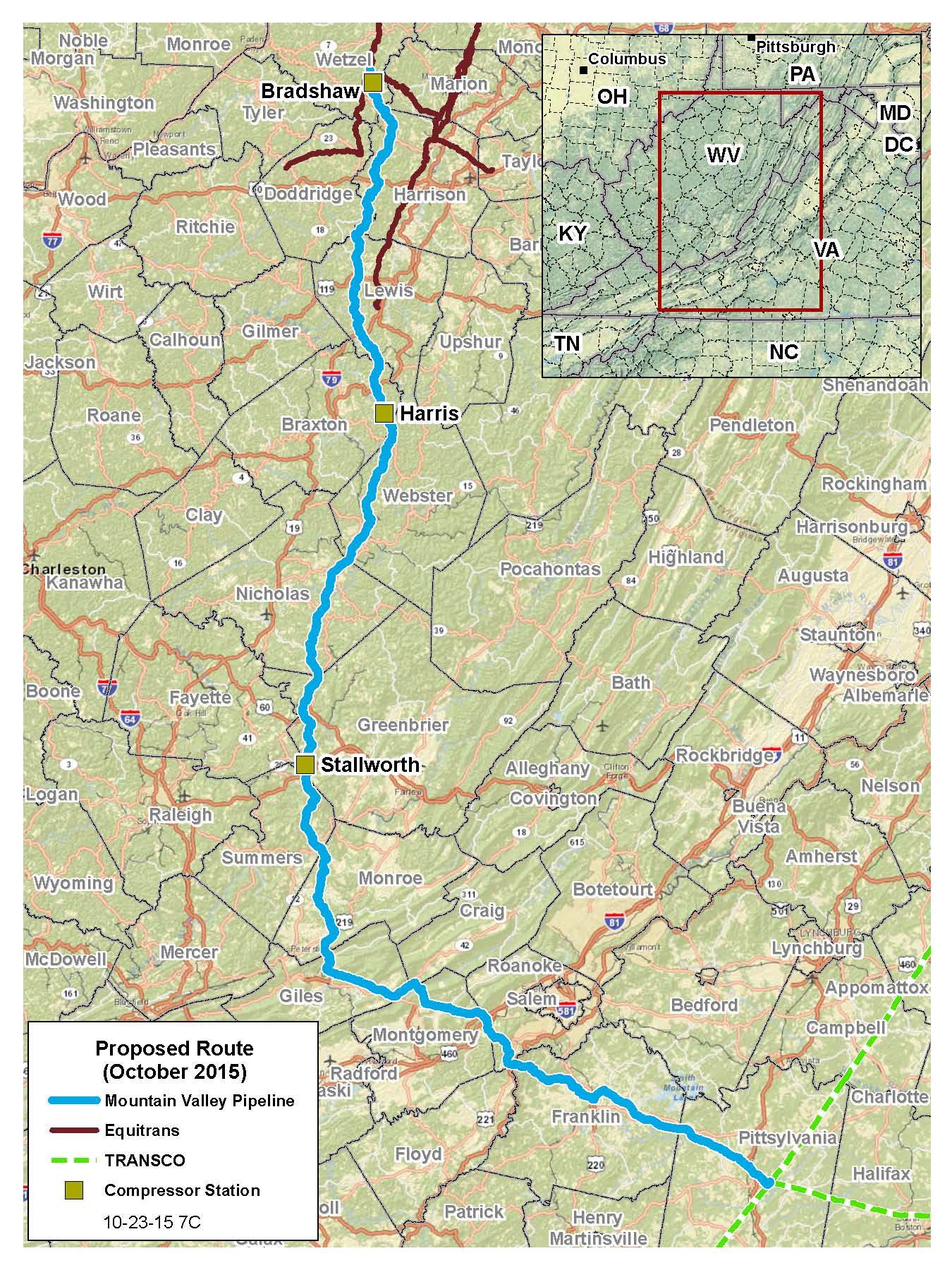
It’s finally official. Although the length of the pipeline changed from 330 miles to 301 miles, and although the number of project partners expanded from the original EQT and NextEra Energy to include WGL Holdings, Vega Energy Partners, and RGC Resources, and although over 100 landowners blocked survey access (later taken to court to force access)–the $3.5 billion Mountain Valley Pipeline (MVP) stretching from Wetzel County, WV to the Transco Pipeline in Pittsylvania County, VA filed an official application with the Federal Energy Regulatory Commission last Friday. Now it’s just a matter of time. Yes it will take a few years to get it approved and built, but the most important step has been accomplished…
Read More “Mountain Valley Pipeline Files FERC Appl, Now Just Matter of Time”
 In addition to releasing their third quarter 2015 results yesterday, the top brass from EQT also held an analyst phone call. On that call we got updated details from EQT’s president of exploration and production, Steven Schlotterbeck, about the single highest initial-producing Utica Shale well ever drilled, EQT’s Scotts Run 591340. We also heard from Steve about two more Utica wells they’re currently drilling–one in Greene County, PA (about five miles from the Scott’s Run well), and one in Wetzel County, WV. But the big news from yesterday’s call came from EQT CEO David Porges. He said EQT has decided to suspend drilling in central PA and in the Upper Devonian–anyplace outside of their “core” Utica locations. Essentially, EQT is giving up on the Marcellus (for now) and going after the Utica instead. This is certainly big news and affects landowners in Marcellus-only areas–pretty much any place outside of southwest PA and the northern panhandle of WV. Porges says IF the Utica pans out as expected, it will be bigger than the Marcellus production-wise over time. EQT’s current thinking is that they will trim their drilling program to concentrate on drilling 10-15 Utica wells in 2016…
 In August MDN brought you the news that Antero Resources has decided to build a new state-of-the-art frack wastewater treatment plant in Doddridge County, WV for $275 million (see
 MDN has just published Volume 2 of the
 With President Obama’s war on coal in full swing, so-called renewable energy sources like wind and solar can’t possibly pick up the slack from coal-powered electric generating plants shutting down. Coal-fired electric plants are shutting down at an alarming rate–we’ve lost 11 million megawatts of coal-fired electric capacity in the past year alone. That situation spells opportunity for natural gas. One reason that natgas is making inroads in the electric generating space is because it’s a whole lot cheaper today than it was just a few short years ago to use clean-burning natural gas to power electric plants. In 2008 the price of natural gas sold for an average of $13 per thousand cubic feet (Mcf). Today? The price of gas has been bumping along at around $2.75/Mcf. In places like southwest Pennsylvania and eastern Ohio Marcellus and Utica gas sells for around $1.50-$1.75/Mcf. So it’s no wonder electric plants powered by natural gas are springing up all over the place. Below is a quick look at six such plants in eastern Ohio and West Virginia…
 What a difference a few months, or even a week, can make. In August, Gastar Exploration, which owns roughly 60,000 acres of leases in the Marcellus/Utica mostly in Marshall and Wetzel counties in West Virginia, was talking up their drilling program in the northeast (see
 Quick: According to the U.S. Energy Information Administration, which three states are responsible for 85% of the increase in natural gas production since 2012? If you answered Pennsylvania, Ohio and West Virginia, you would be correct. The Marcellus/Utica Shale has been the number one economic stimulus and jobs creator in the northeast for the past three years. At times, PA, OH and WV have competed for the same investments, like ethane cracker plants. (All three states have a serious proposals for ethane crackers.) Realizing it may be better to work together rather that compete against each other, all three states have agreed to cooperate to develop shale gas in the Appalachian region. Yesterday political representatives from all three states–Gov. Tom Wolf from PA, Gov. Earl Ray Tomblin from WV and Lt. Gov. Mary Taylor from OH–signed a tri-state regional cooperation agreement at the Tri-State Shale Summit held in Morgantown, WV. There are four main areas the three states have pledged to work together on…
 In April 2013 MDN reported on the tragic death of 56-year-old Bruce Phipps from Marietta, OH who was working at a Eureka Hunter “pig” (Pipeline Inspection Gauge) receiving station near near Wick (Tyler County), WV (see
 Antero Resources’ chief administrative officer, Al Schopp, shared an update on Antero’s activity in WV at the West Virginia Oil and Natural Gas Association’s annual meeting two weeks ago at Oglebay Resort. Schoop’s update was enlightening. Although Antero has cut back from running 15 drilling rigs in WV last year to only 6 this year (due to the low price of natural gas), they remain active and employ 2,000 people in the state–that’s LOCAL people. Since 2009 Antero has spent nearly $5 billion (!) in WV. Some of that money–$500 million–was spent to create a pipeline system to deliver water to drill pads so they don’t have to clog narrow mountain roads with thousands of truck trips. The company spends $20 million a year to employ safety consultants at every major Antero construction, drilling and fracking operation 24/7/365. How long does Antero plan to be a major presence in the Mountain State, and what’s ahead in the near-term? Read on…
 Oilfield service giant Baker Hughes released their venerable monthly rotary rig count report yesterday for September 2015. After posting gains in the overall land-based U.S. rig count number for two straight months in July and August, the September numbers dropped like a rock. September U.S. active land-based rigs averaged 848, down 35 from the average of 883 in August and down 18 from July’s average of 866. Rig counts for the Marcellus/Utica also continued to drop, showing another four rigs were idled during September across the combined PA/OH/WV. It’s getting bloody out there…
 Hey anti-drillers who like to lie about the benefits of fracking: Tell us again how there’s no positive economic impact from the shale industry. It’s all just smoke and mirrors and the only ones who make money are Big Oil & Gas. Tell us how the jobs are “temporary” and the money from the industry illusory. Then we’ll tell you about the Wheeling Metropolitan Statistical Area, comprised of Belmont County, OH along with Marshall and Ohio counties in WV. The Wheeling MSA’s gross domestic product grew by 9.5% from 2013 to 2014, according to data provided by the U.S. Department of Commerce. That’s the fifth fastest growing MSA in the country–out of 381 MSAs. Oh, and the reason it’s growing so fast? Yep–the Marcellus and Utica Shale boom happening in the region…
 MDN’s Jim Willis comes from the marketing world having held marketing positions at various publishing companies over the past 25 years or so. Sometimes (like you) Jim wants to pull his remaining hair out when reading press releases larded up with tech and marketing speak. Just say it in plain English, please! We came across such a press release from GE–as in General Electric. We waded through a tangle of “optimized compression” and “asset level” and “condition-based” phraseology to bring you this news: Crestwood Midstream is using new software from GE that will improve the compressor stations they operate in WV, allowing Crestwood to move more gas using the same equipment. There, that wasn’t so hard, was it? Why can’t marketing types learn the lesson that simple language is better!…
 In March of this year, Syracuse University Professor Dr. Donald Siegel published the results of an extensive research study that found fracking of Marcellus Shale wells in Pennsylvania does not cause methane in water wells (see
 The Rogersville Shale once again popped up on the radar. Yesterday at the West Virginia Oil and Natural Gas Association (WVONGA) Conference in Wheeling, WV, a research geologist with the Kentucky Geological Survey talked about the Rogersville Shale, outlining its geography in both WV and KY. Corky Demarco, executive director of WVONGA chimed in with a reminder that Cabot Oil & Gas has drilled a test well in the WV Rogersville in Putnam County (see
 Just last week MDN told you about the bone-headed proposal from a partisan group in West Virginia calling for a doubling or tripling of the severance tax on natural gas liquids–unless those NGLs stay in the state (see