Yes, new businesses do start up to serve the Marcellus/Utica industry–even in this down cycle. And they’re successful. The latest example comes from the Wheeling, WV area where a new state-of-the-art facility is starting up in Benwood to “inspect and place threading on pipe used to carry natural gas.” JLE Industries, based in Dunbar, PA, is investing $6 million to convert the former Wheeling-Pittsburgh Steel facility into a facility opening in January that will, when fully operational, employ 45 people… Read More “New Pipeline Threading/Inspection Facility Opening Near Wheeling”
Once again the Ben Franklin Shale Gas Innovation and Commercialization Center (SGICC) is back with their annual Shale Gas Innovation Contest. This is the fifth annual contest and four winners will split an $80,000 prize purse. It’s time to enter the contest! Any idea OR already commercialized product/service related to the shale energy space is eligible. ANY. Examples include: well pad EH&S products/services, novel materials or chemicals (to enhance performance, prevent corrosion, or improve product yield), remote site monitoring technologies, natural gas or NGL conversion technologies, and water management or remediation technologies. Why not enter your product or service? Details below… Read More “5th Annual Shale Gas Innovation Contest Now Accepting Applications”
In a somewhat complicated scam, a former landman for XTO Energy, Steven E. Fisackerly (33 years old) defrauded XTO out of more than $1 million with fake lease deals in the West Virginia Marcellus Shale region. He cooked up bogus documents and passed them off as real, pocketing commissions. He even worked with a supposed/fake mineral rights owner to pocket kickbacks from lease payments sent to the fake rights owner. It was elaborate and convoluted–and ultimately stupid. Fisackerly plead guilty in May and will enter prison on January 4. His sentence? Pay back more than $1 million he defrauded from XTO, and serve 63 months (over 5 years) in federal prison… Read More “Former XTO Marcellus Landman Gets 5+ Years in Prison for Fraud”
What is it about politicians needing to get their grubby hands on YOUR money? A group of West Virginia state politicians–delegates and one state senator, both Democrats and Republicans–held a town hall meeting at West Virginia Northern Community College last Thursday in which they pontificated that the severance tax in WV is too low, and property taxes for Marcellus/Utica Shale landowners are too high. Below is a summary of the back and forth at the meeting. The somewhat ominous (from our perspective) talk at the meeting is that in this down market politicians want to further kill the drilling industry (the one bright spot) in their state by taxing it higher… Read More “WV Politicians: Raise Severance Tax, Lower Property Tax”
It’s something straight out of the Tom Cruise movie Minority Report. The federal Environmental Protection Agency has fined the owner of five Pennsylvania natural gas processing plants and one West Virginia plant (six plants total) $50,221 for spills and leaks at the plants–that never happened. The EPA says Elkhorn Gas Processing hasn’t done enough to prevent such incidents from potentially happening, and therefore the EPA is shaking them down and making them pay for possible future violations. Perhaps it’s more like The Godfather than the Minority Report? Talk about an abuse of power! Do you need any further evidence that the Obama EPA is totally out of control?… Read More “EPA Fines PA Gas Plants for Accidents that Haven’t Yet Happened”
West Virginia landowners and mineral rights owners get prepared: the forced pooling issue is coming around again. After five years of trying, it seemed that a forced pooling bill was finally going to pass in West Virginia during the 2015 WV 60-day legislative session. But at the literal eleventh hour of the last day of the session, it failed (see The Real Story of Why Forced Pooling Bill Failed in WV). In April we told you that the forced pooling bill may get a vote this fall, although that never materialized (see WV Forced Pooling Bill HB 2688 May Get Another Vote This Fall). However, yesterday legislators got a look at a revised version of the bill that died earlier this year. The plan, as it currently stands, is to re-introduce it in January when the WV legislature meets for its annual 60-day session… Read More “WV Forced Pooling Bill Coming Around Again in 2016”
It’s time for you, pro-drilling supporters, to weigh in and make comments to the Federal Energy Regulatory Commission (FERC) on your support for two important pipeline projects: EQT’s Mountain Valley Pipeline and EQT’s Equitrans Expansion project. The Mountain Valley Pipeline project is a new $3.5 billion natural gas pipeline running 301 miles (down from 330 miles) from Wetzel County, WV to Pittsylvania County, VA, connecting to the existing Equitrans pipeline along the way (see Mountain Valley Pipeline Files FERC Appl, Now Just Matter of Time). Mountain Valley will flow 2 billion cubic feet per day (Bcf/d) of natgas and is projected to be built and in-service around the fourth quarter of 2018. The Equitrans Project will upgrade compressor stations, add approximately eight miles of pipeline connectors to upgrade capacity on the Equitrans Pipeline from southewestern PA into WV. The $100 million project, when completed, will expand capacity on the Equitrans pipeline by 600 million cubic feet per day (Mmcf/d). The Equitrans project is also due to be completed in 4Q18. Here’s the details for how you can show your support for these two important projects. But hurry, you only have until Nov. 26 to provide your comments/show support… Read More “Time to Support EQT Mountain Valley & Equitrans Pipelines @ FERC”
Summit Midstream has a small but growing presence in the Marcellus/Utica region largely through purchasing pipeline systems from other companies, including Mountaineer Midstream, Summit’s Marcellus-area pipeline system in Doddridge County, WV. Yesterday the company issued its third quarter 2015 financial results. Of particular note: Summit is majority owned by Energy Capital Partners (ECP), a private equity firm (investment company). ECP is talking about selling their interest. That is, it’s sounding like Summit may soon see a change in ownership. Below is the update on that possible change, along with an update on Summit’s Mountaineer Midstream gathering system… Read More “Summit Midstream 3Q15: Current Owner ECP Looking to Sell”
Unimin Energy Solutions – Marcellus/Utica Terminal Network – click for larger version
A Texas-based company, Unimin Energy Solutions, has 11 frac sand terminals throughout the Marcellus/Utica region (see the map). The most recent terminal they opened was this past June in Jerry Run, WV (see Unimin Energy Opens 11th Marcellus/Utica Frac Sand Terminal). Another of those 11 sites is in Benwood (Marshall County), WV. Last week Unimin held a grand opening of its 2nd unit train capable terminal at Benwood. The Benwood terminal now has almost 20,000 tons of silo storage capacity and can load up to 55 frac sand trucks per hour. CSX Railroad shuttles unit trains continuously to replenish frac sand inventory at the site. Details on last week’s soirée… Read More “Unimin Energy Expands Frac Sand Terminal in Benwood, WV”
Noble Energy is a global driller involved in a number of shale plays in the U.S. including the DJ Basin, Eagle Ford Shale, Delaware Basin and Marcellus Shale. Noble idled the last remaining drilling rig they were operating in the Marcellus in September (see Noble Energy to Idle Remaining Marcellus Rig Next Month). Even so, they had a banner third quarter in the Marcellus. Noble issued their third quarter update yesterday and although the section on their Marcellus operations is brief (read it all below), it packs a punch. Even with reducing rigs to zero, Noble completed and brought online their first Utica Shale well (in Marshall County, WV). Noble’s production volumes in the Marcellus in 3Q15 rocketed to 493 million cubic feet of natural gas equivalent per day (MMcfe/d), more than a 50% increase over 3Q14 numbers. But wait, there’s more!… Read More “Noble Energy 3Q15: Marcellus Prod. Up 50%, 1st Utica Well Drilled”
Stone Energy, an independent oil and natural gas exploration and production company (E&P) headquartered in Lafayette, Louisiana drills mainly in the Gulf of Mexico but also has a presence in the Marcellus/Utica Shale. Earlier this year the company released the one active Marcellus rig they were running and said they would not resume drilling in the northeast until receiving a hybrid rig in late 2015/early 2016 that can drill both Marcellus and Utica wells (see Stone Energy 1Q15: No New Marcellus Drilling, But More Production). In September Stone said they were shutting in most of their production in the Marcellus/Utica (see Stone Energy Shuts in Most of their WV NatGas Production). And indeed they did. Yesterday Stone released their third quarter 2015 update and it shows the company turned off the spigots in their northeast operations, cutting out all 100-110 million cubic feet equivalent per day (Mmcfe/d) of production in what they call their Mary field. The company continued to produce 20-25 Mmcfe/d from their Heather and Buddy fields (in the Marcellus). Here’s the latest update from Stone Energy… Read More “Stone Energy 3Q15: Shut Down 110 Mmcfe/d of Marcellus Production”
In August 2014 the Marshall County, WV board of commissioners (a 3-person board) voted to approve a plan to build a Marcellus Shale-powered electric plant in the county (see Marshall County Votes to Accept Gas-Powered Electric Plant). The vote was a bit complicated. In a nutshell, Moundsville Power, a company owned by developers from Buffalo, NY, proposed a deal to the county. They want to build a 549-megawatt plant costing $615 million. But if Moundsville owns the plant, it’s subjected to high property taxes. Moundsville proposed selling the plant to the county but running it for them. In essence the county will own the plant on paper. Because it’s county owned, no property taxes! However, Moundsville would make rental payments to the county–or payments in lieu of taxes (PILOT). The payments would not be as much as if it were taxed–about $13 million less over 30 years. But the county still gets $31 million over those 30 years–and $31M is a whole lot better than $0. Moundsville would not have built the plant at all if not for the PILOT arrangement. One of the three commissioners, Bob Miller, voted against the plan. Now he’s trying to convince the state legislature to overturn the PILOT plan, although he says he still wants the deal with Moundsville to go forward… Read More “Marshall County Commissioner Still Opposes $615M Electric Plant”
When liberal Democrat James Van Nostrand, director for West Virginia University’s Center for Energy and Sustainable Development, associate professor of law at West Virginia University, and a man-made global warming Kool Aid drinker addressed a recent forum at Wheeling Jesuit University, he told the audience they should just accept President Obama’s Clean Power Plan (CPP) and its death sentence for the coal industry. He essentially said “just get over it and move on. Lie down and admit defeat.” It put a smile on Van Nostrand’s face that WV Gov. Earl Ray Tomblin has appeared to cave and will pursue a plan to comply with our Dear Leader’s CPP directive, even though 26 states have sued to stop the plan, including WV (see 26 States Ask Federal Court to Shut Down Clean Power Plan Now). Here’s an overview of Van Nostrand’s “just admit you’ve been beaten” speech… Read More “WVU Professor “All In” on Obama’s Coal-Killing Clean Power Plan”
Contrary to what anti-fossil fuelers would have you believe, midstream companies building big pipeline projects DO listen to concerns and they DO change the route of a pipeline to address those concerns–like changing the route to minimize environmental impacts or to address the concerns of landowners. For example, Dominion has just announced it filed route changes for the Atlantic Coast Pipeline, a $5 billion natural gas pipeline running from West Virginia through Virginia and into North Carolina. The changes are made to minimize impacts on salamanders in two locations, to minimize impacts on a historic district, and to avoid crossing a swamp (yes, a swamp). Somewhere along the way in the past 30 years swamps became precious ecological assets instead of pools of stagnant, smelly, mosquito-infested water that need to be drained (go figure). Dominion is willing to play along. “Hey, if that smelly swamp is important to you, we’ll spend an extra $XX million and go a different route.” Dominion is not alone. Theirs is just the latest example that totally refutes the yarns spun by ninny nanny antis who blat about evil Big Pipelines and how they destroy everything. Here’s the latest “we’ll make some adjustments to the route to keep everyone happy” notice from Dominion… Read More “Dominion Files Pipeline Route Change to Avoid Salamanders, Swamp”

 In a somewhat complicated scam, a former landman for XTO Energy, Steven E. Fisackerly (33 years old) defrauded XTO out of more than $1 million with fake lease deals in the West Virginia Marcellus Shale region. He cooked up bogus documents and passed them off as real, pocketing commissions. He even worked with a supposed/fake mineral rights owner to pocket kickbacks from lease payments sent to the fake rights owner. It was elaborate and convoluted–and ultimately stupid. Fisackerly plead guilty in May and will enter prison on January 4. His sentence? Pay back more than $1 million he defrauded from XTO, and serve 63 months (over 5 years) in federal prison…
 It’s something straight out of the Tom Cruise movie Minority Report. The federal Environmental Protection Agency has fined the owner of five Pennsylvania natural gas processing plants and one West Virginia plant (six plants total) $50,221 for spills and leaks at the plants–that never happened. The EPA says Elkhorn Gas Processing hasn’t done enough to prevent such incidents from potentially happening, and therefore the EPA is shaking them down and making them pay for possible future violations. Perhaps it’s more like The Godfather than the Minority Report? Talk about an abuse of power! Do you need any further evidence that the Obama EPA is totally out of control?…
 Wait a minute! We thought the proposed Odebrecht ethane cracker plant near Parkersburg in Wood County, WV was all but dead. Lifeless. In April the company said it was “re-evaluating plans” to build it (see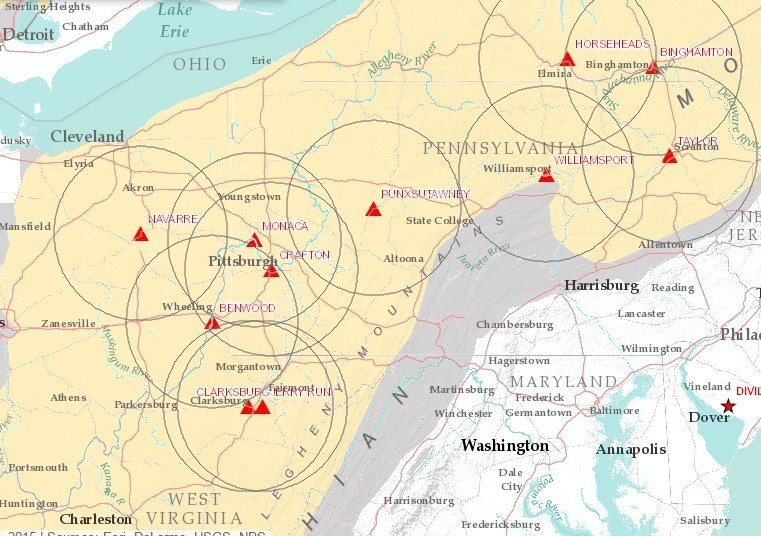
 Noble Energy is a global driller involved in a number of shale plays in the U.S. including the DJ Basin, Eagle Ford Shale, Delaware Basin and Marcellus Shale. Noble idled the last remaining drilling rig they were operating in the Marcellus in September (see
  Stone Energy, an independent oil and natural gas exploration and production company (E&P) headquartered in Lafayette, Louisiana drills mainly in the Gulf of Mexico but also has a presence in the Marcellus/Utica Shale. Earlier this year the company released the one active Marcellus rig they were running and said they would not resume drilling in the northeast until receiving a hybrid rig in late 2015/early 2016 that can drill both Marcellus and Utica wells (see
  In August 2014 the Marshall County, WV board of commissioners (a 3-person board) voted to approve a plan to build a Marcellus Shale-powered electric plant in the county (see
