WV’s First-Ever Gas-Fired Power Plant to Begin Construction
 NOTE: This post was updated 12/17/25 to reflect that there are, in fact, four existing (but small) gas-fired power plants in WV, built years before the shale energy revolution. We have the list—two in Wayne County, one in Marshall County, and one in Pleasants County— embedded below. Our thanks to a faithful reader for alerting us to this information.
How many times over the years have we reported on (and cheerleaded for) gas-fired power plants to get built in West Virginia? MANY times. Dozens, maybe hundreds of posts about this topic. Yet, in all the time we’ve been writing MDN (since January 2009), not a single, solitary gas-fired power plant has been built in the Mountain State. Not one new plant! Until now. Energy investment firm Blackstone announced yesterday it has made a final investment decision (FID) to move forward with building the $1.2 billion Wolf Summit Energy Center power plant in Harrison County, WV. Read More “WV’s First-Ever Gas-Fired Power Plant to Begin Construction”
 In April, Knighthead Capital Management, Homer City Redevelopment (HCR), and Kiewit Power Constructors Co. announced a plan to convert the former Homer City Generating Station, previously the largest coal-fired power plant in Pennsylvania (Indiana County, 50 miles east of Pittsburgh) into a more than 3,200-acre natural gas-powered data center campus, designed to meet the growing demand for artificial intelligence (AI) and high-performance computing (see
  One month ago, we reported that Ohio Republican Senators had introduced Senate Bill (SB) 219, the first significant update to Ohio’s oil and gas laws since the Kasich administration more than a decade ago (see
  U.S. retail natural gas prices are rising across all sectors due to higher wholesale costs, particularly the Henry Hub spot price, which is expected to increase by 58% in 2025 compared to 2024. This increase translates unevenly to consumers. Electric power plants and the industrial sector are expected to see the most significant price hikes, forecast at 37% and 21%, respectively, as their costs are more directly tied to fluctuations in wholesale prices. Residential and commercial customers, however, are expected to experience smaller increases of 4% each. This smaller impact is due to utilities adjusting their rates more gradually, and wholesale commodity costs constitute a smaller portion of the final retail bill for these sectors, which also include significant fixed charges for transportation and distribution.
  MARCELLUS/UTICA REGION: WV announces more than $4B in energy investments in past month; OTHER U.S. REGIONS: NY Climate Act fork in the road; Hochul enrages environmentalists with shift to ‘all of the above’ energy policy; Mike Kennealy calls for review of Massachusetts’ green energy programs; NATIONAL: Natural gas prices hit highest level since invasion of Ukraine; Six US states to watch as rising gas prices drive a coal comeback; Chevron sees oil prices under ‘more pressure’ than LNG next year; INTERNATIONAL: Crude settles higher; This year’s UN climate summit in Brazil, COP30, is a green flop; Paris Climate Accord’s demise—James Hansen was right; Five EU countries import €938 million in Russian oil and LNG in October.
  For seven looooooong years, Pennsylvania Senate Republicans (and MDN, we modestly add) have fought against enrolling the Keystone State in the Regional Greenhouse Gas Initiative (RGGI) carbon tax scheme. RGGI taxes gas- and coal-fired power plants, charging them so much per ton of carbon dioxide emitted. The aim is to eliminate these sources and replace them with unreliable renewable energy sources, such as wind and solar. PA’s former failed Governor, Tom Wolf, tried to force the state to join RGGI via an executive order (see
 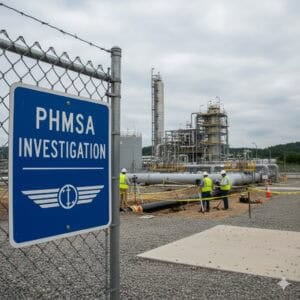 Federal safety officials are investigating leaks of ethane near two small underground storage tanks at the Cove Point LNG export terminal in Maryland and have requested that they be taken out of service immediately, citing potential safety concerns. The cause of the leak appears to be related to the tanks or their piping. However, Cove Point LNG, a facility owned and operated by a Berkshire Hathaway Energy subsidiary, maintains that the 40-gallon tanks are “safe to operate under the current conditions” and that the leaks have never posed an unsafe condition for employees or the community. The Pipeline and Hazardous Materials Safety Administration (PHMSA) issued a proposed safety order in mid-October, and the company has requested an informal consultation to discuss it.
  Despite claims by anti-fossil fuelers that the Tenaska Westmoreland Generating Station in southwestern PA would spread disease and death if it were built, it’s been up and running since 2018, producing power and generating money for both its builders and the community. Oh, and everyone is in good health. However, the plant has been operating under a state permit since it opened. It needs a federal Title V permit for long-term operation. The state Department of Environmental Protection (DEP) is the agency that issues such a permit and is proposing to do so, which (of course) has antis’ knickers in a twist. In particular, antis are complaining that there are no public complaining sessions scheduled.
  Since August, we’ve reported about an ongoing war of words between the City of Marietta officials (mostly Republicans) and the Ohio Department of Natural Resources (ODNR) over a permit for a fifth wastewater injection well located close to the city (see
  In January 2023, New York Gov. Kathy Hochul, a leftist Democrat, floated a plan to ban natural gas hookups in every single new home and business across the “Empire” State (see
  The U.S. Energy Information Administration (EIA) issued its latest monthly Short-Term Energy Outlook (STEO) yesterday. The STEO is the agency’s monthly best estimate of where energy prices and production will head over the next 12 months. In this latest assessment, EIA reversed its months-long trend of lowering its estimates for the Henry Hub spot price for 2025. The agency expects the HH spot price to average $3.50 per million British thermal units (MMBtu) in 2025, $0.10 higher than last month’s forecast. EIA also raised its 2026 forecast by $0.10 to $4.00/MMBtu. Recent soaring HH prices appear to have influenced the official price dartboard at EIA HQ.
  ECA Marcellus Trust I, the royalty interest holder in some of the wells drilled and maintained by Greylock Energy in Greene County, PA, announced yesterday that it will issue a 2-cent per unit dividend to unitholders for the third quarter of 2025. The company continues to hold back some profits ($90,000 in 3Q25) to build a cash reserve for “future known, anticipated or contingent expenses or liabilities.” ECA Marcellus Trust I, traded over-the-counter on the Pink Sheets, canceled distributions to investors for the first three quarters of 2020 due to the pandemic and the crash in oil and gas prices. The company restarted paying dividends in 4Q20. Since then, the Trust has paid out something in most quarters, floating from under a penny to as high as 18 cents/unit in 3Q22.
  EOG Resources, one of the largest oil and gas drillers in the U.S. (with international operations in several other countries), issued its third quarter update last week. EOG closed on its purchase of Utica driller Encino Energy in August (see
  National Fuel Gas Company (NFG), headquartered in Buffalo, NY, is the parent company for Marcellus/Utica driller Seneca Resources and the parent of midstream company NFG Midstream (and subsidiary Empire Pipeline). Last week, NFG issued its latest quarterly update, which is the company’s fiscal year 4th quarter (but everyone else’s 3rd quarter). According to NFG CEO David Bauer, the company added 220 new Upper Utica locations during the quarter, extending the well inventory to “almost 20 years” that will be profitable at a NYMEX price under $2/MMBtu. Bauer also stated the company recently executed a new pipeline deal with an unnamed shipper to haul an extra 250 MMcf/d of Seneca’s molecules from Tioga County, PA, to premium markets, with an expected in-service date of late 2028.