
9 Protesters Arrested at CT Gov’s Office; Stop “Spread” of NatGas
 On Monday, nine so-called “climate defenders” (we call them wackadoodles) from the Don’t Destroy Our Future and youth activists from Sunrise Movement were charged with obstruction of free passage after holding a sit-in protest inside Connecticut Governor Ned Lamont’s office. Approximately 30 protesters were demonstrating against what they call the governor’s plan to approve new methane gas construction, specifically citing opposition to a natural gas compressor station expansion in Brookfield and a plan to update the Capitol Area System with methane boilers. From the images we observed, most of the protesters were old hippies. Read More “9 Protesters Arrested at CT Gov’s Office; Stop “Spread” of NatGas”
 Net Power, backed by the Rice brothers (of Rice Energy and EQT fame), is on a mission to develop and deploy revolutionary new technology to capture every last molecule of carbon dioxide from natural gas-fired power plants (see
  Those who support natural gas and who live (and work) in Virginia apparently labor under a serious delusion: That far-left Democrat Governor-elect Abigail Spanberger will support expanding (or even the continued use of) natural gas in the state. On the campaign trail in August, Spanberger said that natural gas is going to “be part of the energy mix into the future.” And people actually believed her. Suckers. Those who support natgas are reminding Spanberger of her promise regarding natgas. And now that she’s been elected? “Spanberger’s campaign did not return a request for comment on the future of natural gas in Virginia.” She’s ghosting natgas supporters. Suprised? We aren’t.
  Despite past difficulties in building new pipelines, the midstream sector is aggressively expanding, committing to over 34 Bcf/d (billion cubic feet per day) of new pipeline capacity by 2029, mainly in the Permian and Gulf Coast. However, some 5.6 Bcf/d of additional capacity is expected to come to the Marcellus/Utica region by 2029. This new supply, driven by anticipated demand from LNG exports and power for data centers, significantly exceeds the most bullish demand growth projections (18–27 Bcf/d by 2030). Analysts suggest this could lead to a temporary capacity surplus, or “overbuild.” Are we on the cusp of having too much of a good thing?
 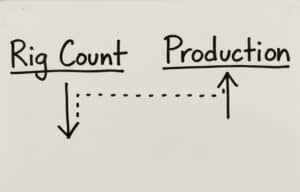 The average number of active oil and natural gas rigs in the U.S. Lower 48 dropped sharply from 750 in late 2022 to 517 in October 2025, driven by lower prices and efficiency improvements. Despite this 31% decline, crude oil and natural gas production reached record highs as operators focused on the most productive areas, utilizing longer lateral lengths and advanced completion techniques. The Permian and Marcellus/Utica (Appalachia) regions exemplify this, with production growing significantly even as rig counts fell by 29%. For 2026, EIA forecasts a slight decline in oil production, constrained by lower WTI prices (predicted at $51/barrel). Natural gas output, however, is expected to increase slightly, supported by rising Henry Hub prices (predicted at $4.02/MMBtu) that will encourage gas-directed drilling.
  OTHER U.S. REGIONS: Venture Global files FERC application for Plaquemines expansion; NATIONAL: India strikes US gas deal under Trump pressure; The true source of civilization’s future is energy wisdom; Goldman sees oil demand rising through 2040 driven by petchem, jet fuel growth; States want proof data centers will get built; INTERNATIONAL: Oil slips as Russia port reopens; Trump backs bill to sanction Russia trade partners; Drone strikes Turkish tanker in Ukraine’s Odesa, where US natural gas will go; Atlantic LNG freight rates surge to highest since early 2024.
  Existing pipelines in the Marcellus/Utica region are testing the market for expansion. Two weeks ago, we told you that DT Midstream (50% owner of NEXUS Pipeline) is eyeing the growing AI data center market in northwestern Ohio as a customer for M-U molecules that flow through NEXUS (see
  Last week, we brought you the fantastic news that the Regional Greenhouse Gas Initiative (RGGI) carbon tax scheme in Pennsylvania is officially dead with the adoption of the 4-month late state budget (see
  Repsol S.A. is a Spanish multinational energy and petrochemical company based in Madrid. It is engaged in worldwide upstream and downstream activities. In the 2022 Forbes Global 2000, Repsol was ranked as the 320th-largest public company in the world. As of 2022, it has 24,000 employees worldwide. Repsol, with shares traded on the Spanish Stock Exchange, has major assets around the world. It also has approximately 214,000 net acres of leased land (with wells) in the Marcellus Shale, primarily located in northeastern Pennsylvania, specifically in Bradford, Susquehanna, and Tioga counties. Repsol is considering a “reverse merger” of its upstream assets (worth $19 billion) with APA (formerly Apache, a Permian oil driller), according to super-secret sources whispering to Bloomberg.
  In August, MDN told you that Black Bear Transmission (BBT), the owner of nine regulated short pipeline transmission systems in the Southeastern U.S. totaling approximately 1,700 miles of pipeline, with a throughput capacity of about 2.6 billion cubic feet per day (Bcf/d), was selling itself to Enstor Pipeline Holdings, LLC, for an undisclosed sum (see
 Last week, the Baker Hughes U.S. national rig count gained rigs for the second week in a row. The national count increased by one rig, rising from 548 to 549. The BH rig count has added rigs in four of the last five weeks. Rigs in the Marcellus/Utica remained the same last week at a combined 37, the same number for seven weeks in a row. Pennsylvania remained unchanged at 17 active rigs (seven weeks in a row). Ohio was the same at 13 rigs (eight weeks in a row). And West Virginia maintained its 7 rigs, which it has operated since May 30 (25 weeks in a row). There were 23 rigs targeting the Marcellus and 14 targeting the Utica.
  You knew the number of new permits issued in the M-U would come back down to earth sooner or later. Last week it happened. After three consecutive weeks with numbers of 37, 39, and 37, the number of new permits issued fell to 24 last week. Still respectable, but not in the coveted 30s. Pennsylvania issued 16 new permits last week, up from 13 the prior week. Ohio issued 6 new permits, down from 8 the prior week. West Virginia was shut out, issuing no new permits last week, which was the main reason why the number fell precipitously.
  We continue to win so much, it feels strange. But hey, we can get used to it! Back in April 2021, we reported that the leftist Democrats who run the North Carolina Department of Environmental Quality (NCDEQ) had, for the third time, rejected giving the Mountain Valley Pipeline (MVP) Southgate project a necessary Clean Water Act (CWA) Section 401 water quality certification permit (see
  Infinity Natural Resources (INR), headquartered in Morgantown, WV, focuses 100% on the Marcellus/Utica. The company went public earlier this year with a $265 million ($20/share) initial public offering, giving INR a $1.18 billion market capitalization (see