
Feds Say 1970s Gov’t Study of Devonian Shale Birthed Marcellus
 A new federal advisory report says the Marcellus and Utica Shale plays we all make a living from got their start with a taxpayer-funded government study launched in the mid-1970s — and that somewhere between 70% and 90% of the hydrocarbons in a typical shale reservoir are still down there after the well stops flowing. On Sunday, August 31, the National Petroleum Council (NPC) released American Resources for a Secure Future: A National Cooperative Subsurface Assessment Program, the latest installment in a series of studies U.S. Energy Secretary Chris Wright asked the NPC to produce. The NPC is a roughly 200-member federal advisory committee to the Energy Secretary, chartered back in 1946. Around 80 experts from industry, state governments, Tribal organizations, universities and the sciences worked on this study, and the full NPC membership voted to approve it. Read More “Feds Say 1970s Gov’t Study of Devonian Shale Birthed Marcellus”
 NATIONAL: U.S. natural gas futures gain ahead of long weekend; Why oil majors don’t want to build new U.S. refineries; Elevated crack spreads and crude oil prices contribute to higher prices at the pump; White House to focus on what’s blocking energy permitting reform; Cash-strapped blue cities stand to collect billions from climate suits headed to Supreme Court; INTERNATIONAL: Oil holds, gains; Iran, Oman claim to close in on Hormuz deal; Analysts still expect USA-Iran deal by end-September; Formentera and Daly Waters Energy achieve first natural gas sales from the Beetaloo basin.
 The Marcellus/Utica region received 39 new drilling permits last week, August 24 – 30, up significantly from the 19 permits issued two weeks ago. Pennsylvania finally bounced back, issuing the vast majority of the new permits, with 25. Ohio issued 8 permits. And West Virginia issued 6 new permits. The drillers who received new permits were: Antero Resources, Campbell Oil & Gas, CNX Resources, EOG Resources, EQT, Expand Energy, Infinity Natural Resources, PennEnergy Resources, and Repsol Oil & Gas.
 It’s that time of year again. Cove Point LNG, the Berkshire Hathaway-operated export terminal on the Maryland shore of the Chesapeake Bay, is heading into its annual maintenance turnaround — and when the plant goes down, roughly 850 million cubic feet per day (MMcf/d) of demand for Marcellus/Utica gas simply evaporates. MDN has obtained the official notice from pipeline operator BHE GT&S laying out exactly what happens and when.
 Pennsylvania’s utility regulators just told the General Assembly what Marcellus drillers have been saying for two years: the electricity business is about to get very busy, and natural gas is going to be the one doing the heavy lifting. On Tuesday, September 1, the Pennsylvania Public Utility Commission (PUC) released its annual Electric Power Outlook for Pennsylvania, this one covering 2025 through 2030. The report is required by state law — the PUC has to collect demand forecasts from the state’s 11 electric distribution companies (EDCs, the utilities that run the poles and wires to your house) and hand a summary to the Legislature and the Governor every September. Usually it’s a snoozer. Not this year.



 Two weeks ago, we told you Net Power had pivoted to building plain old gas plants and would worry about the carbon dioxide later (see
 EQT is planning another pipeline — and this one is big. Through a brand-new subsidiary called Appalachian Transmission Gateway LLC (ATG), the Marcellus/Utica’s largest driller has opened bidding on the “POWER Pipeline,” a 42-inch, 50-mile line that would carry a full 1 billion cubic feet per day (Bcf/d) of gas from Greene County, Pennsylvania, west to the Clarington hub in Monroe County, Ohio. The open season quietly began Aug. 26 and runs through Oct. 26. We found no press release announcing it — the notice simply went up, and the trade press caught it a week later.
 Range Resources had a genuinely rotten 16 hours at its Laurel Hill B well pad in Cogan House Township, Lycoming County, last week. First, a gasket blew on a water filter pod and sent recycled frack water down the pad’s fill slope. Then, while the state inspector was standing there writing that one up, a water truck hauling more of the same stuff drove off the access road and rolled over. MDN obtained both DEP inspection reports, and they tell a more complete story than the headlines indicate.
 Yesterday, the Pennsylvania Independent Fiscal Office (IFO) released its quarterly Natural Gas Production Report covering April through June 2026 (full copy below). Three numbers, all pointing in the same direction: PA drillers spudded (started drilling) 89 new horizontal wells in 2Q26, down 16 wells (-15.2%) from the 105 spudded in 2Q25. Production volume was 1,925 billion cubic feet (Bcf), down 32 Bcf (-1.6%) from 1,957 Bcf in 2Q25 — the lowest quarterly volume since 4Q24. And the average Pennsylvania spot hub price was $2.11 per MMBtu, down 27 cents (-11.3%) from last year’s $2.38.
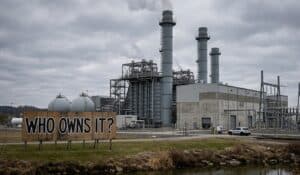 Fayette County, Pennsylvania, spent six months quietly chasing NextEra Energy’s giant gas plant, and now that it’s landed, county officials are publicly sharing their support. Two follow-up stories — one from the Pittsburgh Business Times, one from Salena Zito at the Washington Examiner — fill in a lot of what we didn’t have yesterday about the East Riverside Energy Center. Including who is actually going to own the thing. Hint: it isn’t NextEra.
 Anti-drilling group Protect PT has opened a new front against the biggest gas-fired AI project in Westmoreland County, Pennsylvania. On Aug. 25, Protect PT and two Upper Burrell residents — Allen Uhler and Guy Fuller — filed a land use appeal in Westmoreland County Court challenging the township supervisors’ approval of TECfusions’ work at the former Alcoa/Arconic research campus. Notably, the appeal doesn’t attack the gas turbines or the Marcellus wells feeding them. It attacks a piece of paper. Or rather, the absence of one.
 West Virginia State Treasurer Larry Pack released a report Tuesday that finally puts real numbers on a question a lot of Mountain State residents have been shouting past each other about: when a giant data center lands in your county, who actually gets the tax money? The answer, according to Treasury Strategic Analyst Mark Muchow, is that two projects alone — the Penzance Management campus in Berkeley County and Google’s project in Putnam County — would generate more than $103 million a year in property taxes, and roughly 62% of it stays home with county commissions and county school boards.