
Antis Flood PA DEP Hearing Against Drilling in Loyalsock Forest
 In December, MDN told you that three anti-shale drilling groups—the PA Council of Trout Unlimited, the Keystone Trails Association, and the Responsible Drilling Alliance—requested the Pennsylvania Department of Environmental Protection (DEP) hold a hearing on the Chapter 105 permit requested for a 3.9-mile shale gas access road and staging area proposed by PA General Energy (PGE) in the Loyalsock State Forest (see PA Antis Want DEP Hearing on 3.9-Mile Rd to Shale Pad in Loyalsock). The antis kept up the pressure. The DEP held a virtual public hearing on February 3 regarding PGE’s proposal to construct the shale gas access road. The hearing centered on Chapter 105 water quality permits. The PGE plan includes drilling 90 new shale wells in Loyalsock State Forest (Lycoming County). Read More “Antis Flood PA DEP Hearing Against Drilling in Loyalsock Forest”
 Antis somehow got to the board of commissioners in Montour County, PA. Yesterday, the commissioners voted unanimously to reject Talen Energy’s request to rezone empty agricultural land near Talen’s Montour Power Plant (converted from coal to run on Marcellus gas in 2023) for a proposed data center. This decision followed community concerns stoked by lying groups like Food & Water Watch regarding “potential environmental impacts” on the nearby Montour Preserve.
  A Cleanview report reveals that nearly 75% of planned on-site power for U.S. data centers is natural gas-fired as operators bypass traditional grid connections. Driven by surging AI demands and grid delays of up to seven years, this trend involves 46 projects totaling 56 gigawatts. While developers publicly highlight renewables, immediate capacity remains dominated by gas due to its reliability. Development is concentrated in gas-rich regions like Texas and Pennsylvania. To overcome equipment shortages, some firms use creative solutions, such as repurposed jet engines. This shift underscores natural gas’s vital role in supporting the rapid expansion of American AI infrastructure.
  McKinsey & Company’s 2025 LNG Buyers Survey (full copy below) reveals a strategic shift toward flexibility and risk mitigation as global markets stabilize with upcoming supply from North America and the Middle East. Faced with geopolitical uncertainty, buyers are prioritizing supply diversification and flexible contract terms, specifically regarding destination and volume. While demand is expected to rise in Asia due to price-sensitive coal-to-gas switching, European demand will likely decline as renewables expand. To manage volatility, 70% of buyers are pursuing a mix of short- and long-term contracts (instead of just long-term). Overall, the survey emphasizes that adaptive procurement strategies are essential for navigating today’s evolving energy landscape.
  In an op-ed appearing on the Fox News website, Dan Doyle, the president of Reliance Well Services and Arena Resources, draws on decades of firsthand experience to defend hydraulic fracturing against activist criticism. He argues that fracking is a safe, highly regulated process that is essential to American energy independence and economic prosperity. By debunking common myths regarding groundwater contamination and seismic activity, Doyle emphasizes that technological advancements have significantly minimized environmental risks. Furthermore, horizontal fracking has lowered energy costs for families and reduced reliance on foreign energy sources. Ultimately, Doyle contends that the industry’s benefits to national security and the economy far outweigh the concerns raised by what he characterizes as misinformed rhetoric.
  MARCELLUS/UTICA REGION: Part-time Governor Shapiro promotes cotton candy budget; OTHER U.S. REGIONS: Severe climate act impacts threaten New York State; Oklahoma exits cement Houston as America’s oil and gas capital; NATIONAL: U.S. natural gas futures slip in choppy trade; USDA revise oil, gas approval process on National Forest Land; America’s irreversible goodbye to climate governance; U.S. feedgas demand strengthens; AGA’s 2026 Playbook highlights affordability of natural gas; INTERNATIONAL: Oil edges down; North Sea sees Europe’s first Grade A methane-certified gas project; BofA report compares Big Oil companies; Exxon says EU methane rules would add 13% to refiners’ oil costs; The perils of petronomics in a warring world; China’s “clean” energy boom still rests on coal, oil, and gas; The Great Oil Conspiracy – oil is not a fossil fuel.
  Yesterday, Expand Energy announced it is moving its corporate headquarters from Oklahoma City, OK, to Houston, TX. That was the headline and lead in the announcement. And oh, by the way, the company’s very successful CEO, the guy who guided the merger of Chesapeake Energy with Southwestern Energy and has made the resulting Expand Energy *the largest* natural gas producer in the country, Nick Dell’Osso, has “stepped down” effective immediately. Talk about burying the lede! The press release and just about every news story you will read imply that Nick didn’t want to move to Houston, so he’s cashing in. Not so. What the press release doesn’t tell you is that the board terminated (fired) Dell’Osso last Friday. The question is, why?
 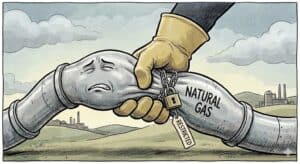 We’ve recently begun actively tracking flow restrictions on pipelines that carry Marcellus/Utica molecules. Current pipeline flow data for February 2026 show that the Marcellus/Utica (M-U) region is experiencing significant, albeit weather-driven, volatility. While the basin remains a production powerhouse, a combination of recent Arctic weather and localized maintenance has triggered several flow restrictions, including a restriction along the Tennessee Gas Pipeline.
  In January, a coalition of so-called environmental groups lodged an ethics complaint against Ohio Senator Brian Chavez, alleging that he failed to disclose ownership in five natural gas LLCs while leading the Senate Energy Committee (see
  We stumbled across a mention of a lawsuit (Kriley v. XTO Energy) that we previously were not aware of—a lawsuit that had its beginning back in 2019 and involves seven landowners in Butler County, PA. The landowners claim that XTO Energy (a subsidiary of ExxonMobil) systematically underpaid natural gas royalties. Over the past six years, the lawsuit has evolved and was certified as a class action in late 2025, meaning it has expanded from affecting seven landowners to potentially hundreds. XTO, in its latest court filing, is attempting to limit the class action.
  According to an E&E News – Energywire article, U.S. natural gas exporters are bracing for a “global glut” in LNG. While the Trump administration champions LNG exports for “energy dominance,” lefty analysts warn that diverting one-fifth of domestic production abroad could inflate American utility bills (a long-disproven canard). These analysts expect a temporary price lull in 2026, followed by a significant spike in 2027. On the one hand, analysts say the U.S. will flood the global market with LNG, and the world won’t be able to “absorb” all of that energy, crashing prices. On the other hand, the same analysts say exporting “one-fifth” of our production will cause price spikes here at home. So, we’ll crash the price for everyone else, but cause a price increase here? You see the contradiction.
  In 2009, during the Obamadroid administration, the federal Environmental Protection Agency (EPA) adopted a major regulatory rule called the “endangerment finding.” The finding concluded that six so-called greenhouse gases — carbon dioxide (CO2), methane (CH4), nitrous oxide (N2O), hydrofluorocarbons (HFCs), perfluorocarbons (PFCs), and sulfur hexafluoride (SF6) — constitute an endangerment to public health and welfare due to their contribution to global warming (which is a complete hoax). The finding gave the EPA the power to regulate those gases under the Clean Air Act. This week, the Trump EPA will repeal and obliterate that finding. Victory!
  Two weeks ago, the Pennsylvania Marcellus picked up one rig, while the Ohio Utica lost a rig (see
  The highly functional and responsible Susquehanna River Basin Commission (SRBC), unlike its highly dysfunctional and irresponsible counterpart, the Delaware River Basin Commission (DRBC), continues to support the shale energy industry by approving water withdrawals and consumptive use requests for responsible and safe shale drilling. The SRBC published a notice in the February 7 Pennsylvania Bulletin that the Executive Director of the SRBC approved and/or renewed 42 general water use permits in December and 32 general permits in January (74 combined) for individual shale gas well drilling pads in Bradford, Clearfield, Clinton, Lycoming, Sullivan, Susquehanna, Tioga, and Wyoming counties.
  The Pennsylvania Department of Environmental Protection (DEP) is seeking public comment on an Individual Stormwater Permit for a 5.8-mile natural gas pipeline in Indiana County. Serving the proposed Homer City Generation LP 4.5 GW power plant and data center, the 30-inch pipeline will traverse Black Lick, Burrell, and Center Townships, involving several stream and wetland crossings. Interested parties have 30 days to submit comments to the DEP’s Northwest Regional Office. While no public hearing is currently scheduled, one may be requested. Additional project details and permit applications are available for review through the DEP’s regional office and website.