
DT Midstream Adds M-U Pipeline Expansions, NEXUS Interconnect
 DT Midstream (DTM) is an owner, operator, and developer of natural gas interstate and intrastate pipelines, storage and gathering systems, compression, treatment, and surface facilities, including major assets that are in (or flow molecules from) the Marcellus/Utica. Last week, the company issued its first quarter 2026 update. CEO David Slater announced two new projects to expand pipelines that carry Marcellus/Utica molecules. He also announced a project to build a new lateral to an Indiana power plant and a new interconnect that flows more M-U molecules into the NEXUS pipeline. Great things are happening at DTM! Read More “DT Midstream Adds M-U Pipeline Expansions, NEXUS Interconnect”
 Last week, the combined Marcellus/Utica Baker Hughes rig count remained at 37 active rigs for the sixth week in a row. The M-U’s chief competitor, the Haynesville, added two rigs and now runs 58 active rigs, some 21 more than the M-U. Clearly, drillers are choosing to put their money into the Haynesville over the M-U despite that play’s higher costs because (a) it’s closer to the Gulf Coast LNG export facilities, and (b) it’s easier to build pipelines in Louisiana and Texas than it is in the northeast. The national count added three rigs last week and now operates 547 rigs.
  Last Friday, TC Energy reported a robust first quarter in 2026, highlighted by a 14% increase in comparable EBITDA to $3.1 billion and record delivery volumes across its North American pipeline network. For the Marcellus and Utica shale region, the standout development is the newly announced $1.5 billion Appalachia Supply Project on the Columbia Gas system. Slated for 2030, this expansion will add 0.8 Bcf/d of takeaway capacity to meet surging electricity and data center demand. Appalachia is explicitly identified as a major contributor to the growth in U.S. natural gas production, and is expected to account for over 55% of the growth by 2035.
 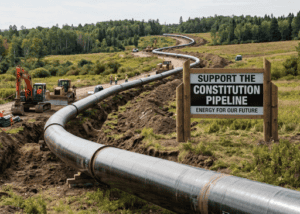 This is a critical moment for reliable, affordable energy in the Northeast, and your voice can make a difference. The Federal Energy Regulatory Commission (FERC) is currently accepting public comments on the Constitution Pipeline, representing an important step toward finally advancing this long-delayed project and a key opportunity for supporters to be heard. If you support building the Constitution Pipeline, please take a few minutes to submit a brief comment to FERC by May 4, 2026, because your input truly matters. We have instructions below on how to file a comment (it takes just a couple of minutes).
  Just yesterday, MDN told you that three left-wing judges from the 4th Circuit (“Circus”) who hate the Mountain Valley Pipeline (MVP) were back at it, badmouthing an extension of MVP into North Carolina, called Southgate (see
  We’ve been tracking a story that we consider an ongoing tragedy for more than a decade. American Water Management Services (AWMS) owns a wastewater injection well in Trumbull County, Ohio, that supposedly caused a low-level earthquake (that nobody could feel) in 2014. Actually, there are two injection wells located at the site, both operated by AWMS. They were both “temporarily” shut down by the Ohio Department of Natural Resources (ODNR) following the quake nobody could feel (see
 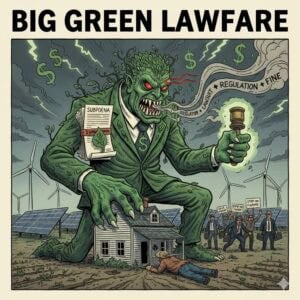 In February 2024, members of the South Carolina Public Service Commission approved a proposed project to build a 1,020-megawatt (MW) gas-fired power plant in the state’s Lowcountry, in Colleton County (see
  In March, the Trump administration announced “South Mon,” a $17 billion natural gas-fueled facility in southwestern Pennsylvania intended to expand domestic energy production (see
  Last November, the Buckeye Environmental Network, backed by lawyers from the controversial Earthjustice, sued the Ohio Department of Natural Resources (ODNR) over permitting two new shale wastewater injection wells in the Marietta area, claiming the standard used to evaluate the wells was old and out-of-date (see
  Earlier this year, the Federal Energy Regulatory Commission (FERC) approved the Williams Transco Southeast Supply Enhancement Project (see
  The Iroquois Gas Transmission’s Enhancement by Compression (ExC) project will increase horsepower at three compression stations — two in New York and one in Connecticut — by an extra 125 MMcf/d, to flow more Marcellus/Utica gas into New York City and New England. The NY Department of Environmental Conservation (DEC) approved the permits for the NY compressors with the condition that Iroquois pays a $1.5 million “contribution” (we call it a bribe) to the “Disadvantaged Community Benefit Program” (see
  Halliburton, the world’s second-largest OFS (oilfield services) company, issued its first quarter 2026 update yesterday. CEO Jeff Miller said, “In North America, I see clear signs that we are in the early innings of a recovery.” Cool. Of course, he’s talking about oil drilling, mostly. While the update and earnings conference call did not specifically mention the Marcellus/Utica, they did include information highly relevant to our region. In particular, the company prominently mentioned its electric fracking “e-fleets” and said that the current low price of natural gas represents a significant opportunity for drillers to save money by using it instead of diesel to power fracking equipment.
 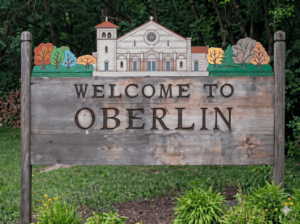 Oberlin, Ohio, officials are weighing a proposal to amend the city’s Community Bill of Rights to allow Dominion Energy Ohio to build a gas pipeline connection to a planned eco-industrial park, unlocking possible state support. Environmental groups and students at Oberlin College (neither of which pay any property or income taxes in Ohio, meaning they don’t have a say) argue the change would weaken Oberlin’s anti-fossil-fuel commitments and revive ties to Enbridge, whose NEXUS pipeline previously “divided” the city. City officials and utility experts counter that renewables alone are not yet feasible, citing constraints on electric capacity and on wind, solar, and geothermal options.