
CT GOP Candidate for Gov Sues NY to Allow Constitution Pipeline
 Connecticut gubernatorial candidate Betsy McCaughey (Republican) has sued New York Governor Kathy Hochul (Democrat), alleging a violation of the Interstate Commerce Clause for blocking the Constitution Pipeline. McCaughey claims Hochul’s actions prevent cheaper Marcellus Shale natural gas from reaching New England, thereby increasing Connecticut’s electricity rates. McCaughey, who lives in Greenwich, claims legal standing to sue as a consumer and ratepayer. The lawsuit, filed in U.S. District Court, aims to force New York to allow construction of the pipeline, which she argues would provide Connecticut residents with more affordable energy. Do-nothing Governor Ned Lamont (lifer Democrat, running for a third term) dismissed the suit as a political stunt. Read More “CT GOP Candidate for Gov Sues NY to Allow Constitution Pipeline”

 As we report in today’s lead story, Williams held a groundbreaking ceremony for the Transco Northeast Supply Enhancement (NESE) project in New York City yesterday (see Groundbreaking Ceremony for NESE Pipe in NYC an All-Star Event). One of the speakers at the event, the master of ceremonies, was Williams CEO Chad Zamarin. One of the comments he made at the event that deserves its own post here on MDN was news about the Constitution Pipeline project, a 124-mile greenfield pipeline from the Marcellus gas fields of Susquehanna County, PA, to Schoharie County, NY, to move Marcellus gas into New York State and New England.
  As we reported last week, anti-fossil fuel fanatics haven’t given up on trying to block construction of the Williams Northeast Supply Enhancement (NESE) pipeline, a $1 billion+ project designed to increase Transco pipeline capacity and flows of Marcellus gas heading into New York City and other northeastern markets (see
  We spotted an interesting article that posits Williams’ strategy is to expand its mighty Transco natural gas pipeline system by increasing the capacity of existing infrastructure rather than building new pipelines. The Transcontinental Gas Pipe Line (Transco) is the largest-volume, highest-capacity interstate natural gas transmission system in the U.S. It spans roughly 10,000 miles (with 60+ compressor stations) from the Gulf Coast (Texas/Louisiana) to New York City. The Williams strategy of expanding Transco rather than building new pipes minimizes disruption to communities and the environment while meeting growing demand from residential, commercial, industrial, and power generation sectors.
  Last week was status quo for the rig count. The Marcellus/Utica combined count maintained the same number of 37 active rigs, the third week in a row after Pennsylvania lost two rigs in March (see
 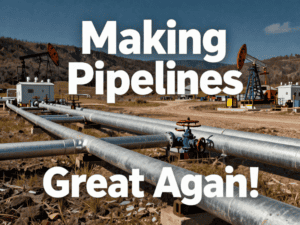 Williams Companies is breaking ground tomorrow on the Northeast Supply Enhancement (NESE) pipeline in Brooklyn — the first new pipeline in New York in over a decade — signaling a broader national natural gas infrastructure boom. Driven by AI data center power demand, LNG export growth, and population expansion, the U.S. is tracking over 150 pipeline projects representing roughly 150 Bcf (billion cubic feet) of daily capacity.
  In March, South Carolina regulators approved Duke Energy’s proposal to build a 1.4-gigawatt (GW) natural gas-fired power plant in Anderson County, marking the utility’s first new generation project in the state in a decade (see
  Fervo Energy and Youngstown, OH-based Vallourec announced a five-year supply agreement, potentially worth up to $800 million, to scale domestic geothermal infrastructure in the United States. Vallourec will exclusively supply Fervo with U.S.-manufactured tubular solutions (pipelines) and pipeline connectors, creating a fully domestic supply chain for critical geothermal well infrastructure. This collaboration aims to reduce supply chain risks, improve project timelines, and ensure cost certainty for Fervo’s deployment of standardized 50 MW geothermal units, leveraging Vallourec’s expertise in tubular solutions. Here’s the cool part: the pipelines and connectors Vallourec will manufacture for Fervo’s geothermal work were originally developed for shale energy applications.
  In July 2024, EQT Corporation closed on a $5.4 billion deal to buy back the midstream division it had spun off in 2018 (see
  In Antero Resources Corp. v. Stonewall Gas Gathering LLC, the Texas Business Court resolved a contract dispute over a 2014 gas gathering agreement following a bench trial. The court denied Antero’s claims for $200 million in past and future monetary damages. However, it granted Antero “declaratory relief” and specific performance, ordering Stonewall to reduce Antero’s service fees in accordance with the affiliate agreements and to produce the requested contract documents. The court awarded Antero $1 in nominal damages for discovery breaches, while a ruling on attorney’s fees was deferred pending further proceedings.
 The Mountain Valley Pipeline (MVP), which began operations in 2024 through West Virginia and Virginia, is now slated for an extension, the MVP Southgate, into North Carolina. This expansion faces opposition from some residents and environmental groups who raise concerns about safety, environmental impact, eminent domain issues, and the need for increased natural gas infrastructure (they believe cataclysmic global warming comes from burning natural gas). Despite court challenges and past environmental violations, the project has received government approvals and is forging ahead. On March 23, the Federal Energy Regulatory Commission (FERC) issued a notice to proceed with construction in Virginia.
  Anti-fossil fuel fanatics haven’t given up on trying to block construction of the Williams Northeast Supply Enhancement (NESE) pipeline, a $1 billion+ project designed to increase Transco pipeline capacity and flows of Marcellus gas heading into New York City and other northeastern markets. Last November, the states of New York and New Jersey issued federal Clean Water Act permits for their respective states, allowing NESE to be built (see
  On Tuesday, seven radicalized Big Green groups filed a court challenge to the Federal Energy Regulatory Commission’s (FERC) authorization for Mountain Valley Pipeline, LLC, to construct the MVP Southgate gas pipeline. The petition for review, filed by the Southern Environmental Law Center (SELC), Appalachian Mountain Advocates, and Sierra Club in the United States Court of Appeals for the District of Columbia Circuit (DC Circuit), asks the court to vacate the amended certificate of convenience and public necessity issued by FERC in December 2025.