
OH Attorney Predicts DMA Ruling to Come Soon, Settle Now

MDN has been reporting on the Ohio Dormant Minerals Act (DMA) for years (see Video: OH Lawyers Explain Dormant Minerals Act & Impact on Utica). In a nutshell, there are two DMAs in Ohio–one passed in 1989 that went into effect in 1992, and another in 2006 which added certain additional procedural requirements to the 1989 version. The DMA in its various versions provides for mineral rights that had previously been separated from surface rights to transfer back to the surface owner under certain conditions. The problem, for drillers and for landowners in Ohio, is in knowing which set of DMA rules to use (1989 or 2006) in determining who owns the mineral rights. A number of DMA cases have gone before the Ohio Supreme Court. Some of the minor cases have been decided (see Ohio Supreme Court Rules in Important Dormant Mineral Act Case). However, most of the big cases remain stalled at the Supreme Court. That is, until now. Ohio attorney David Wigham (Roetzel & Andress law firm) says there are signs that the Supremes are about to release a massive, all-in-one-go ruling on the DMA. He says if landowners (and drillers) were waiting to see which way the wind will blow, they may want to settle now before the Big Decision comes down…
Read More “OH Attorney Predicts DMA Ruling to Come Soon, Settle Now”
 This is the tale of landowners who negotiated a lease without consulting a qualified oil and gas attorney, and later regretted the decision. In 2008 the owners of a small hunting and fishing camp in Tioga County, PA negotiated and signed a lease with East Resources, which was later sold to SWEPI (i.e. the shale drilling arm of Shell). The lease, so the landowners thought, guaranteed that 11 wells would be drilled on the 240-acre property, and that a pipeline would be used to flow gas only from those wells. The landowners got a nice signing bonus–$287,000. They also got $164,000 for a pipeline right-of-way. But only one well was ever drilled–and it’s capped. And there is a pipeline–flowing other people’s gas through it. The landowners sued and a district court judge ruled last week that the landowners don’t have a case for their “shattered dreams” as they thought they did. It all comes down to a poorly worded lease and signing a lease without running it by a lawyer first…
 A group of radical/leftist environmental groups have just launched their latest “sue and settle” case against the federal Environmental Protection Agency (EPA). For a description of the despicable practice of sue and settle, where our own government colludes with these groups in a faux lawsuit which “forces” an agency to do what it wanted to do but couldn’t otherwise under existing laws, see this MDN story:
 Something noteworthy has happened in western Pennsylvania and (so far) local media has chosen not to cover it. So MDN is happy to break the following story about South Fayette Township in Allegheny County (near Pittsburgh). South Fayette is one of seven PA towns that sued the state after the Act 13 law was enacted in 2012 (see
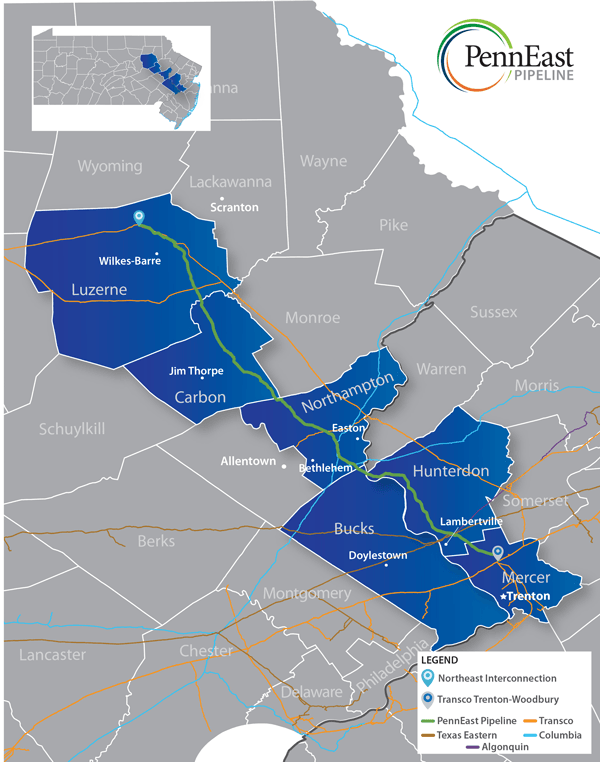
 In January MDN told you about a $130 million, 30-mile natural gas pipeline proposed by New Jersey Natural Gas (NJNG) to connect NJNG’s distribution system serving customers in Ocean, Burlington and Monmouth counties (in NJ) and the interstate pipeline system adjacent to the New Jersey Turnpike. The idea came about after Superstorm Sandy. How can NJNG create reliable natgas service in the region, preventing major disruptions like that which happened after Sandy? The “Southern Reliability Link” pipeline project was the result, and in January the NJ Board of Public Utilities (BPU) approved it 5-0 (see
 The partners in the Constitution Pipeline, including Williams and Cabot Oil & Gas, have come roaring back against Gov. Cuomo and his pusillanimous Dept. of Environmental Conservation (DEC) after the DEC lied last Friday in announcing they would not grant stream crossing permits for the pipeline project. Yesterday Cabot, along with Williams, issued a STRONGLY worded rebuttal that says, in part that the DEC’s “stated rationale for the denial includes flagrant misstatements and inaccurate allegations, and appears to be driven more by New York State politics than by environmental science.” Flagrant misstatements is another way of saying the DEC lied, which is exactly what we said yesterday (see

 Is this the smoking gun that proves collusion and corruption between Democrat New York Attorney General Eric Schneiderman and radical Big Green groups? In March, AG Schneiderman and a handful of other Democrat Attorneys General, along with climate huckster Al Gore, gathered in New York City to discuss a coordinated legal attack against oil and gas companies (see
 As we have long chronicled, a few anti-drilling parents from the Mars School District (Butler County, far western part of the state), backed by a couple of Big Green groups from the other side of the state (THE Delaware Riverkeeper and the Clean Air Council, both based in the Philadelphia area), sued Middlesex Township to stop shale drilling in rural portions of the county. Rex Energy had applied for, was legally permitted for, but wasn’t allowed to drill a series of wells some three-fourths of a mile from the Mars School (for background, see our long list of “Martian” stories
 An important case regarding royalties was ruled on in the Superior Court of Pennsylvania on April 7th. As with many of these cases, this one is complicated. We’ll do our best to summarize it. A husband and wife leased their property in the 1990s to a company that eventually sold the least to CNX (i.e. CONSOL Energy). The couple later signed another lease with CNX in 2002. Both leases states that CNX will pay the couple one-eighth of the sale price for the gas as a royalty. But more than just the wells on the couple’s land are commingled in a drilling unit, so the way CNX calculate the royalties (as per the lease) is to measure the amount of production at the wellhead and divide accordingly. If the couple’s well produced 20% of the overall volume produced by all the wells in the unit, they get 20% of one-eighth of the sale price. But here’s the thing: the amount of gas that eventually gets sold “down the pipeline” is less than what is produced at the wellhead. As gas travels through pipelines and compressor stations, some of it disappears. The couple’s attorney says because CNX can’t account for 100% of the gas that disappears (maybe more disappears from the neighbor than his client), that CNX is in breach of the lease and owes the couple a royalty based on the gas produced at the wellhead and not based on what is eventually sold “down the pipeline.” A lower court ruled in favor of CNX. Now, the Superior Court of PA has also ruled in favor of CNX and says the clever legal reasoning by the couple’s attorney doesn’t hold water…