
Supreme Court to Decide Landowner Request for Pipeline Legal Fees
 The Supreme Court will hear a North Dakota eminent domain dispute (Leonard Hoffman v. WBI Energy Transmission) over whether gas pipeline companies must pay landowners’ attorney fees when taking property under the Natural Gas Act. While the case is specific to North Dakota, it has the potential to affect the entire country—landowners and drillers everywhere should watch this case closely. The case stems from WBI Energy Transmission’s 12-mile pipeline across ranchland in the Bakken, where landowners challenged compensation offers and later sought more than $383,000 in legal fees. Read More “Supreme Court to Decide Landowner Request for Pipeline Legal Fees”
 We have an update on the lawsuit to overturn New York’s laws that ban shale fracking. In April, a father and son who own mineral rights for a 164-acre tract in Delaware County, NY, filed a lawsuit (with the help of the Pacific Legal Foundation) against New York for “taking” their rights to profit from fracking their minerals (see
  In mid-April, MDN brought you the great news that a major lawsuit had been filed against New York State, alleging a “taking” of private property by the state through its ban on fracking (see
  It never ends well for landowners who believe they can block pipeline surveyors from accessing their land. In April 2025, MDN told you about a new greenfield expansion of Kinder Morgan’s Elba Express pipeline into South Carolina to serve growing demand for natural gas in the state (see
  Williams’ Transco Southeast Supply Enhancement Project (SESE) is a 55-mile, 42-inch-wide pipeline that will run through Pittsylvania County, Virginia, and Rockingham, Guilford, Forsyth, and Davidson counties in North Carolina. It will provide natural gas to Duke Energy customers. Big Green sued to overturn a federal water quality permit issued by the U.S. Army Corps of Engineers. Big Green wanted the court to block construction until the full case could be heard. In May, a three-judge panel from the U.S. Court of Appeals for the Fourth Circuit (4th Circuit) rejected arguments Big Green put forward that claimed the Army Corps’ decision was “arbitrary and capricious” and refused to block construction (see
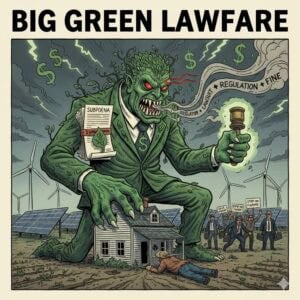
  Honestly, this story is likely to spike your blood pressure the way it did ours. Breathe in, breathe out. Find your calm, center space. OK. Now you’re ready to hear about it. Foreign companies and billionaires are funneling money to American NGOs and law firms that use the money to attack (in court) fossil energy companies. If a lawsuit prevails and either a settlement or a judgment is entered, the foreigners who helped finance it receive a cut of the “profits” from the settlement. And they don’t pay taxes on their so-called profits! IT IS DISGUSTING and an outright attack on our country. AND IT MUST STOP. NOW. A group of 21 energy-related organizations has sent a letter to both the U.S. House and Senate, outlining a loophole in our laws that allows this immoral practice and urging them to fix it. Pronto.
  In February, MDN told you about the Kriley v. XTO Energy lawsuit (see
  In early April, the EPA revised certain Biden-era oil and natural gas regulations, specifically aspects of the 2024 Clean Air Act rules (OOOOb/c, known as “Quad O”), to reduce compliance burdens and lower energy costs (see
  The same three judges from the U.S. Court of Appeals for the Fourth Circuit who blocked the 303-mile Mountain Valley Pipeline (MVP) for *years* suddenly changed course in late April, ruling on an extension of MVP into North Carolina called Southgate. Big Green, represented by the Sierra Club and Appalachian Voices, sued to block a permit issued by North Carolina regulators for the Southgate project. While the three judges grumbled and complained about Southgate during oral arguments (see
  In a significant ruling for Utica and Marcellus shale landowners, the Ohio Seventh District Court of Appeals affirmed a trial court’s decision denying a motion by Ascent Resources to compel arbitration in a lease-expiration dispute. The court ruled that when an oil and gas lease expires by its own terms without active production or drilling operations, the lease’s arbitration clause does not survive the lease’s expiration to govern subsequent disputes—such as claims of trespass and unauthorized drilling. To force arbitration on post-expiration events, a lease must contain explicit “survival” language or involve rights that accrued/vested while the lease was still active.
  The U.S. House Judiciary Committee has issued its first subpoena in a probe of what it calls a coordinated climate litigation campaign against energy companies. The subpoena targets Roger Worthington, attorney for Multnomah County, Oregon. Multnomah seeks more than $51 billion from energy companies (and if they prevailed, Worthington’s law firm would get one-third of that, making every person working the case an instant millionaire). Chairman Jim Jordan and Rep. Darrell Issa are investigating possible coordination (collusion) between Worthington, the Environmental Law Institute, and its Climate Judiciary Project, despite CJP’s supposed neutrality.
  The U.S. Court of Appeals for the Ninth Circuit on Tuesday upheld the dismissal of a lawsuit brought by 22 “youths,” aged 7 to 25 (kids used as a prop by Big Green groups), challenging three Trump executive orders promoting fossil fuel production and domestic energy investments. The appeals panel affirmed that the plaintiffs lacked standing, finding they failed to demonstrate the executive orders directly caused their injuries and could only speculate about future agency actions to implement those orders.