
Connecticut Approves New Natgas-Fired Electric Plant in Killingly
 The State of Connecticut’s “Siting Council” has changed its mind. In 2016, NTE Energy proposed building a 650-megawatt natural gas-fired electric plant in Killingly. The Siting Council said NTE couldn’t justify the plant and refused to issue a certificate. In February, we reported the Siting Council was once again actively considering the project (see CT Wisely Reconsiders, Allows NatGas Power Plant to Proceed). Good news: the Siting Council has approved the project.
Read More “Connecticut Approves New Natgas-Fired Electric Plant in Killingly”
 It’s not every day you read an editorial in a prominent Pennsylvania newspaper lending a full-throated endorsement for PA’s impact fee over a so-called severance tax, but it just happened in Williamsport. The Sun-Gazette editorial board published a column pointing out the superiority of an impact fee (actually an impact tax) over a severance tax. They make some great points, pointing out the numbers speak for themselves…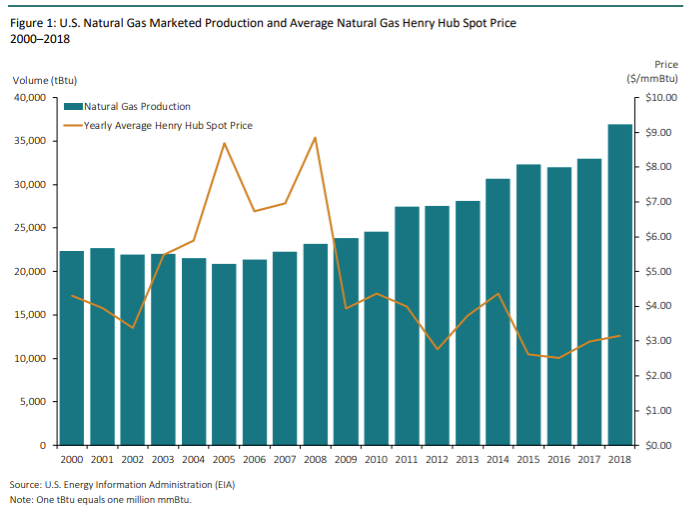
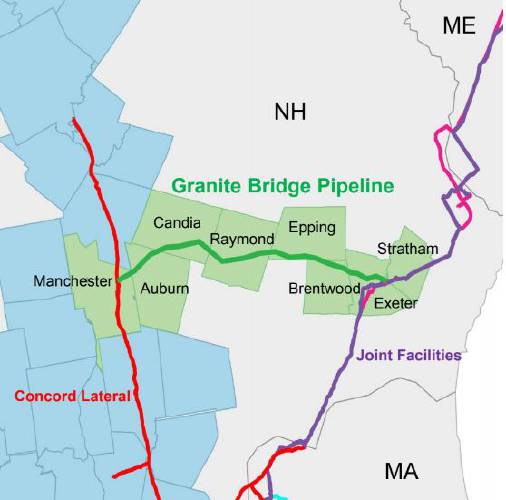 In May 2018, Liberty Utilities, a New Hampshire company, announced a new pipeline project called Granite Bridge–27 miles of new natural gas pipeline to be buried along Route 101 from Stratham to Manchester (see
  New York Gov. Andrew Cuomo tried to stop a fully built, brand new natural gas-fired electric generating plant in Orange County from going operational last year by instructing his Dept. of Environmental Conservation (DEC) to deny renewing an air permit it had approved just five years earlier (see
  Columbia Transmission is on a mission to flow more Marcellus/Utica gas south–all the way to the Gulf Coast in Louisiana. Earlier this week Columbia filed a new application with the Federal Energy Regulatory Commission (FERC) to build the Louisiana XPress Project, a project to beef up flows along the existing Columbia pipeline system by an additional 850 million cubic feet per day (MMcf/d) by adding and expanding several compressor stations in Louisiana. Most, if not all of the M-U gas that will flow through it, is heading to Cheniere Energy’s Sabine Pass LNG export facility in Lake Charles.
 Kinder Morgan (KM), perhaps the largest pipeline company in the United States, was first out of the chute yesterday with a financial and operational update for the second quarter. While KM maintains a number of pipelines in the northeast, primarily the Tennessee Gas Pipeline, our main focus in reviewing yesterday’s update is for new information about the long-delayed Elba Island LNG export facility along the coast of Georgia. Elba Island will export Marcellus/Utica molecules.
 A small cabal of 18 leftist Virginia state legislators sent a letter to the Federal Energy Regulator Commission (FERC) last week trash talking the Atlantic Coast Pipeline (ACP) proposed by Dominion Energy. The odious Sierra Club “applauds these legislators for standing up to polluting corporations like Dominion Energy that are putting their profits over people.” Same old tripe the Clubbers always peddle. What the Sierra Club doesn’t tell you is that there are 140 Virginia legislators, meaning 122 legislators either support, or certainly don’t oppose, ACP. Translation: The vast majority of Virginia residents and their representatives are in favor of ACP.

 Here’s a major scientific study that’s being suppressed and ignored by mainstream “news” (i.e. propaganda) outlets: A recently published study by Finnish researchers finds that human activity, specifically burning fossil fuels for energy, doesn’t even move the needle on global average temperatures. They point out a major flaw in climate modeling used by “mainstream” alarmists–in how they use a computer model that overestimates warming by a factor of 10.
 Super secret sources are whispering to Bloomberg that Energy Transfer is seriously considering selling its 33% ownership stake in the 713-mile, 3.25 billion cubic feet per day of natural gas Rover Pipeline, a line that flows Utica Shale gas from Ohio into Michigan and all the way to Ontario, Canada. Such a sale would net ET somewhere around $2.5 billion. Yes, we’re shocked!
 Invenergy’s 1,480 megawatt, $1 billion Marcellus gas-fired electric plant, called the Lackawanna Energy Center (located near Scranton, PA), is now 100% done with construction. Yesterday the company celebrated the end of construction with a special ceremony and tour.

 American Energy Partners, Inc. (AEPT), based in Allentown, PA, has just added a fourth subsidiary/division to the company. AEPT has agreed to acquire 100% of Hickman Geological Consulting, LLC in an all-stock deal. AEPT is giving owners Josh and Jessica Hickman 40.5 million shares of AEPT stock as payment. Josh Hickman is an AEPT board member. As of this morning AEPT shares are trading (on the Pink Sheets, over the counter) at $0.0055 per share (a little over half a penny per share). Doing the math, we peg the value of the deal at $222,750.