
Antis Get Lib Judge to Shut Down All Mariner East Pipes, Dems Rejoice
 Anti-fossil fuel nutters have finally, after months and years, scored a minor victory. They’ve been shopping to locate an ultra-liberal judge who would ignore the law and instead issue edicts from the bench–to shut down both the Mariner East 1 (ME1) and Mariner East 2 (ME2) pipeline projects. Yesterday Elizabeth Barnes, an administration law judge for the Pennsylvania Public Utility Commission (PUC), unilaterally ordered Sunoco Logistics Partners to “cease and desist all current operation, construction, including drilling activities on the Mariner East 1, 2 and Mariner East 2X pipeline” in West Whiteland Township (Chester County, PA). The judge also moved to shut down all operations of Mariner East 1 across the state, ruling that she is “enjoining Respondent from operating Mariner East 1.” It is a breathtaking display of arrogance and seizure of power that does not belong to her. The ruling runs counter to other decisions regarding these critical pipeline projects–projects that have been thoroughly vetted by numerous regulatory agencies. Construction of ME2 is 94% complete! ME1 has been flowing NGLs for over a year–with ZERO problems! And yet Barnes has shut it all down, with the stroke of a pen. We predict it won’t last long…
Read More “Antis Get Lib Judge to Shut Down All Mariner East Pipes, Dems Rejoice”

 All New England states are in desperate need of more natural gas–for both consumers (residences and businesses that use it to heat and cool) and for power generating plants. Yet each New England state in one fashion or another has actively opposed any new interstate pipelines to bring in more gas. Two major pipeline projects were proposed to help alleviate the situation. Kinder Morgan’s Northeast Energy Direct (NED) was canceled in April 2016 (see
  It’s about time! One of the favorite tactics of antis to fall back on when they don’t win in court is to simply take the law into their own hands (i.e. anarchy). If the courts or a regulatory body (like FERC, or the PA DEP) refuse to stop a critical energy infrastructure project, like a pipeline, antis take it upon themselves to trespass, illegally, in an attempt to block work on the project. They call it “free speech.” It’s nothing of the sort. To trespass is, by definition, breaking the law. Antis know this. However, such a violation of the law is currently only a misdemeanor–a lessor penalty. The PA Senate has just approved a bill that would make infrastructure trespass for pipelines and other key energy infrastructure a felony, giving antis more incentive to behave themselves. Most Republican Senators (except a few Philly RINOs) voted for the bill. Most Democrat Senators (who prefer to be lawless), voted against it. We can only hope the bill gets adopted–it now goes to the House–although with Wolf as governor, we’re not confident it will get signed into law…
 A recent New Hampshire Supreme Court decision may breathe new life into a natural gas pipeline project believed to be dead–or at least on life support. Spectra Energy (now owned by Enbridge) first announced an unnamed pipeline project to shuttle gas from the Marcellus/Utica to New England in July 2014 (see
  Last week MDN told you that the U.S. Fourth Circuit Court of Appeals had invalidated (vacated) a permit issued by the U.S. Fish and Wildlife Service that allows Dominion Energy’s Atlantic Coast Pipeline (ACP) to accidentally kill a few bats and bumble bees (classified as endangered) as it builds the massive $6.5 billion, 600-mile project from West Virginia to North Carolina (see
  On average, New York residents pay 44% more for electricity than neighboring states, like Pennsylvania. In January of this year, New Yorkers (and NY utility companies) were briefly forced to pay a record high of $140.25 per thousand cubic feet (Mcf) for natural gas, as opposed to what everyone else was paying (an average of $3.08/Mcf)–which is 46 times as much! Both stats are rooted in the same issue: NY pays WAY MORE for energy than it has to, because Andrew Cuomo is blocking natural gas pipelines into the state from PA. So says a new report titled “Pipelines and their Benefits to New York” (full copy below). The report, published by the Consumer Energy Alliance, examines the benefits of pipelines to New York, highlighting the need for affordable energy supplies to keep the daily lives of families and businesses across New York moving. Without those pipelines, we’re toast. You can’t build windmills and solar farms fast enough to meet the growing demand for electricity–and natgas. Cuomo’s dysfunctional energy policies are blocking all New Yorkers, upstate and downstate, from living even moderately prosperous lives…
 UGI, a large utility (and pipeline) company located in Pennsylvania, has announced they will expand a northeastern PA pipeline gathering system. UGI built what they call the Auburn Gathering System between 2011 and 2015–46 miles of pipe, two compressors stations and various other pipeline related facilities located in Susquehanna, Wyoming, and Luzerne counties (near Scranton). UGI spent $215 million to build the system, a system that currently flows 470 million cubic feet per day (MMcf/d) of natural gas. Much (most?) of that the gas comes from Cabot Oil and Gas in Susquehanna County. The new news is that UGI will build two new compressor stations, adding to the existing two, which will increase flows through the system by another 150 MMcf/d–all of the increase coming from Cabot. Here’s the good news that more Cabot gas will soon flow through the Auburn System, connecting with two of the biggest pipeline systems in the country–the Tennessee Gas Pipeline (Kinder Morgan) and the Transco Pipeline (Williams)…
 New Jersey’s Attorney General, Gurbir Grewal (Democrat), and New Jersey Senator Corey Booker (also a Democrat) continue a coordinated attack on the PennEast Pipeline in an effort to appease their radical/left base of supporters. PennEast is a $1 billion, 120-mile, 36-inch pipeline from Dallas (Luzerne County), PA to Pennington (Mercer County), NJ. The Federal Energy Regulatory Commission (FERC) granted final approval for the project in January (see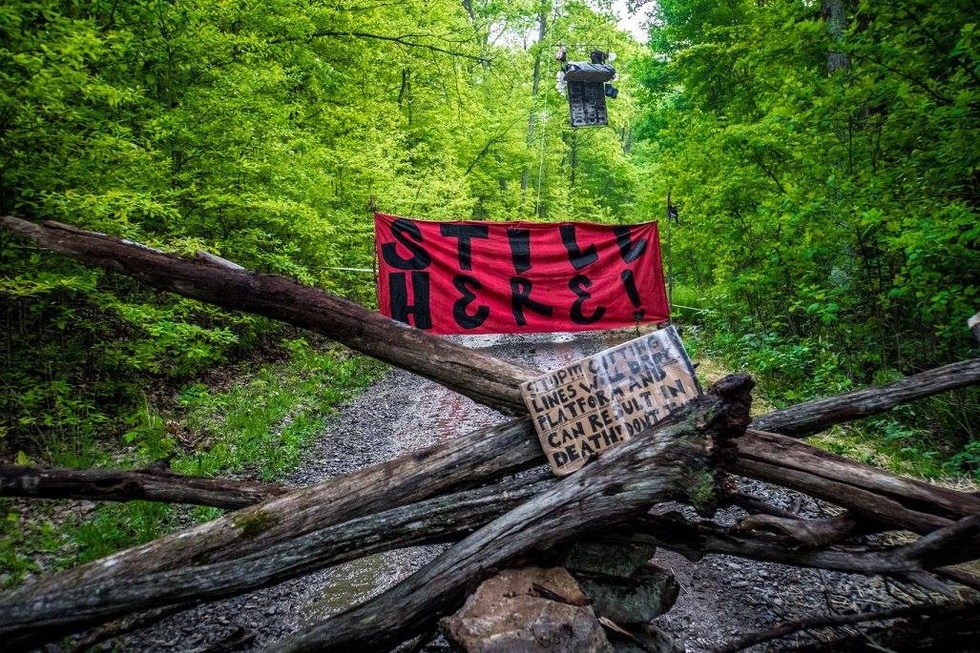
 Has someone “gotten” to FERC Commissioners Cheryl LaFleur and Richard Glick–told them, “You vote against these pipeline projects or you don’t have a future in the Democrat Party”? That’s the thought we increasingly have as we watch the two sitting Democrats on FERC repeatedly vote against projects that in some cases they previously voted to approve. What makes someone like LaFleur flip and change her vote on something that two years ago she was 100% on board with? Something has to explain it! Two and a half years ago LaFleur, then a member of FERC, voted to approve Dominion Energy’s $165 million New Market Project, a project that expands Dominion’s transmission pipeline from western New York across the state to the Capital Region of the state, near Albany (see
 Is a march considered “peaceful” if it includes using a bullhorn to disturb the neighbors as you march? We don’t know the answer–just asking. “About 40” (meaning 20-30) protesters “peacefully marched” down State Street in Media, PA (Delaware County, near Philadelphia) last Saturday. The protest was billed as an “Interfaith Prayer Walk for Pipeline Safety,” organized by the so-called Faith Alliance for Public Safety. Of course the protesters weren’t walking to encourage pipeline safety at all. They were walking to block or shut down pipelines. They probably crossed a hundred or more buried pipelines on their way to the protest–but that little fact doesn’t appear to bother them. The protesters claim there are “moral issues” at stake with pipelines like Mariner East 2–which was the particular ire of the protesters. We wonder, are there “moral issues” with other inanimate objects–like sticks and stones? Just asking. The so-called prayers that were offered weren’t offered to God the Father, but to Mother Earth: “Love the Mother Earth. Put fire into the prayer.” Whatever that nonsense means. Supposed Christians, Jews and Muslims were among the protesters. A real ecumenical gathering. Although they all worship different gods, they were all united in one respect: An irrational hatred of fossil fuels and the companies that extract and transport them…
 Two Canadian provinces that share a border, Alberta and British Columbia (BC), are in the midst of a heated argument/conflict/civil war(?)–over a pipeline. We’ve not covered the conflict, until now. The short version is this: Alberta has a rich deposit of oil in what are called oil sands. In order to get more of the bountiful supply of oil to new markets, in Asia, Alberta needs a new pipeline. Kinder Morgan operates the Trans Mountain Pipeline system and previously proposed expanding Trans Mountain–from Alberta through British Columbia to the shore where the oil can be loaded on tankers and sailed to other continents. BC has blocked the new pipeline, and so now Alberta has passed a law that allows them to stop existing oil and gas flows into BC. If that happens, it will bring BC to its metaphorical knees from lack of energy sources. Yes, it’s getting nasty. The Canadian federal government is also involved, attempting to pressure BC to allow the pipeline. What does that have to do with the Marcellus/Utica? If we were to say “Constitution” or “Northern Access”–perhaps the light bulb will go off. You see, we have a parallel situation here in the states. New York State is blocking gas pipelines critical to PA (as supplier) and to the New England states (as demand centers). At some point, it’s not beyond the realm of possibility that PA will begin to turn off existing natgas flows into NY–and then what will we do? We New Yorkers would be royally screwed. Gov. Cuomo pay attention to our neighbors to the north. What’s happening up there is coming in your direction, if you don’t change course…
 Let’s be right up front about how we feel about the innocent-sounding Trout Unlimited (TU). Four years ago the organization was outed as a radical, far-left environmentalist group–hellbent on opposing fossil fuels (see