
DRBC Alarmed at Potential Loss of Authority to Ban Fracking
 The far-left activists who occupy and control the Delaware River Basin Commission (DRBC) are shocked and dismayed that their iron grip on power is slipping away. As we reported yesterday, Congress is close to adopting an amendment to the federal Water Resources Development Act (WRDA) that would block the DRBC and its sister organization, the Susquehanna River Basin Commission (SRBC), from banning hydraulic fracturing (and shale drilling) within their respective jurisdictions (see Congress Close to Overturning DRBC Ban on Watershed Fracking). It’s no skin off SRBC’s nose as that organization has allowed safe shale fracking in its region for nearly two decades. Only the lefties of the DRBC would be affected. And they don’t like it. Read More “DRBC Alarmed at Potential Loss of Authority to Ban Fracking”
 Four Washington County, Ohio, Class II injection wells voluntarily stopped operating July 1-2 after state regulators from the Ohio Department of Natural Resources (ODNR) said they may be affecting nearby oil and gas production wells. The wells are Redbird Nos. 4 and 5, American Growers No. 1, and Nichols No. 1-A, although the Nichols owner disputed that operations had ceased at that well. ODNR and operators will develop corrective plans, while a third-party consultant examines nearby private water wells. Activists want broader, long-term groundwater testing, noting that Redbird No. 4 waste has previously migrated more than 5 miles underground. It’s important to note that the alleged migration of fluids affected other (conventional) oil and gas wells, NOT water wells.
  For the past decade, landowners in Wayne and Pike counties in northeastern Pennsylvania have unfairly been denied the ability to profit from fracking on (and under) their property, simply because they happen to live inside the imaginary boundaries of the Delaware River Basin, an area under the iron hammer control of the Delaware River Basin Commission (DRBC). The DRBC, unlike its counterpart in the Susquehanna River Basin (SRBC), is controlled by left-wingers. They falsely claim that allowing fracking anywhere in the basin would destroy the water supply of 14 million people. Congress is now on the cusp of overturning this ongoing tragedy.
  On July 12, the Pennsylvania Senate and House passed, and Governor Josh Shapiro signed into law, a $50.84 billion General Fund budget. It was only 12 days late this year. This is a net-positive budget for the Marcellus/Utica industry. It contains no new taxes or fees on production, delivers a long-sought modernization that unlocks the deep Utica play, and builds legal scaffolding favorable to gas-fired power for data centers. The only new obligations — full-cement plugging and (for midstream-adjacent projects) data-center reporting — are modest.
  Eastern Gas Transmission and Storage (EGTS), a wholly owned subsidiary of Berkshire Hathaway Energy Company (Warren Buffett’s company), filed a new project with the Federal Energy Regulatory Commission (FERC) in July 2025 (see
 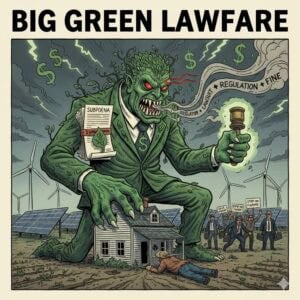 A long-running and favorite tactic of the environmental left is to use our own judicial system against us. On the federal level, foreign-backed groups like the Sierra Club, Earthworks, Food & Water Watch, and others have (in the past) challenged new pipeline or drilling projects, filing appeal after appeal up the line, blocking construction until said lawsuits were resolved. Last June (2025), the Federal Energy Regulatory Commission (FERC) took away the left’s ability to block construction while lawsuits are filed and played out (see
  The Trump administration and its officials continue to aggressively push the Williams 125-mile Constitution Pipeline project, which would stretch from the prolific shale gas fields of Susquehanna County, PA, into and through New York State, to Schoharie County, NY, to move Marcellus gas into New York State and New England. In June, Trump EPA Administrator Lee Zeldin visited Binghamton to advocate for reviving the long-stalled project (see
  Over the past two weeks, just prior to heading out on summer vacation, the U.S. Supreme Court issued a number of extremely important decisions. One of them was Slaughter v. Trump, a 6-3 decision in which the Supremes overturned the 91-year-old Humphrey’s Executor precedent, granting the president broad authority to remove members of independent federal agencies for any reason. Chief Justice John Roberts wrote that the president must have trusted subordinates to ensure accountability, though the Court exempted the Federal Reserve to preserve its independence. This ruling permanently solidifies President Trump’s earlier removals of Democratic appointees, significantly expanding executive control over critical regulatory bodies, including the National Labor Relations Board, the Federal Trade Commission, and most importantly for MDN readers, the Federal Energy Regulatory Commission (FERC).
  All we can say is, get the heck out of New York while you still can. Sooner or later, property values in the “Empire” State will crash. (Probably sooner rather than later.) Yesterday, the U.S. Court of Appeals for the Second Circuit (2nd Circuit) ruled in support of New York State banning natural gas from being used in new home (and business) construction across the entire state. If it stands, it is the beginning of the end for NY. The end will eventually come when Wall Street firms finally give up and move from New York City to Texas or Florida, completely bankrupting the state from lost revenues.
  In February, MDN alerted you to yet another gas-fired power plant project that Williams (the pipeline giant) was adding to its roster. Williams entered the gas-fired power plant space (actually building and operating them) in April 2025 via a subsidiary called Will-Power (see
  The Federal Energy Regulatory Commission (FERC) isn’t letting any grass grow under its feet regarding the advancement of the Constitution Pipeline, a 125-mile greenfield pipeline from the Marcellus gas fields of Susquehanna County, PA, to Schoharie County, NY, to deliver Marcellus gas into New York State and New England. FERC is actively reviewing two requests related to reviving the project (see
  Chestnut Run Energy plans to construct a $2 billion natural gas-powered electric power plant in Carroll County, Ohio, capable of powering up to 900,000 homes (see
 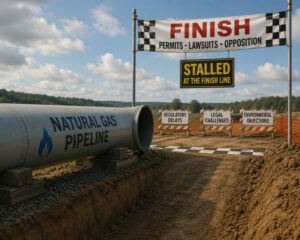 This is so frustrating. After seven years, $150 million, and 31 of 34 miles already underground, Connecticut has halted a pipeline project designed to provide a more dependable natural gas supply to the booming southeastern Connecticut economy. Ealier this year MDN told you that Connecticut’s Department of Energy and Environmental Protection (DEEP) had determined that Eversource Energy’s plan to install a natural gas pipeline through Hurd State Park and the Connecticut Valley Railroad State Park Trail requires a formal Environmental Impact Evaluation, unnecessarily delaying a tiny portion (1.1 miles) of this critically-important reliability project (see
  The highly functional and responsible Susquehanna River Basin Commission (SRBC), unlike its dysfunctional and irresponsible counterpart, the Delaware River Basin Commission (DRBC), continues to support the shale energy industry by approving water withdrawals and consumptive use requests for responsible, safe shale drilling. The SRBC published a notice in the June 27th Pennsylvania Bulletin that the SRBC approved and/or renewed 34 general water use permits in May for individual shale gas well drilling pads in Bradford, Clinton, Lycoming, McKean, Sullivan, Susquehanna, Tioga, and Wyoming counties.
  Last September, MDN told you that two major Kinder Morgan pipeline projects that will flow Marcellus/Utica molecules in the southeastern U.S. took a big step forward at the Federal Energy Regulatory Commission (FERC) with FERC actively working on an environmental impact statement (EIS) for both projects (see