
Liberal Short Seller Says Shale Oil & Gas on “Road to Ruin”
 Ever notice how liberal mainstream news organizations, like CNBC, call someone “renowned” when they echo the media narrative of the day? Such is the case with an investor, Jim Chanos, who is betting against the shale industry by short selling–taking stock positions that bet stock prices for shale companies will go DOWN. So this big-time investor bets against shale, then gives a talk at a big-time financial industry conference in New York to trash talk the shale industry, hoping he can create a run (down) against the stocks he’s bet against. Anyone else see a huge conflict of interest here? And then lib-central CNBC comes along to give this guy a megaphone to spew his trash talk of the shale industry. Welcome to Wonderland, Alice. A day after CNBC ran their segment on Chanos trash talking shale, Harold Hamm, CEO of Continental Resources (great guy) showed up on CNBC asking, “Who is this guy?” One of the stocks Chanos focused on trash talking was Hamm’s company. Hamm’s point was/is “renowed” investor Chanos is a nobody, at least nobody most folks have ever heard of. Hamm rips him a new one, revealing that Chanos made big bets the price of shale stocks (particular that of Continental) would go down, and when they didn’t, Chanos scrambled to try and talk them down…
Read More “Liberal Short Seller Says Shale Oil & Gas on “Road to Ruin””
 The “best of the rest” – stories that caught MDN’s eye that you may be interested in reading. In today’s lineup: Rover Pipeline sends more Marcellus/Utica shale gas west; Maryland antis hold public meeting to trash talk short pipeline under Potomac River; LNG exports picking up post-Hurricane Harvey; Sabal Trail pipeline operated safely through Hurricane Irma; Texas frac sand in demand; House votes to block funding for Obama EPA methane rule; we’re hitting the “golden age” of natgas; Canadians strike back against U.S. shale; and more!
 Well they did it. Yesterday at a regularly scheduled meeting of the Delaware River Basin Commission (DRBC), representatives for the five voting members voted to begin the process of formalizing a permanent ban on fracking in the Delaware River Basin. It wasn’t unexpected, but it was hotly contested–by both sides in the debate. As we’ve previously chronicled, the DRBC is composed of five voting members: the governors of Pennsylvania, New York, Delaware, New Jersey, along with the U.S. Army Corps of Engineers. The governors all sent people to represent them at the meeting, with clear instructions. The three Democrat governors–Tom Wolf (PA), Andrew Cuomo (NY), and John Carney (DE) all voted in favor of a resolution to take the next step in the process of a permanent ban, voting to adopt a draft resolution MDN previously shared (see
  Three cheers for Pennsylvania House Republicans. Hip hip, hooray! House Republicans did the near impossible–they held the line against a cockamamie plan to raise all sorts of taxes, including slapping a severance tax on the Marcellus gas industry (on top of the existing impact tax). You may recall our story about a group of hardworking Republican House members who, during the recent recess, did a masterful forensic accounting job of locating existing money sitting idle in a variety of programs and departments–money that can used to plug a deficit in the budget this year (see
  Following yesterday’s vote by the Delaware River Basin Commission (DRBC) to take the first step in a permanent ban on fracking in the Delaware River Basin (DRB), reaction from those who support drilling was swift. The American Petroleum Institute issued a statement saying, among other things, that the DRBC’s intention to permanently ban fracking in the DRB is “bad public policy.” More than a few Pennsylvania legislators took issue with PA Gov. Wolf’s vote to endorse a permanent frack ban. Three ranking State Senators–Senate President Pro Tempore Joe Scarnati, Senate Majority Leader Jake Corman, and Senate Environmental Resources and Energy Chair Gene Yaw, ripped into Wolf with a joint press release yesterday, saying they “strongly objected” to Wolf’s vote. The three said a permanent ban on natural gas drilling in the Delaware River Basin is “arbitrary, short-sighted and a blow to economic development, job-creation and landowner’s rights.” We appreciate their support. However, those same three Senators recently sold out the gas industry when they voted for a severance tax. They were part of the high-tax cabal that made the job of the House that much harder (thank God the House passed a no-severance-tax budget yesterday, see today’s companion story). While we appreciate the Senators’ support on the DRB frack ban issue, their bloviating against Wolf on the frack ban vote doesn’t remove the stain of their betrayal of the gas industry in voting for the severance tax. All three Senators need to go at the next primary…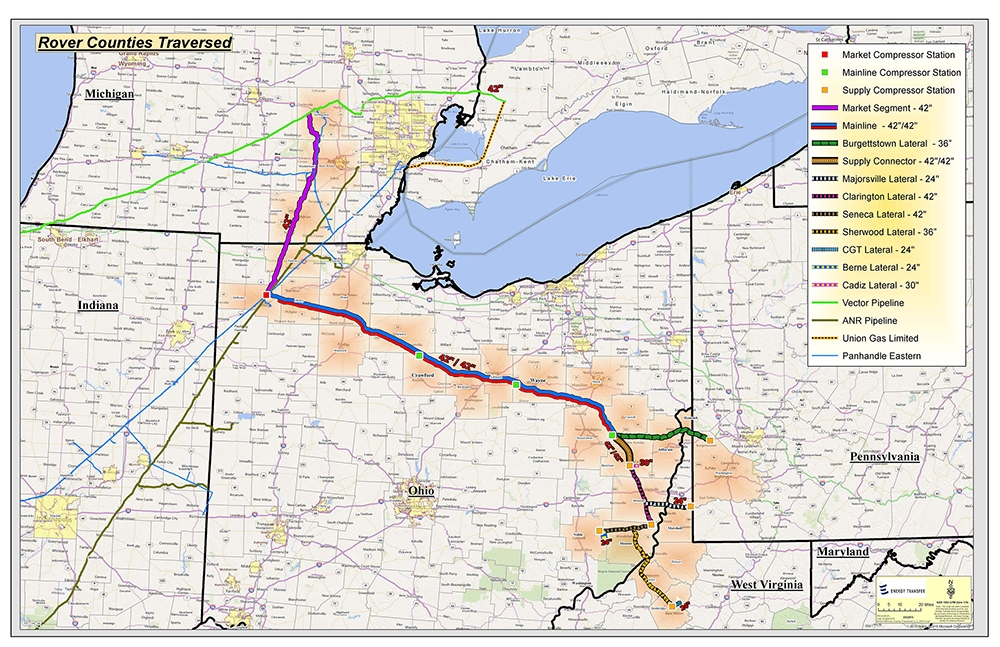
 Monroeville, PA (Allegheny County, suburb of Pittsburgh) voted last night to restrict seismic testing within municipal boundaries–a move meant to restrict future shale well drilling in the area by Huntley & Huntley. In a July story, MDN brought you the news that Cougar Land Services, a subcontractor working with Huntley & Huntley, is planning to conduct seismic testing in two rural areas of the municipality, including “small portions” of Monroeville’s northernmost and southernmost tips (see
  Mountaineer NGL Storage wants to build a new underground NGL storage facility in Monroe County, Ohio, near Clarington, along the Ohio River (see
  In an incredible story of how Marcellus Shale drilling benefits local communities, the Municipal Authority of Westmoreland County (i.e. the water authority) reports that it expects royalties received from 52 shale wells drilled on authority-owned land will jump another $1 million this year, to a total of over $3 million. The authority is still pushing forward with a three-year rate hike plan that began in 2016–so customers will get a 7% rate hike this year. Even though the authority has all of that extra cash. Why not suspend the rate hike because of the extra royalty money? Because, says an authority official, “The rate hikes were designed to help pay for a $140 million loan finalized last year for capital improvements to the water system that serves more than 120,000 customers in five counties as well as nearly 25,000 sewer customers.” What will the authority do with the extra $1 million they hadn’t planned on receiving? It’s “more money to be reinvested into the system.” Here’s the lowdown on Westmoreland’s windfall from gas royalties, and why royalties are jumping this year…
 Four years after then-Pennsylvania Attorney General Kathleen Kane decided to turn an accident into a criminal prosecution against XTO Energy, the final chapter has been written. Anti-drilling Kane attempted to criminalize the accidental spill of a small amount of recycled wastewater by XTO that happened years before she took office (see
  Who knew there was ANYBODY who supported a virtual pipeline project in Broome County, NY?! As MDN recently reported, a Broome County judge ruled that the Town of Fenton (Binghamton area) Planning Board did not take a hard enough look at environmental and traffic issues related to their approval of NG Advantage’s plan to construct a facility in the town to compress and load natural gas onto tractor trailers for delivery to regional customers who desperately need the gas–called a “virtual pipeline” (see
  Lawsuits filed against Antero Resources in both Ohio and West Virginia seek class action status. Both lawsuits make similar claims: Namely that Antero has improperly deducted post-production expenses from royalty checks (not allowed under lease terms), and that Antero has avoided, with creative accounting, paying royalties on natural gas liquids (NGLs) produced. The OH lawsuit was first filed in January of this year, followed by a lawsuit filed in WV in May. We have copies of both complaints below, so you can read the language for yourself. In the case of the OH lawsuit, Antero filed a motion to dismiss. The landowners amended the complaint and Antero dropped their motion to dismiss. The OH lawsuit, and as near as we can tell, the WV lawsuit, are both moving forward. Here’s our summary of both lawsuits–the MDN Cliffs Notes version…
 Here’s a surprise: Big Green mouthpiece PBS StateImpact Pennsylvania is dishing some dirt on one of their own–PA Gov. Tom Wolf. We’ve been closely following the developing situation with the Delaware River Basin Commission (DRBC) finally coming out of the closet as an extended arm of radical Big Green group Delaware Riverkeeper. The DRBC will vote (today) on beginning the process to permanently ban fracking in the Delaware River Basin (DRB), which will prevent landowners in Wayne and Pike counties (PA) from accessing the bountiful shale gas under their land (see our article yesterday,
 In June 2016, MDN told you about an economic development group of business and government leaders from Ohio and West Virginia (the Mid-Ohio Valley) called Shale Crescent (see