Will the AI Boom Create a “Knife Fight” with LNG for Natural Gas?
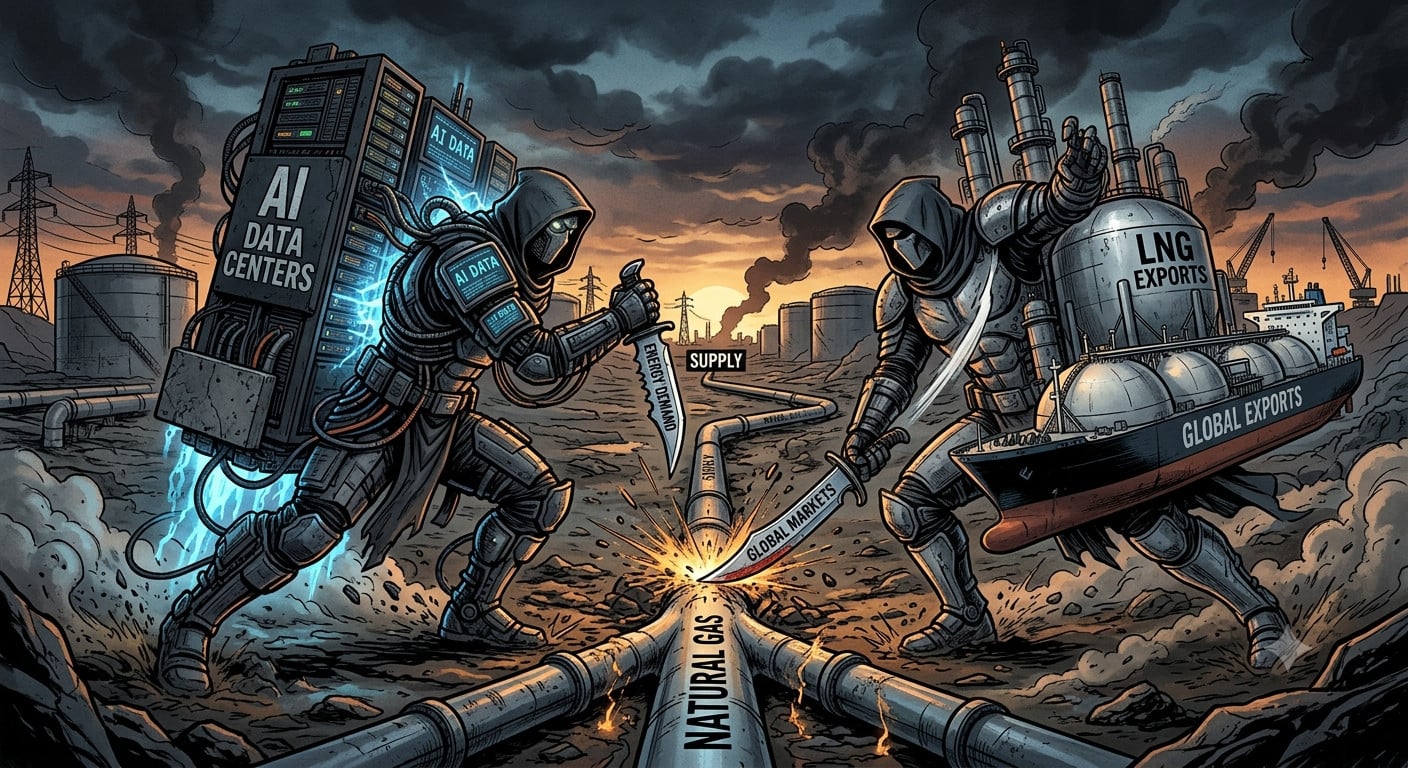
Chronometer Partners CIO Matthew Smith warns the U.S. faces a structural natural gas shortage by 2028, as AI data centers’ round-the-clock power needs collide with surging LNG export commitments. His firm’s 18-month study found production may grow roughly 20 Bcf/d by 2030, but LNG exports alone (rising from about 15 to 35 Bcf/day) could absorb most of that gain, sparking a “knife fight” for supply. Energy already accounts for roughly 10% of AI compute costs, potentially reaching 20-30% if gas prices double or triple. Winners could include gas producers, nuclear and solar generators; hyperscalers and equipment suppliers face rising cost pressure and possible slower buildout. Read More “Will the AI Boom Create a “Knife Fight” with LNG for Natural Gas?”
 MARCELLUS/UTICA REGION: Yaw bill to ensure responsible solar development signed into law; OTHER U.S. REGIONS: Eversource, National Grid, and partners to test MA V2G program; A New York Climate Act project doing more harm than good; NATIONAL: U.S. natural gas futures slip at the close; Meta drops out of clean energy pact as its natgas buildout accelerates; INTERNATIONAL: Oil surges above $100; QatarEnergy prepares to extend LNG force majeure; UK’s new Energy Secretary opposed North Sea drilling; China finances Putin’s war against Ukraine by buying oil.
  Yesterday, EQT Corporation, the largest Marcellus/Utica-only producer by far, issued its second-quarter 2026 update. We’re pulling out what we consider to be the biggest news from that update for this separate post. During an earnings call with analysts, EQT CEO Toby Rice said that since the Federal Energy Regulatory Commission (FERC) approved the company’s 31-mile Mountain Valley Pipeline (MVP) Southgate project from southern Virginia into northern North Carolina in June (see
  EQT Corporation issued second quarter 2026 results on July 21, followed by an analyst call on July 22. Here’s what matters if you lease acreage to EQT — or own the stock. The company produced more gas using less money in 2Q, raising its estimate of how much it will produce in 2026 by 90 Bcfe to 2,375-2,450 Bcfe (which works out to 6.5 to 6.7 Bcfe/d). As a point of reference, the country’s largest natural gas producer, Expand Energy, is estimating production of 7.5 Bcfe/d in 2026. For landowners leased with EQT with older wells, there’s good news about workovers.
  Range Resources released second quarter 2026 results on July 21 and held its analyst call on July 22. For Marcellus landowners and RRC shareholders alike, there’s a lot packed into this one. Range produced 2.30 Bcfe/d in 2Q26, roughly 67% natural gas, up 5% from a year ago. Of particular note for landowners, Range’s drilling tempo for new wells will slow somewhat during the second half. However, great news for those already drilled. Range is drilling over 50% of its wells on existing pads this year. And, Range drilled a rare Utica well. Does that mean more Utica drilling is on the way for the company?
  Georgia Power announced yesterday that it will serve a new OpenAI data center project in Effingham County, Georgia — about 45 minutes from Savannah — expected to create thousands of jobs and billions of dollars in local investment. The $20 BILLION OpenAI facility will need roughly 3,200 megawatts (3.2 GW) of power, and OpenAI has agreed, under a 25-year deal, to provide up to 1,000 MW (1 GW) of flexible demand response, allowing Georgia Power to curtail deliveries during peak periods. The utility calls it among the largest single-facility demand response commitments in the U.S. OpenAI will cover full infrastructure and electric service costs with financial assurances, consistent with Georgia PSC rules. And yes! There is a direct connection to the Marcellus/Utica. Get ready; your future ChatGPT queries may be powered by M-U molecules!
  As part of Kinder Morgan’s second-quarter update, the company made an important announcement that (until now) it had not made. Namely, on May 26, 2026, TGP (Tennessee Gas Pipeline) placed in service its approximately $235 million Cumberland Pipeline project. The 30-inch pipeline is a 32-mile lateral originating from TGP’s existing 100 Line in Dickson County, Tennessee, and terminating at Tennessee Valley Authority’s (TVA) new natural gas-fired power plant in Stewart County, Tennessee. Big Green tried its best to block this project along with the gas-fired power plant, but failed.
  Yes, there is a direct connection between the Federal Energy Regulatory Commission’s (FERC) approval of the expansion of an underground salt-dome storage cavern project in Mississippi and the Marcellus/Utica. FERC has approved Leaf River Energy Center’s expansion of its New Home Salt Dome storage facility in Smith, Jasper, and Clarke counties, Mississippi, adding 19.18 Bcf of working gas capacity through new cavern development and facility upgrades. The project includes a new Cavern 5, expansion of Caverns 2 and 4, new compression, and pipeline additions, raising total working gas capacity from 36.0 to 55.18 Bcf.
  In April 2025, Knighthead Capital Management, Homer City Redevelopment (HCR), and Kiewit Power Constructors Co. announced a plan to convert the former Homer City Generating Station, previously the largest coal-fired power plant in Pennsylvania (Indiana County, 50 miles east of Pittsburgh) into a more than 3,200-acre natural gas-powered data center campus, designed to meet the growing demand for artificial intelligence (AI) and high-performance computing (see
  We stumbled across an article by East Daley Analytics that is a real eye-opener for us. East Daley analyzed 13 major public G&P (gathering and processing) operators (i.e., pipeline companies). They found that Expand Energy (created by the merger of Chesapeake Energy with Southwestern Energy), with major assets in the Marcellus/Utica and the Louisiana Haynesville, accounts for 52% of DT Midstream’s gathering volumes, 32% of Williams’, and 21% of Energy Transfer’s throughput. Yikes! Just one company.
 If we had a nickel for every time we’ve read or heard the Democrats claim the Regional Greenhouse Gas Initiative (RGGI), a tax on carbon dioxide emissions for coal- and gas-fired power plants, doesn’t raise electricity rates, we’d be millionaires! Not that it was ever in question that RGGI does raise rates; we now have a smoking gun. Connecticut’s carbon allowance auction prices under RGGI have risen from $3.07 per allowance in 2008 to $35 per allowance in June 2026, a jump of over 900%. Connecticut residents pay the third-highest (or second-highest, depending on the source) electricity rates in the entire country behind only Hawaii and California. Massachusetts, another RGGI member, is right behind Connecticut at fourth-highest.
  Last week, New York Governor Kathy Hochul had the ignominious distinction of signing an Executive Order establishing the nation’s first statewide moratorium on new hyperscale data centers, temporarily pausing state environmental permit issuance for up to 1 year (see