
CNG/LNG | Duke Energy | Electrical Generation | Energy Services | Industrywide Issues | North Carolina
Duke Sets 2028 Construction Start for NC Gas Plants, LNG Facility
 Duke Energy just handed Marcellus/Utica producers something more useful than another press release. It handed us a calendar. Back in July we told you Duke had picked its sites: two 1,360-megawatt (MW) combined-cycle gas plants on its Davie County, North Carolina parcel, and the largest liquefied natural gas (LNG) storage facility in company history directly across the Yadkin River in Davidson County (see Duke Picks Davie County for 2 Gas Plants, Davidson for LNG Facility). What we didn’t have was a schedule. Now we do. Read More “Duke Sets 2028 Construction Start for NC Gas Plants, LNG Facility”
 Round and round she goes. Yesterday Shell Energy North America (SENA) announced it is doing two deals at once: selling the 609-megawatt (MW) Rhode Island State Energy Center (RISEC) near Providence to Constellation Energy for $715 million, and buying the 169-MW Hunlock Creek Energy Center in Luzerne County, Pennsylvania, from Castleton Commodities International (CCI). Shell has owned the Rhode Island plant for all of about 20 months. CCI has owned Hunlock Creek for two years. Both deals are expected to close in the first quarter of 2027, pending the usual regulatory blessings.
  A month ago, we took a press release that pointedly refused to name a county, did some division on a tax-assessment number buried in the fine print, and concluded that Alpha Compute Corp.’s (Nasdaq: ALP) proposed 200-megawatt gas-fired AI data center was headed for Tioga County (see
  NATIONAL: U.S. natural gas futures edge higher; Enbridge to acquire Tallgrass pipelines for $2.55B; EPA removes online Scope 3 emissions guidance for companies; United States on track for record crude oil production in 2026; AI data center boom pushes U.S. power equipment to the breaking point; INTERNATIONAL: Oil soars as Hormuz risks rattle markets.
  The U.S. Energy Information Administration (EIA) dropped its September Short-Term Energy Outlook (STEO) yesterday, and for once the natural gas headline numbers barely budged. Henry Hub is forecast at $3.43/MMBtu for 2026 and $3.28/MMBtu for 2027 — a penny and three cents below last month. After August’s 23-cent haircut, that’s practically a rounding error. The interesting stuff this month isn’t in the price line. It’s in the regional production tables, where EIA lays out exactly who is growing and who isn’t. Spoiler: it’s the same story as last month, only now EIA has put hard numbers on it.
  Accounting giant Ernst & Young dropped its annual reserves benchmarking study yesterday, and while the press release leads with oil, the real story for our part of the country is buried in the tables: EQT is now the largest holder of proved natural gas reserves in the United States, and Appalachian-focused producers control roughly a third of all the gas reserves booked by America’s 30 biggest publicly traded drillers.
  EOG Resources, the biggest acreage holder in the Ohio Utica, sent Chief Operating Officer Jeff Leitzell to the Barclays 40th Annual Energy-Power Conference yesterday (Sept. 9), and he spent a good chunk of his stage time explaining exactly how EOG thinks about our play. We’ve heard some of it before. But Leitzell went deeper on Utica geology than the company usually does on an earnings call — including a north-versus-south distinction that shapes how tightly EOG spaces its wells — and he dropped a fresh well-results number: three inherited Encino wells with 3.5-mile laterals that each came online at more than 35 million cubic feet per day (MMcf/d). He also confirmed that Ohio’s first in-basin frack sand mine is still on track for a year-end startup, and that the savings from it are not yet baked into EOG’s cost numbers.
  Last week we told you Dominion Energy cleared its first hurdle for the monster 3,000-megawatt (3 gigawatt) Cumberland Energy Center in Cumberland County, Virginia (see
  Virginia Democrats have spent the summer hammering the proposed $67 billion NextEra-Dominion merger — letters to regulators, a 64-question interrogation, a statewide listening tour, a demand for a special session. Last week the pile-on reached the very top when House Speaker Don Scott (D-Portsmouth) filed his own letter with the State Corporation Commission (SCC). Here’s the twist: the same Democrat leaders doing the loudest complaining just refused to do the one thing that would actually slow this deal down.
 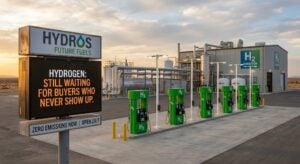 We’ve said it here more times than we can count: hydrogen has no customers. A new investigation from RealClearInvestigations, published Sept. 1, backs that up with numbers — and the picture it paints of the federal hydrogen push should worry anyone who thought ARCH2 was going to become a big new buyer of Marcellus/Utica gas. Reporter James Varney’s piece walks through what’s become of the Biden administration’s National Clean Hydrogen Strategy and Roadmap, released in June 2023. That plan promised $9.5 billion in spending would produce 100,000 jobs by 2030 and cut economy-wide emissions 10% by 2050. Three years on, the biggest single piece of it — $3 billion split between two West Coast hydrogen hubs — is frozen and tied up in court. California’s ARCHES hub says on its own website that the state has paused activities. Thirteen Democratic attorneys general sued in February to force the money out the door.
  Big Green scored a win yesterday — but not the win they’re telling you they got. On Tuesday, September 8, a three-judge panel of the U.S. Court of Appeals for the Third Circuit vacated the Clean Water Act Section 401 water quality certification (WQC) that the New Jersey Department of Environmental Protection (NJDEP) issued last November for Williams/Transco’s Northeast Supply Enhancement (NESE) project — the $1 billion, 400,000 Dth/d expansion that carries Marcellus gas from Pennsylvania, across New Jersey, under Raritan Bay, and into New York City (see
 West Virginia has sued the Pennsylvania Public Utility Commission in federal court, arguing that two Pennsylvania laws — Act 40 of 2017 and Act 114 of 2020 — built a wall around the state’s “alternative energy credit” market and locked out every power producer outside Pennsylvania’s borders. West Virginia Attorney General JB McCuskey filed the 54-page complaint on September 3 in the U.S. District Court for the Middle District of Pennsylvania, and here’s the kicker: the PUC’s own annual report, published seven months earlier, told the legislature that these very rules needed a second look.
 A federal judge in Knoxville has thrown out the environmental review behind the Tennessee Valley Authority’s $2.5 billion Kingston gas plant — and almost nobody has seen the ruling, because it’s sealed. We pulled the public docket and found the whole story hiding in TVA’s own court filings. On August 31, U.S. District Judge Curtis L. Collier granted partial summary judgment to Appalachian Voices, the Center for Biological Diversity, and the Sierra Club, represented by the Southern Environmental Law Center. The judge vacated TVA’s Environmental Impact Statement (EIS) and Record of Decision (ROD) for the plant, which is replacing nine coal units at the old Kingston Fossil Plant in Roane County, Tennessee — the site of the infamous 2008 coal ash spill.