
Blair County | Energy Services | Energy Transfer Partners | Industrywide Issues | Pennsylvania | Perry County | Pipelines | Regulation | Sunoco Logistics
PA DEP Issues Permits for ME2 Pipe Work in Blair, Perry Counties
 In January the Pennsylvania Dept. of Environmental Protection (DEP) lifted a moratorium (in place for more than a year) on new construction permits for the Mariner East 2 pipeline project (see PA DEP Slaps Energy Transfer Again – $2M Fine re Mariner East 2). All new pipeline construction by Energy Transfer was on hold following a pipeline explosion in western PA in September 2018 (see Revolution Pipeline Near Pittsburgh Explodes – Home & Barn Destroyed). With the moratorium lifted, the DEP has just issued two of the first (maybe THE first) permits to allow construction on the final bits of ME2 to begin–in Blair and Perry counties.
Read More “PA DEP Issues Permits for ME2 Pipe Work in Blair, Perry Counties”
 Energy Transfer, a huge pipeline company that builds and maintains Marcellus/Utica pipelines including Rover and the Mariner projects, released its fourth-quarter and full-year 2019 update earlier this week. The company reports making the most profit it has ever made in its 25-year history–$3.6 billion in profit for 2019 (more than triple the $1.1 billion made in 2018). Although ET’s financial performance is impressive, it was comments made during the quarterly conference call with analysts about the Mariner East pipeline project that caught our attention.
 TC Energy (once upon a time called TransCanada Corporation) is a major pipeline company in North America. The company has a big presence in the Marcellus/Utica region via its Columbia Pipeline subsidiary. Last week TC Energy issued its fourth-quarter and full-year 2019 update and hosted a quarterly conference call with analysts. While the official update contains a mention about the company’s Buckeye XPress project (see
  Score another victory for the Mariner East Pipeline project in southeast Pennsylvania. On Tuesday Pennsylvania Commonwealth Court ruled against Chester County Commissioners and their attempt to obtain an injunction to stop construction of the Mariner East pipeline project. The petition fought to curtail open trench construction rather than horizontal directional drilling on two easements the county gave to the pipeline. Energy Transfer/Sunoco Logistics wants to change from using underground horizontal directional drilling (HDD) to instead use conventional bore or open trench technology on those easements, which would avoid more problems with HDD already experienced during construction.
 Big Green continues its fight to strip away the Federal Energy Regulatory Commission’s (FERC) right to use tolling orders when considering requests to “rehear” decisions to approve pipelines (see
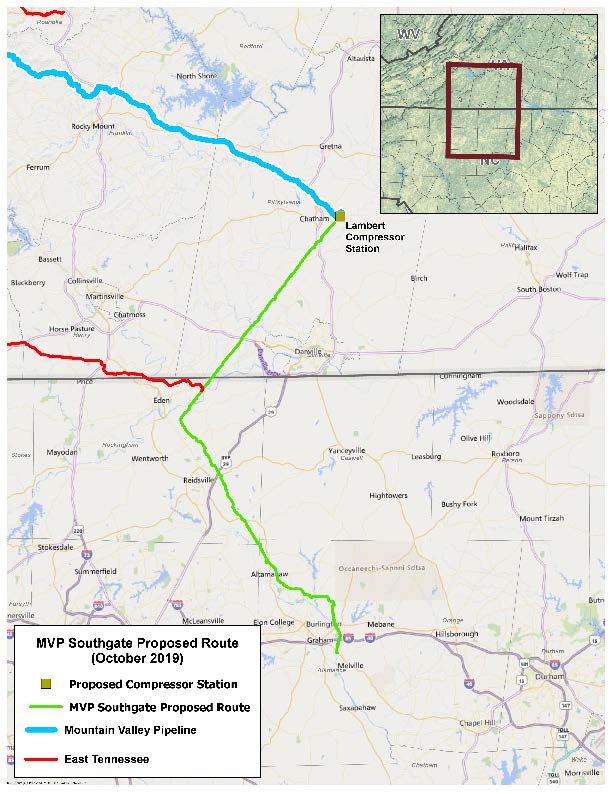
  Last Friday the U.S. Fish and Wildlife Service (USFWS) filed a request with the Federal Energy Regulatory Commission (FERC) asking for an extra 45 days to revise an Endangered Species Act (ESA) review of the Mountain Valley Pipeline (MVP) project. Also from last week: anti-fossil fuelers (Big Green groups) virulently opposed to MVP (which is 90% built) continued to hound the project by pestering the Virginia Department of Environmental Quality (DEQ) over minor violations the DEQ found in construction activities from September to December. Big Green wants to know what the DEQ is going to “do” about the violations.
 UGI Corp. has just won a case on appeal at the U.S. Court of Appeals for the Third Circuit that overturns an order by a lower court ordering UGI to pay more than $380,000 combined to two sets of property owners for taking their land as part of the Sunbury Pipeline in Snyder County, PA. The landowners who sued used a so-called expert whose testimony was, according to the judges, “speculation and conjecture” and “not good science.” Therefore the lower court award was overturned.
 In January the Pennsylvania Dept. of Environmental Protection (DEP) finally, after more than a year, agreed to lift a moratorium on new construction work for several Energy Transfer pipeline projects in the state, including the Mariner East 2 and 2X projects (see
  A Boston University professor has gone on a so-called “hunger strike” in his campaign against fossil fuels and a compressor station near Boston that will flow more of them. And you actually *pay* to send your kids to BU?
 The Ohio Supreme Court ruled yesterday that the Ohio tax commissioner correctly charged Tallgrass Energy’s Rockie Express (REX) pipeline $2 million in excise tax (based on $699 million of income), for gas transported from and to (within) Ohio. REX claimed it did not owe the tax because the same law that exempts gas transported out of state applies to gas sales in-state. But the tax commission, and now the Supremes, say that the portion of gas transported through REX that stays in Ohio is not exempt and can be taxed. So pay up.
 Yesterday Dominion Energy issued its fourth quarter and full-year 2019 update. As part of the update, Dominion’s top brass talked about 2020 and beyond. Of particular interest for us was a bunch of news about the company’s stalled Atlantic Coast Pipeline (ACP) project. In particular, Dominion has purchased a small stake in the pipeline from partner Southern Co. for $175 million. The new price tag for the project has now gone to $8 billion. Even with the delays and setbacks in court, Dominion remains 100% committed to building ACP.
 New Fortress Energy, which funds and builds LNG (liquefied natural gas) infrastructure to “help accelerate the world’s transition to clean energy,” yesterday announced it has signed a 10-year supply agreement for the purchase of 27.5 million MMBtu per annum of LNG (approximately 8 cargoes a year) to an unnamed buyer at a price indexed to Henry Hub–through January 2030. The announcement does not contain details about who the buyer may be, or what the actual price is they will receive–but we have some speculation about all that.
 It amazes us that we now have to defend perhaps the greatest advancement to the longevity of not only humankind but all species on planet earth. That advancement is PLASTICS. Yes, plastics. The invention of plastic and its uses on Mom Earth has made our lives better. Plastics, contrary to the current popular mythology, have extended human and animal life. And yet, even the companies that build giant cracker plants to create raw plastic pellets (for further use in thousands of plastic products) must now bow down before environmental crackpots to declare their concern (even dislike) of the very thing they produce: plastic. It’s bizarre.