Energy Services

  • | | | | | |

    Rover Again Asks FERC for OK to Restart Tuscarawas Drilling

    On Jan. 24, the Federal Energy Regulatory Commission (FERC) sent a letter to Rover Pipeline stopping drilling at the Tuscarawas River site, which had only restarted in December (see FERC Stops Rover Drilling Near River After 200K Gal Mud Disappears). In a strongly worded letter dated Sunday, Jan. 28, Rover told FERC they are “frustrated by the inaccurate central premise underlying the letter received from” FERC shutting down drilling at that location (see Rover “Frustrated” with FERC Order to Stop Drilling at Tuscarawas). Some 99% of all construction work is now complete for Rover Pipeline. There’s only a little more to do to finish things up, including installation of a second Rover Pipeline (next to the first) underneath the Tuscarawas River. Rover has “lost” 200,000 gallons of drilling mud down the hole in drilling for the second pipe. However, the “lost” mud has not come back to the surface. Mud disappearing–and staying down the hole–when drilling for pipelines is not uncommon. Yet FERC will not lift the stop work order. On Friday, FERC sent a letter to Rover saying Rover must provide information on three different scenarios before work can resume: (1) how Rover plans to complete drilling at the current location without losing any more mud, (2) change locations and run the second pipe under another part of the Tuscarawas River, or (3) forget about drilling and installing a second pipe altogether, and stick with just a single pipe already in place now. FERC’s letter brought a swift response. On Sunday, Rover provided a mountain of evidence to say the current plan of drilling under the river at the existing location is the right plan. Rover went one step further, asking FERC to allow them to begin drilling again by yesterday (Monday) afternoon at 3pm. To the best of our knowledge, that did not happen…
    Read More “Rover Again Asks FERC for OK to Restart Tuscarawas Drilling”

  • |

    Patterson-UTI Rig Count of 165 in January Another All-Time High

    As we do each month, MDN tracks how many rigs oilfield services company Patterson-UTI Energy reports operating–as a proxy for rig count health in general and rig count health in the Marcellus/Utica in particular. Patterson operates many rigs in our region. Last April, Patterson bought out and merged in Seventy Seven Energy (SSE). The addition of SSE’s rigs served to rocket Patterson’s rig count number in April and May much higher (see Patterson-UTI Rig Count Continues to Rocket Skyward – 159 in May). With SSE fully absorbed into Patterson, the rig count number settled down. In September Patterson’s rig count slipped by 1–the first loss since June 2016. In October the count retreated another three, to 158. But the trend reversed in November when the the count jumped again–back up to 161. Then in December Patterson’s rig count hit a new, all-time high of 163 (see Patterson-UTI Rig Count Hits All-Time High in December, Up to 163). And here we are, in the dead of winter, and Patterson has done it again. The average rig count for January was 165, another new, all-time high…
    Read More “Patterson-UTI Rig Count of 165 in January Another All-Time High”

  • | | | | |

    NJ Continues to Hassle PennEast Pipe with Refusals & Rejections

    The State of New Jersey and its elected leaders (Governor and Attorney General) continue their quest to hassle and block the PennEast Pipeline from entering a small portion of their state. Why? To answer that question you’d have to enter their brains to understand all of the political calculations that go on–a very scary proposition. NJ Attorney General Gurbir Grewal (far-left Democrat) on Friday rejected PennEast’s request to use state-owned land for small part of the pipeline’s route. Also last week, the NJ Dept. of Environmental Protection (an executive branch agency, reports to NJ’s newly elected LibDem Gov. Phil Murphy) told PennEast the DEP is closing the books on PennEast’s water crossing permit application for lack of information. PennEast says the DEP’s action was not a surprise and that they will refile the application with the additional information sought. It all just points to a very hostile (to private business) government that has seized power in The Garden State. Don’t worry, PennEast isn’t letting NJ’s hostility stop them. This pipeline will still get built…
    Read More “NJ Continues to Hassle PennEast Pipe with Refusals & Rejections”

  • | | | | | |

    PennEast Pipe Forced to Do It Hard Way – Using Eminent Domain

    As we told you last week, today (Monday, Feb. 5) is the final day for landowners who live along the path of the PennEast Pipeline to accept an offer from PennEast to lease their land for the pipeline (see PennEast Pipe Gives Holdout Landowners Feb 5 Deadline to Sign). The landowners have had near three years to deal in good faith negotiations with PennEast, and now time has run out. On Friday, a group of holdout landowners symbolically tore up their PennEast lease offers in a vain media stunt. Starting later this week they will receive something via certified mail they better not tear up–a court summons for an eminent domain proceeding. It’s a shame when it has to come to that, but denial is a strong emotion. Now it’s off to court they go where they’ll get a splash of reality…
    Read More “PennEast Pipe Forced to Do It Hard Way – Using Eminent Domain”

  • | | | | | |

    Federal Judge Pushes Pause Button on Mountain Valley Pipe in VA

    In mid-January MDN brought you the news that (sadly) Mountain Valley Pipeline (MVP) had to file in federal court to “condemn” some holdout landowner properties along the pipeline’s route (see Mountain Valley Pipe Tweaks Route, Asks VA Judge for Eminent Domain). MVP is a $3.5 billion, 303-mile pipeline that will run from Wetzel County, WV to the Transco Pipeline in Pittsylvania County, VA. Holdout landowners in Virginia hired attorneys who argued that because MVP continued to tweak the route of the pipeline (in an attempt to work WITH said landowners!), that serves as evidence MVP doesn’t know what it really wants and whom to condemn with eminent domain–therefore the whole thing should be put on hold. MVP wants condemnation using eminent domain for Virginia landowners to happen now, because they are playing Beat the Clock with tree clearing along the path of the pipeline, work that must be done by March 31st because federal law prohibits it after March 31st for fear of killing a few roosting bats (we kid you not). In a decision handed down last week, a federal judge gave both sides reason for hope. The judge ruled that MVP can proceed with eminent domain cases against some 300 landowners–a huge legal victory for MVP. However, MVP can’t (yet) enter those properties for tree clearing and survey work. Why? Because MVP hasn’t provided the judge with enough proof that they will be able to pay landowners a fair price for their property when the time comes to settle up. She’s not saying MVP can’t or won’t pay up, she’s saying she wants to see more evidence first (surety bonds), before she will let MVP begin work. Those opposed to the pipeline heralded the judge’s decision to temporarily prevent work as some sort of victory–which it is not. They lost the case! The properties are now condemned using eminent domain (or soon will be, once the court paperwork proceeds). The judge’s order temporarily prevents work, but we expect MVP will remedy that post haste so they can then start up the chainsaws and get to work…
    Read More “Federal Judge Pushes Pause Button on Mountain Valley Pipe in VA”

  • | | | | | | | |

    Atlantic Sunrise Pipe’s Positive Impact in Lancaster Already Felt

    Money–a lot of money–is flowing into Lancaster County because of construction work now being done on Williams’ $3 billion, 198-mile Atlantic Sunrise natural gas pipeline project running through 10 Pennsylvania counties to connect Marcellus Shale natural gas from northeastern PA with the Williams’ Transco pipeline in southern Lancaster County. Local media pitches the revenue and jobs created by the project as “temporary.” MDN once heard a union pipeline worker respond to that very argument at a FERC hearing (for the Constitution Pipeline) by saying he’s had an entire career of “temporary” pipeline jobs that last a few months or a year–making enough money to put his kids through college and make a nice living for himself and his family. Lancaster residents should jump for joy at their “temporary” blessing of this pipeline’s construction. Among the beneficiaries of these “temporary benefits” are “dozens of local businesses” and “more than 100 workers” who are employed full-time working on the project. An estimated $75 million (!) is now flooding into the Lancaster County economy, thanks to Atlantic Sunrise…
    Read More “Atlantic Sunrise Pipe’s Positive Impact in Lancaster Already Felt”

  • | | |

    Can Virtual Pipelines Rescue New England from Russian LNG?

    The whole story of Russian LNG coming to Boston to help New England with its crisis shortage of natural gas continues to irk us. Although Russia and the Yamal plant where the gas was liquefied were sanctioned under President Obama. However, the actual gas itself was/is not sanctioned, for whatever reason. We have a situation where New England continues to obstinately refuse new natgas pipelines, instead buying LNG from Russia during critical shortages. We’re paying (and depending on) our enemies for natural gas when world-class supplies of it exist a few hundred miles away in the Marcellus. We’ve written about this confounding situation since early January (see our Russian LNG stories here). Last Friday the co-founder of NG Advantage–a “virtual pipeline” company that compresses natural gas from interstate pipelines and transports it, via trucks, to businesses and organizations that want gas but can’t get it via pipelines–wrote an intriguing blog post. Tom Evslin’s post makes a case for using virtual pipelines (i.e. CNG transported by trucks) as an alternative to help alleviate the extreme winter shortages in New England. Could trucked CNG (and LNG) actually eliminate the need for a pipeline to New England? We would argue “no.” However, without a doubt a virtual pipeline could help in certain places and under certain circumstances. Here’s Tom’s argument in favor of using virtual pipelines to alleviate New England’s stubbornly high prices for natural gas, and possibly save us from importing Russian LNG…
    Read More “Can Virtual Pipelines Rescue New England from Russian LNG?”

  • | | | | | |

    Utica Pipeline Explosion in Noble County, OH Affects Natl Output

    Seneca Lateral pipeline fire – Noble County, OH

    On Wednesday around 2:30 am in the morning, a section of 24-inch pipeline that runs from the MarkWest Energy natural gas processing plant in Noble County, OH and the Rockies Express (REX) pipeline (also in Noble County) exploded and caught fire. The Noble County Emergency Management Office says it happened about three miles north of Summerfield, Ohio, near Ohio State Routes 513 and 379. Fortunately, no one was injured. Neighbors heard the explosion and saw a glowing night sky. The only damage was to some nearby trees. That short segment of pipeline is known as the Seneca Lateral, owned by Tallgrass (owner of REX Pipeline). Tallgrass is investigating the cause of the accident. Believe it or not, that one pipeline and the gas it flows from the MarkWest plant to REX, carrying it to the Midwest, has caused the entire national output of natural gas to decrease by an estimated 2%, according to Reuters. A single small pipeline can actually move the needle on output! Right away the Sierra Club jumped into the story with a wild claim that the pipeline was not properly reviewed before regulators signed off on it. Typical headline-grabbing propaganda from the Clubbers. Here are the details we could find about the explosion/fire…
    Read More “Utica Pipeline Explosion in Noble County, OH Affects Natl Output”

  • | | | |

    PennEast Pipe Gives Holdout Landowners Feb 5 Deadline to Sign

    It took over three years, but finally PennEast Pipeline received a full, final approval from the Federal Energy Regulatory Commission (FERC) two weeks ago (see FERC Grants Final Approval for PennEast Pipe – Real Battle Begins). PennEast is a $1 billion, 120-mile primarily 36-inch natural gas pipeline that will stretch from Dallas (Luzerne County), PA to Transco’s pipeline interconnection near Pennington (Mercer County), NJ. The pipeline is an important conduit to move gas from the prolific gas fields of northeastern PA to markets in southeast PA and New Jersey. There has been plenty of opposition, mostly whipped up by Big Green groups like THE Delaware Riverkeeper and the nutty Sierra Clubbers of NJ. PennEast has been (for years) negotiating with landowners along the pipeline’s proposed route, to purchase easements. Some 75% of landowners have either signed leases and/or allowed survey access of their property. Some landowners apparently bought in to the Big Green lie that this project won’t happen, so they have refused to negotiate or allow survey access. Time has now run out. With the FERC certificate in hand, PennEast can now go to court and request eminent domain proceedings against the holdouts. PennEast has sent letters to the holdouts telling them they have until Feb. 5 to accept the generous offer PennEast has made. After that, the landowners can expect to receive court paperwork telling them to allow access. What generally happens is that (a) a court order appears granting PennEast access to the property now, and (b) months or even over a year later, a judge will decide what a fair value is (typically less than being offered by PennEast) for the lease. The holdouts should have known this day was coming, but denial is a powerful emotion…
    Read More “PennEast Pipe Gives Holdout Landowners Feb 5 Deadline to Sign”

  • | | | |

    MPLX 2017 Results: Income Up Astounding 241%, Adding 6 Plants

    MPLX, which used to be known as MarkWest Energy prior to selling itself to Marathon Petroleum, issued its fourth quarter 2017 update yesterday. And wow, what an update! MarkWest…OK, MPLX (old habits die hard)…is the Marcellus/Utica region’s leading gas processing company. MPLX’s facilities process on the order of 60% of all the gas produced in the Marcellus/Utica. The region produced record volumes of gas in 4Q17 (and indeed for all of 2017), which in turn led to record volumes of gas processed (separating the methane from the other hydrocarbons), and record volumes of fractionation (separating the other hydrocarbons into their respective components) for MPLX. Net income soared, both for the fourth quarter and full year. In 4Q17, MPLX’s net income was $238 million, up from $133 million in 4Q16–a 79% increase. For the entire year, MPLX’s net income was $794 million, vs. $233 million in 2016. That a 241% increase year over year! Yeah, the Marcellus/Utica came back big time in 2017. But MPLX isn’t sitting around basking in the glow of success–they have big plans for 2018. In the Marcellus/Utica, MPLX will add six new gas processing plants, increasing the company’s processing capacity by 21% to over 7 billion cubic feet per day. Additionally, MPLX expects to add 40,000 barrels per day of ethane fractionation capacity, and 60,000 barrels per day of propane-plus fractionation. Below is the full update along with the latest PowerPoint presentation…
    Read More “MPLX 2017 Results: Income Up Astounding 241%, Adding 6 Plants”

  • | | | | |

    UGI Energy Tweaks LNG Peak Shaver for Bethlehem, PA

    UGI LNG’s Temple I peak shaver near Reading, Pa. with 3-million-gallon storage tank

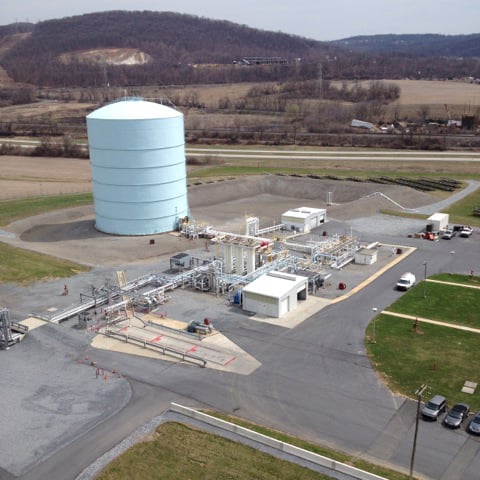
    It’s time to learn something new (there’s always something new to learn in this industry). Ever hear of a peak shaver? No, nothing to do with that thing guys use in the morning to shave off the stubble. An LNG peak shaver is a unit used for storing surplus natural gas, to have extra natgas on hand and ready during times of peak consumption during really hot summers or really cold winters. Sometimes your local gas utility will build and use a peak shaver (small LNG storage facility), so they don’t run out of natgas at a critical time, and to help with keeping prices lower by drawing down from storage if prices spike. Low prices make for happy customers. UGI, a diversified energy company with both midstream (pipeline) operations and one of PA’s largest utility companies, uses peak shavers. We’ve written about their use of peak shavers in the past (see UGI Building LNG Plant in NEPA, Local Marcellus Gas to Feed It). We’re interested in such facilities because of their potential as a new demand source for our plentiful gas supplies. UGI is proposing a new peak shaver for Bethlehem, PA. The project hit some early opposition, so UGI has tweaked the design, meaning they can proceed…
    Read More “UGI Energy Tweaks LNG Peak Shaver for Bethlehem, PA”

  • | | |

    PTT’s “Big Announcement” – Gets a New Partner for Belmont Cracker

    PTT Global Chemical, based in Thailand, has snagged a major/important new partner in its project to build a $6 billion ethane cracker complex in Belmont County, Ohio. That partner is Daelim Chemical, a subsidiary of Daelim Industrial, which is one of Asia’s top engineering/construction firms (and one of the largest companies in South Korea). The addition of Daelim is yet another positive sign that PTT will, at some point this year, pull the trigger and make a “final investment decision” (FID) to move forward with the project. PTT disappointed when they didn’t follow through with an FID in 2017, as they had promised. To be fair, these projects are big and a misstep can bankrupt a company. The Belmont cracker will be the largest single investment made by PTT since becoming a company–so we understand their reticence. Still, when you promise, you promise. Just last month, in December 2017, PTT delivered the disappointing news that there would be no FID announcement in 2017, but that there would be a big announcement “in early 2018” (see PTT Global Chemical Officially Delays Cracker Decision Until 2018). We figure the announcement about Daelim must be that announcement. It certainly qualifies as big, and it’s still early in 2018. In football terms (in honor of this weekend’s Superbowl), on Tuesday PTT achieved another first down, retaining possession of the ball (control of the Belmont cracker project), moving it further down the field toward the goal. But they haven’t yet made a touchdown (an FID). Perhaps not learning from past mistakes, PTT set a new expectation that the FID will be made “by the end of 2018″…
    Read More “PTT’s “Big Announcement” – Gets a New Partner for Belmont Cracker”

  • | | | | | | | |

    Dominion Cove Point Begins Producing LNG – for Shell

    On Monday, Dominion Energy CEO Tom Farrell reported that the company’s Lusby, Maryland Cove Point LNG export facility will become operational and begin to export LNG in “early March” (see Dominion CEO Says Cove Point LNG Operational in “Early March”). Then yesterday, Dominion issued a press release to say Cove Point has now (as of this week) begun producing LNG! What gives? This “we’re now producing LNG” is part of the commissioning process which began back in December (see Dominion Cove Point LNG Export – Dress Rehearsal Begins). Feed gas is imported and used for testing purposes, and is the final step before the plant goes online into full production. The feed gas came from Shell (sourced from Nigeria), and Shell will take delivery of the LNG that results. When the initial commissioning is done, Marcellus/Utica gas will then begin flowing to the plant and the LNG produced will begin shipping (by “early March”) to Japan and India…
    Read More “Dominion Cove Point Begins Producing LNG – for Shell”

  • | | | | | |

    Rover “Frustrated” with FERC Order to Stop Drilling at Tuscarawas

    In a strongly worded letter dated Sunday, Rover Pipeline tells the Federal Energy Regulatory Commission (FERC) they are “frustrated by the inaccurate central premise underlying the letter received from” FERC shutting down drilling at the Tuscarawas River location. On Jan. 24 FERC sent a letter to Rover stopping drilling at Tuscarawas, which had only restarted in December (see FERC Stops Rover Drilling Near River After 200K Gal Mud Disappears). In April 2017, some 2 million gallons of drilling mud went down the hole near the Tuscarawas River and popped back out where it should not have, harming a wetland by smothering aquatic life (see Rover Pipeline Accident Spills ~2M Gal. Drilling Mud in OH Swamp). That 2 million gallon “spill” in April triggered a shutdown of all HDD work in Ohio. It was only last December that Rover was allowed, by FERC, to resume more HDD work at the Tuscarawas site (see FERC Gives Rover OK to Resume All HDD Work, Incl. Tuscarawas River). After “losing” another 200K gallons down the hole, FERC shut it down a second time, on the 24th. So why is Rover frustrated? Because (a) losing some drilling mud was predicted and expected, and (b) NONE of the 200K gallons of mud lost has come back to the surface. There is no “inadvertent return,” as it’s called. Rover says 200K gallons staying down the hole, in the ground and not coming back out, is no big deal. That’s why they’re frustrated…
    Read More “Rover “Frustrated” with FERC Order to Stop Drilling at Tuscarawas”

  • | | | | | |

    Part of TGP’s Broad Run Pipe Expansion Starts Up in Kentucky

    In December 2016 MDN brought you news about Kinder Morgan’s “Broad Run Expansion Project” that will expand transportation capacity of natural gas on the existing Tennessee Gas Pipeline (TGP) system. Antis tried to stop the project, but the Federal Energy Regulatory Commission rejected their pleas (see FERC Denies Anti Request to Stop KM’s Broad Run Expansion Project). The Broad Run Expansion includes construction of two new compressor stations in Kanawha County, WV, one new compressor station in Davidson County, TN, and one new compressor station in Madison County, KY. TGP is also increasing compression capacity by modifying two of its existing compressor stations in Powell and Boyd counties in KY by replacing existing capacity with new, higher-rated horsepower compression units. The project will provide an extra 200,000 dekatherms per day (Dth/d) of transportation capacity along the same path as the Broad Run Flexibility project, which was placed in service on Nov. 1, 2015. All of the additional gas will come from Antero Resources and their Marcellus/Utica program. Kinder/TGP has been busy working on the $406 million project and the pieces are now coming together. On Monday, FERC sent a letter to KM/TGP telling them the brand new compressor station in Madison County, KY can begin operations. KM plans to have the entire project up and running by June 1st of this year…
    Read More “Part of TGP’s Broad Run Pipe Expansion Starts Up in Kentucky”

  • |

    Dominion Energy Gives Update on ACP, Greensville Plant & SCANA

    Dominion Energy, a huge company with fingers in many pies (gas and electric utility, electric generator, nuke plant owner, pipeline company, LNG exporter) issued its fourth quarter and full year 2017 update on Monday. Dominion’s top brass also held an earnings call with analysts. We reported yesterday that on the earnings call, Dominion CEO Tom Farrell said the Cove Point LNG export plant on the shore of Maryland will begin shipping LNG “in early March” (see Dominion CEO Says Cove Point LNG Operational in “Early March”). Farrell said getting the facility ready is “an enormously complicated process” and safety is front and center. While the Cove Point news was tops in importance for us, Dominion is working on other critically important projects for the Marcellus/Utica. Dominion is the company building the $5 billion Atlantic Coast Pipeline, a huge 1,588-megawatt gas-fired electric plant in Greensville County, VA, and they are in the process of (hopefully) buying South Carolina-based SCANA Corporation–the main electric and gas company for much of South Carolina. What about an update on all these other important projects? We have it for you below…
    Read More “Dominion Energy Gives Update on ACP, Greensville Plant & SCANA”