
Nuverra 3Q21: M-U Rig Count Up 19%, M-U Revenue Down 27%
 Nuverra Environmental Solutions (formerly Heckmann) is one of the largest companies in the United States that handles the transportation and disposal of shale drilling wastewater and leftover rock and dirt from drilling. The company has major operations in the Marcellus/Utica region. We keep an eye on its performance as an indicator of whether there is more or less drilling happening in the M-U. Although the rig count in the M-U went up year over year for 3Q21, revenues for Nuverra did not.
Read More “Nuverra 3Q21: M-U Rig Count Up 19%, M-U Revenue Down 27%”
 In October the owner of the Glen Riddle Station Apartment complex in Delaware County, PA convinced a county judge to order the release of emails between officials in Middletown Township and Energy Transfer, owner of the Mariner East pipeline system (see
  Over the past two years, MDN has told you about a tiny 2.1-mile looping pipeline segment proposed by Kinder Morgan’s Tennessee Gas Pipeline (TGP), to be buried next to the existing TGP, to connect regions around Springfield, Massachusetts to receive more natural gas supplies. Springfield neighborhoods like Holyoke have an ongoing moratorium on hooking up new natgas customers unless/until more supply is provided (see
  Ohio’s House Bill (HB) 6 law granted billions (plural) of dollars to FirstEnergy in an attempt to prop up the company’s economically failing nuclear power plants. FirstEnergy bribed state legislators to pass, and keep passed, HB 6 by paying out $61 million to a small group of insiders, including the now-former Speaker of the House (see
  We have some exciting, and exclusive, news to share with the MDN audience. We previously told you that the Ohio Dept. of Natural Resources (ODNR) was behaving like a child, dragging its collective heels to prevent two side-by-side injection wells in Belmont County developed by Omni Energy from beginning operation (see
 We suppose it takes a lot to surprise the CEO of one of the world’s biggest pipeline companies. Yet yesterday Williams CEO Alan Armstrong expressed his surprise that even with the dramatic increase in the price of natural gas during the third quarter, demand for natural gas was “inelastic” and remained high. Translation: Williams had all it could do to keep up with flowing natural gas through it’s extensive pipeline system, even with super-high prices. Much of the demand to flow gas came from the Marcellus/Utica.
 Equitrans Midstream, formerly known as EQT Midstream, issued its third quarter update yesterday. The main focus (for us) of the update is new or updated information related to the company’s all-important Mountain Valley Pipeline (MVP) project and those projects connected to MVP–including Hammerhead and Southgate. Yesterday we learned Equitrans still believes MVP, a 303-mile pipeline from West Virginia to southern Virginia, is on track to start up in “summer 2022.” The company plans to begin construction of a related extension of MVP, called Southgate (from Virginia into North Carolina) in 2022 and bring it online in early 2023.

 Last week MDN told you the news that EQT Corporation has sold part of its reserve capacity along the Mountain Valley Pipeline (MVP) to “an undisclosed investment-grade entity for six years” (see
  Chesapeake Energy, which has gone through a transformation since declaring bankruptcy earlier this year, announced yesterday it has selected oilfield services (OFS) company Nabors Industries as its preferred drilling contractor across all of the company’s shale oil and natural gas assets moving forward. Nabors is Chessy’s new dancing partner. What’s that? Who is Nabors?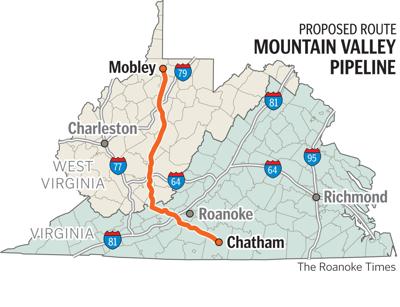
 Earlier this month MDN exclusively broke the news that earlier this year (slipping under the radar) the Ohio Department of Natural Resources (ODNR) issued permits to Powhatan Salt Company/Mountaineer NGL Storage for three planned solution mining wells in Monroe County (see