
Guest Post: Why PA HB 1391 Bill is Bad for the Marcellus
 We don’t mind telling you that the royalty issue in Pennsylvania, specifically passage of House Bill (HB) 1391 to ensure landowners are guaranteed 12.5% royalty checks regardless of post-production costs, is a thorny issue for MDN. We can see both sides of the issue, but tend to favor the landowner side–slightly. The drilling industry knows that there is no bigger booster for them than MDN. So our periodic coverage and editorializing in favor of 1391 is a bone of contention. Drillers are not happy with your faithful editor. A long-time MDN subscriber and friend who works for a sizable driller in PA recently wrote us an email that (a) lays out the case for not tampering with existing, signed contracts, and (b) gently chides MDN for taking the landowners side in this issue. We asked for and received permission to bring you his email. As we responded to our friend, we are interested in getting this issue settled quickly. It breaks our heart to see allies divided. We all need to be firing at the other side, not within our own ranks. MDN is happy to run guest posts and views on this issue (or any issue). This letter writer does a good job, and makes a compelling case, for NOT passing HB 1391. Does he change your mind on the issue?…
Read More “Guest Post: Why PA HB 1391 Bill is Bad for the Marcellus”
 The benefits of shale energy are almost too numerous to list. Contrary to the ninny nannies who spit and spout and preen about yelling the sky is falling if we frack one more well–the OPPOSITE is the truth. Shale is GREAT for America, in so many ways. Channeling our inner Donald Trump, “It’s very very great. So great you won’t believe how great it is. You’re gonna love it!” Here’s just one more way shale is great. A researcher from Clemson University (in South Carolina) poured over mortgage data for the state of Pennsylvania. As you know, not all of PA is blessed with being located in the Marcellus Shale–but much of it is. The intrepid Clemson researcher found in reviewing records from 2004 to 2011 that those with mortgages who live in areas where there is Marcellus Shale defaulted on those mortgages 58% LESS than the statewide average. That is, shale means there’s more money to pay bills, a mortgage being one of them. Might we say that the Marcellus can literally save the family farm? Yes, we can say it, and back it up with data! The Clemson researcher also found living in a shale region boosts your FICO credit score…
 Day One of Shale Insight is now in the books. MDN editor Jim Willis is attending, with a booth, and had a chance to shake hands with many subscribers. A hearty and heart-felt “thank you” for the kind words to subscribers and long-time industry friends who stopped by. There is no way to sugarcoat the fact that the exhibit space (number of exhibitors) is much smaller this year than in past years. However, you just can’t replace getting face-to-face with customers and (hopefully) future customers. Although the event may be smaller in numbers, that’s not a reflection of the conference program. This year’s program is filled with terrific speakers. Jim had a chance to listen to the speakers during the main sessions in the morning and at lunch. They were some of the best he has heard in attending Shale Insight over the past five years–and that’s no exaggeration. Without a doubt the speaker from Day One grabbing the most headlines was Harold Hamm, CEO of Continental Resources and one of the drillers who figured out how to frac (with no “k”, we’ll explain below). Below are highlights only–pickings from the things Jim heard on Day One. We hope, at some point, to bring you the PowerPoint presentations and perhaps even videos for some of the talks–we’re working on it. In the meantime, here are brief highlights, things that caught our fancy, from the first day…
 One of the interesting tidbits to come out of yesterday’s first day of the Shale Insight conference in Pittsburgh was an off-the-cuff remark from Pennsylvania Gov. Tom Wolf’s special assistant for infrastructure, Yesenia Bane, who said that Gov. Wolf is “willing to talk” with New York Gov. Andrew Cuomo to ask him to approve the Williams Constitution Pipeline project in the Empire State. Bane said Wolf has met with Williams and other stakeholders in the Constitution project, and apparently Wolf was impressed enough that he’s willing to add his own voice to those calling for an approval of the Constitution. Democrat on Democrat. Mano a mano. Should be interesting, if Wolf ever gets up the nerve to do it…
 Canadian driller and midstream company Epsilon Energy had a shareholder rebellion in 2013 and threw out the sitting board of directors (see
  The Pennsylvania Dept. of Conservation and Natural Resources (DCNR) used to, once upon a time, lease a small fraction of the land under its oversight to allow Marcellus Shale drilling. And like any private landowner, the DCNR received bonus payments when leasing, and royalties when the gas began to flow. In fact, when Marcellus drilling had hit its peak in 2013, the DCNR received almost enough just from bonuses and royalties they were nearly self-funding (see
 Anti-coal, anti-natural gas, anti-oil, anti-logic…the radicals who make up the Sierra Club are anti-everything. They can’t even stand themselves! Self-loathing seems to be a requirement for membership. The Allegheny sub-group of the Sierra Club is planning to protest in front of the David L Lawrence Convention Center in Pittsburgh this coming Thursday morning. Why? Because presidential candidate Donald Trump is scheduled to speak and they HATE HIS GUTS. They also hate frackers and those who support them, like your humble editor. There’s no better unifier on the left than hatred. MDN will be on location at the event and if we get a chance we’ll snap a picture or two of the nutters out front protesting. Meanwhile, here’s the Sierra Club game plan for Thursday…
 From time to time exploration and production companies (aka “drillers” or “producers”) decide to sell leases for acreage they don’t plan to drill on or under. Typically when a new play is discovered there is a bit of a land rush as drillers begin leasing. In the Marcellus, a driller may decide to concentrate on a specific county in the state, as Cabot Oil & Gas did with Susquehanna County in northeastern PA. Cabot happened to hit the jackpot with some of the most productive gas wells on the planet. Other times, when the leasing is done and drilling has begun drillers begin to figure out where they want to spend their money. It takes a lot of money to drill a Marcellus well–on the order of $7 million. Eventually drillers find there are isolated tracts of acreage they’ve leased that don’t fit with their future plans, so they either horse trade and swap, or perhaps put the acreage leases up for public auction. Such is the case with Shell’s SWEPI subsidiary. They recently posted three largish tracts of leased acreage up for auction–two in Tioga County, PA and one in Potter County, PA. Here’s a description of the land SWEPI is trying to dump…
 This story is unbelievable on so many levels. A pointy-headed liberal who cloisters himself inside the insular Beltway of Washington, DC made a trip to Pittsburgh last week to talk to a small class of 70 students at Carnegie Mellon University. In this talk the lib proclaimed that the “incentives” provided by PA to Shell to lure a cracker plant to the state are, essentially, monies the state didn’t have to spend and a burden to the taxpayers of PA because Ohio and West Virginia may also reap some of the benefits of the cracker (without “paying” for it). The lib’s operating assumption is that 100% of everyone’s money belongs to the all-knowing government–including money made by big, evil corporations like Shell. He further states that by granting a few exemptions on taxes to Shell, PA is taking money out of the pockets of common folk. His philosophy and assumptions are so twisted it’s beyond belief. What’s more twisted is that the Pittsburgh Post-Gazette wrote a major story about the talk–as if it’s news…
 For some time now MDN has highlighted the ongoing internal division among the ranks between Pennsylvania landowners and drillers over the issue of royalty checks. PA landowners are supporting House Bill (HB) 1391 which would guarantee landowners receive a minimum 12.5% royalty check regardless of post-production costs (see
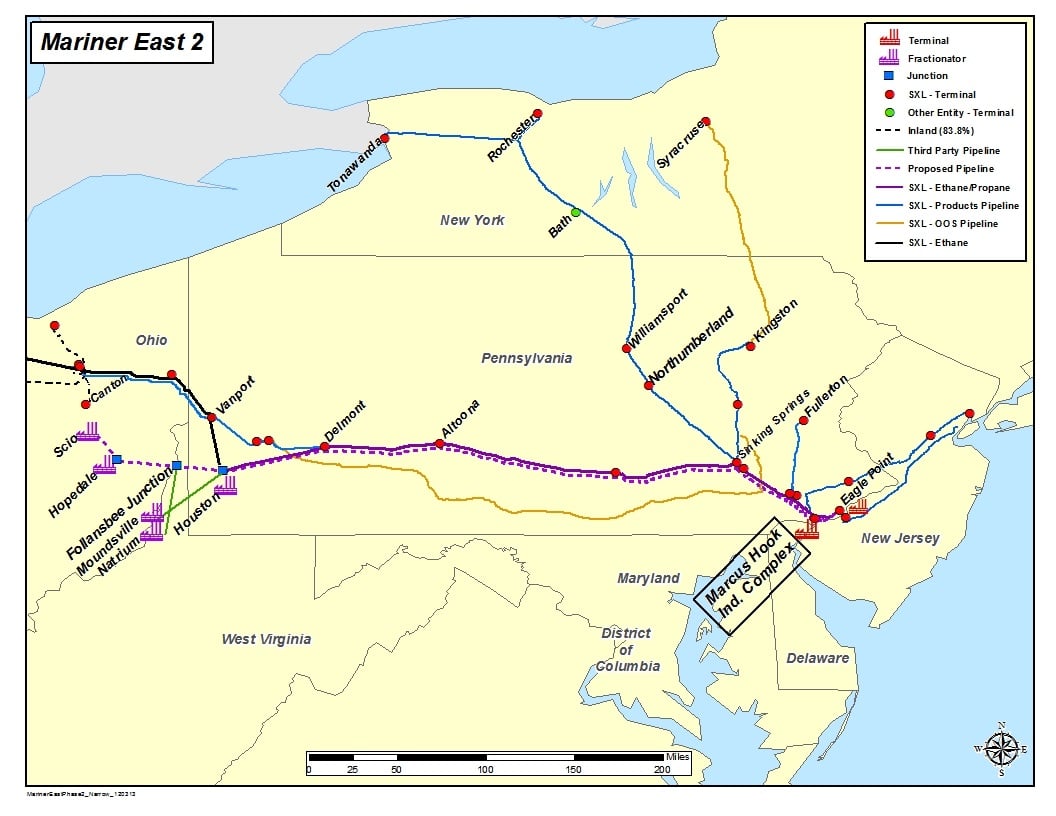
 There is no doubt Sunoco Logistics Partners has been pushing a boulder up a hill when it comes to the Mariner East 2 pipeline project–a $2.5 billion, 350-mile natural gas liquids (NGL) pipeline that will run from eastern Ohio through the state of Pennsylvania to the Marcus Hook refinery near Philadelphia, carting ethane, butane and propane to the facility from both the Utica and Marcellus region. For over a year the project was mired in legal challenges of whether or not it can claim public utility status, with a right to use eminent domain. In July, PA’s Commonwealth Court ruled it is a public utility with a right to use eminent domain (see