Antero Resources | Bradford County | CNX Resources | Energy Companies | EOG Resources | EQT Corp | Expand Energy | Greene County (PA) | Ohio | Pennsylvania | Range Resources Corp | Tuscarawas County | Tyler County | Washington County | Weekly Permits | West Virginia | Westmoreland County
28 New Shale Well Permits Reported for PA-OH-WV Jun 29 – Jul 5
 The Marcellus/Utica region received 28 new drilling permits last week, June 29 – July 5, down 3 from two weeks ago. Last week, Pennsylvania issued 18 new permits. Ohio issued 4 new permits. And, West Virginia issued 6 new permits. The drillers who received new permits included: Antero Resources (6), CNX Resources (10), EOG Resources (4), EQT (1), Expand Energy (3), and Range Resources (4). Read More “28 New Shale Well Permits Reported for PA-OH-WV Jun 29 – Jul 5”
 The Trump administration and its officials continue to aggressively push the Williams 125-mile Constitution Pipeline project, which would stretch from the prolific shale gas fields of Susquehanna County, PA, into and through New York State, to Schoharie County, NY, to move Marcellus gas into New York State and New England. In June, Trump EPA Administrator Lee Zeldin visited Binghamton to advocate for reviving the long-stalled project (see
  Last week was (once again) noteworthy for the Baker Hughes rig count. Although the Marcellus/Utica count didn’t budge, the national count increased by another 7 rigs. The national count has risen over the last three weeks — by 18 rigs! The new national count, 580, is also the highest the combined count has been since May 2025. The combined M-U rig count remained at 36 active rigs for the eighth consecutive week. The M-U’s chief competitor, the Haynesville, maintained its count of 55 active rigs, operating 19 more than the M-U.
  Data center growth is rapidly reshaping Northeast power and natural gas markets, with projects clustering near transmission lines, substations, gas-fired power generation, and pipeline corridors. Virginia remains the epicenter, led by Northern Virginia’s massive hyperscale hub and tens of gigawatts of planned capacity. Ohio is emerging fast around Columbus, with more than 15 GW proposed. Pennsylvania could become a major growth story, pairing Marcellus/Utica gas resources with large campuses such as Homer City’s planned 4.5-GW gas-fired/data center redevelopment. However, PA is attempting to shoot itself in the foot with talk of both short- and long-term moratoriums on new data center construction. So, the jury is still very much out on how successful PA will be with data centers.
  Wow! Where did the last 10 years go? In June 2015, MDN brought you the news of two Pennsylvania business groups, the Delaware County Chamber and the Washington County Chamber, along with two labor unions, the Laborers’ International Union of North America (LiUNA) with 25,000 members and the International Union of Operating Engineers (IUOE) Local 66 with 7,000 members, joining forces to form the
 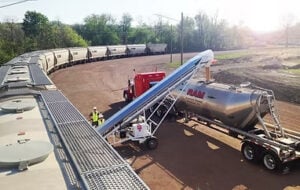 We love a good railroad story, and at its core, that’s what this story is. Investment firm FTAI Infrastructure has completed its acquisition of Tidewater Logistics, a barge-and-rail transloading company operating in Ohio, West Virginia, and Texas, for about $45 million in cash. Tidewater serves producers, shippers and industrial customers in Appalachian Basin and Gulf Coast shale and energy markets, making it complementary to FTAI’s Wheeling & Lake Erie Railway. Tidewater’s facilities include frac sand transloading in Steubenville, OH; Fairmont, WV; and Allenport, PA.
  Earlier this month, MDN brought you the news that Talen Energy would file an application to expand its power generation facility with two new gas-fired power units in Montour County, PA (see
  The highly functional and responsible Susquehanna River Basin Commission (SRBC), unlike its dysfunctional and irresponsible counterpart, the Delaware River Basin Commission (DRBC), continues to support the shale energy industry by approving water withdrawals and consumptive use requests for responsible, safe shale drilling. The SRBC published a notice in the June 27th Pennsylvania Bulletin that the SRBC approved and/or renewed 34 general water use permits in May for individual shale gas well drilling pads in Bradford, Clinton, Lycoming, McKean, Sullivan, Susquehanna, Tioga, and Wyoming counties.
  In early 2024, we reported that Penn America Energy CEO Franc James, the potential builder of the proposed Penn America LNG export facility in the Philadelphia area, said that he “pumped the brakes” on the project but that it wasn’t dead yet (see
  Pennsylvania radical green groups, including PennFuture, the Center for Coalfield Justice, and the Sierra Club Pennsylvania Chapter, continued a full-court press against AI data centers in the Keystone State yesterday. Just yesterday, we reported that Food & Water Watch had assembled dozens (perhaps one hundred at most) protesters in Harrisburg on Tuesday to support a bill (Senate Bill 1359) that would (if signed by Governor Shapiro) ban new data center development in PA for three years (see
  Last week, MDN told you about a group of landowners in Salem Township (Luzerne County), PA, near Wilkes-Barre, who had banded together to offer their land for sale to a data center project and potentially become very wealthy (see
  The thing about the political left is that they NEVER give up. EVER. And so, neither must we. The left wants to destroy new shale drilling in Pennsylvania. They couldn’t do it via regulation. They couldn’t convince a majority of residents that shale drilling is bad. So they search out other ways to make it happen. Among those ways are efforts to increase setbacks (distance from wells to homes and other structures) from the current 500 feet to over 3,200 feet, which would ban drilling in 95%+ of the state (see