Quebec Agrees to Mediate Utica Drilling Ban Fight with Questerre
 For four years, the province of Québec has had one answer for the drillers whose mineral rights it seized: see you in court. Last week that changed — a little. Questerre Energy announced it has signed a mediation protocol with Québec’s Attorney General and the province’s Ministry of the Economy, Innovation and Energy, agreeing to sit down at a table and talk. Longtime MDN readers know the backstory. Québec sits on top of a big slice of the Utica Shale — yes, the same Utica that runs under Ohio, West Virginia and Pennsylvania. Read More “Quebec Agrees to Mediate Utica Drilling Ban Fight with Questerre”

 OTHER U.S. REGIONS: D.C. gas ban gets favorable hearing in federal appeals court; NATIONAL: U.S. natural gas retreats as weather set to cool down; End of life oil and gas wells in the United States – practical and legal issues; INTERNATIONAL: Brent nears $100 on Mideast strikes; Enbridge names Harradence CEO, Ebel retires Jan. 1, 2027.
  Two things happened last week, and both of them are unusual. Pennsylvania dropped a rig to 15, pulling the combined Marcellus/Utica down to 33 — a number we haven’t printed since the fall of 2024. And the national count came in at 588 for the third consecutive week. Not 588, then 587, then 589. The same number, three times in a row. We’ve been writing this column a long time, and we can’t recall the national count sitting perfectly still for three straight reports. Underneath it, the shuffle continued: two more oil rigs, two fewer gas rigs. Look at the price sheet, and you’ll see why. WTI settled Friday near $90.76 a barrel. Natural gas settled around $2.98 per MMBtu.
  Devon Energy’s Coterra unit is asking Pennsylvania regulators for permission to lay 18.4 miles of 20-inch freshwater pipeline across three Susquehanna County townships — which is a strange thing to spend money on if you’re about to sell the place. The Department of Environmental Protection (DEP) published the notice in the September 5 Pennsylvania Bulletin, opening a comment window that closes October 5. The project is the Brooks to Forwood Temporary Waterline, running through Springville, Lathrop, and Lenox townships.
  Shell Chemical Appalachia signed a consent order and agreement (COA) with the Pennsylvania Dept. of Environmental Protection (DEP) last Friday, Sept. 4, agreeing to hand over $15 million to settle three years’ worth of air, storage tank, and water violations at its Monaca (Beaver County) ethane cracker. Half of it — $7.5 million — is an actual civil penalty. The other half is a “contribution” to a brand-new community fund. If that arrangement sounds familiar, it should. It’s the same two-bucket structure the Shapiro administration used to squeeze nearly $10 million out of Shell back in May 2023.
  The hill above Homer City now has more people working on it than the borough below has living in it. Homer City Generation dropped a Labor Day announcement on Friday: more than 1,800 direct-hire tradespeople and skilled contractors are on site building the 4.4-gigawatt (GW) gas-fired plant and data center campus rising from the bones of what was once Pennsylvania’s largest coal-fired power station. The borough of Homer City has roughly 1,800 residents. That’s a nice bit of symmetry, and it says more about what this project means to Indiana County than any press release paragraph could.
 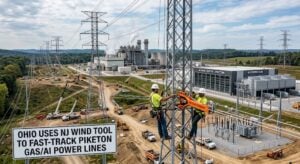 Ohio has asked PJM to dust off a rarely used piece of grid-planning machinery — a tool invented to string wires to offshore wind farms — and use it instead to speed up $4.2 billion in new high-voltage power lines to the 10-gigawatt SoftBank data center and gas plant complex at Piketon. We got our hands on the letter. It’s dated June 15, 2026, from PUCO Federal Energy Advocate Sarah J. Parrot to PJM President and CEO David E. Mills, and it’s been sitting quietly for nearly three months. It surfaced this week because PJM is briefing its Transmission Expansion Advisory Committee (TEAC) on the request today, Sept. 8, to use the “state agreement approach.”
  Six weeks after announcing it would sell up to 49% of its $1.2 billion Florida Energy Pathway pipeline (see
 The Marcellus/Utica region received 39 new drilling permits last week, August 24 – 30, up significantly from the 19 permits issued two weeks ago. Pennsylvania finally bounced back, issuing the vast majority of the new permits, with 25. Ohio issued 8 permits. And West Virginia issued 6 new permits. The drillers who received new permits were: Antero Resources, Campbell Oil & Gas, CNX Resources, EOG Resources, EQT, Expand Energy, Infinity Natural Resources, PennEnergy Resources, and Repsol Oil & Gas.
  It’s that time of year again. Cove Point LNG, the Berkshire Hathaway-operated export terminal on the Maryland shore of the Chesapeake Bay, is heading into its annual maintenance turnaround — and when the plant goes down, roughly 850 million cubic feet per day (MMcf/d) of demand for Marcellus/Utica gas simply evaporates. MDN has obtained the official notice from pipeline operator BHE GT&S laying out exactly what happens and when.
  Pennsylvania’s utility regulators just told the General Assembly what Marcellus drillers have been saying for two years: the electricity business is about to get very busy, and natural gas is going to be the one doing the heavy lifting. On Tuesday, September 1, the Pennsylvania Public Utility Commission (PUC) released its annual Electric Power Outlook for Pennsylvania, this one covering 2025 through 2030. The report is required by state law — the PUC has to collect demand forecasts from the state’s 11 electric distribution companies (EDCs, the utilities that run the poles and wires to your house) and hand a summary to the Legislature and the Governor every September. Usually it’s a snoozer. Not this year.