Iroquois Gas Asks FERC for Expedited Reissue of Constitution Link
 Just coming to light for us now is that Iroquois Gas Transmission System petitioned the Federal Energy Regulatory Commission (FERC) in February to reissue authorization for the $152 million Wright Interconnect Project in New York State, aiming to revive a critical link for the previously canceled Constitution Pipeline. Originally approved in 2014, the project seeks to establish a new receipt interconnection and compression facilities at the Wright Compressor Station. By creating 650,000 dekatherms per day (650 MMcf/d) of transportation capacity, the initiative intends to alleviate persistent natural gas supply constraints in the Northeast and New England markets. If approved, the project targets a May 2028 in-service date, utilizing existing company-owned infrastructure to minimize environmental impacts. Read More “Iroquois Gas Asks FERC for Expedited Reissue of Constitution Link”
 The tagline (remit) of Marcellus Drilling News is “Helping People & Businesses Profit from Northeast Shale Drilling.” Sometimes people can make money apart from leasing land and drilling. As we have pointed out many times, there is a direct connection between shale gas and the power generation market. Gas-fired power plants use (are HUGE customers for) natural gas extracted in the Marcellus and the Utica. AI data centers, which have burst on the scene over the past year or so, have an enormous appetite for electricity. Most of the electricity used to power data centers comes from gas-fired power plants, whether those plants are owned and operated by independent power operators, or (increasingly) owned and operated on-site by the data center itself. This is the story of one farmer in northeastern Pennsylvania who became a millionaire apart from shale drilling—by selling his small farm to a data center company.
  Antero Midstream (AM) recently detailed its 2026 growth strategy, targeting an adjusted EBITDA of $1.19 billion to $1.24 billion, representing an 8% year-over-year increase. This growth is driven by Marcellus Shale infrastructure expansion and the integration of recently acquired HG Midstream assets. The company plans capital expenditures between $190 million and $220 million, primarily for gathering and compression infrastructure across its Appalachian footprint. Key focuses include high-return rich gas gathering projects and dry gas infrastructure development. With strong projected free cash flow, Antero Midstream aims to maintain capital discipline, reduce leverage to approximately 3.0x, and pursue opportunistic share repurchases.
 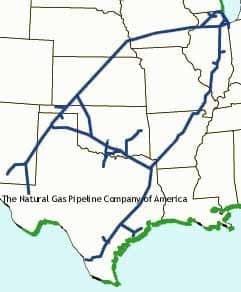 The Natural Gas Pipeline Company of America (NGPL), a Kinder Morgan pipeline subsidiary, flows Marcellus and Utica molecules. While the pipeline’s primary footprint is in the Midcontinent and Gulf Coast, it is a critical takeaway path for Appalachian gas through key interconnections. NGPL’s recent tariff announcement reaffirmed its commitment to offering negotiated rate arrangements for pipeline transportation services, maintaining continuity in its commercial practices. These options allow shippers to develop customized pricing based on factors like contract duration, gas volume, and specific operating needs, providing greater flexibility than standard maximum recourse rates.
  In January, Constellation Energy Corporation finalized its acquisition of Calpine Corporation, becoming the largest private-sector electricity producer in the United States (see
  OTHER U.S. REGIONS: Prince William County Public Schools unveils 62 new propane buses; NATIONAL: Front-month Nymex natural gas rose 1.06% to settle at $3.0650; A new way to measure U.S. energy security; Keystone XL revival gains momentum as new pipeline plan emerges; Times of conflict or war remind us of the importance of U.S. natgas; INTERNATIONAL: Oil settles higher on Gulf escalation; Oil, gas majors cut green spending for first time since 2017; Israel hits Iran South Pars facilities in world’s largest natural gas field; European natural gas prices spike amid attacks on Middle East energy sites; Asian prices may surpass $26 after strike on Qatar LNG plant.
  Shale drilling in Wayne and Pike counties in the northeastern tip of Pennsylvania has been blocked since 2010 (16 looooong years), denying landowners in those counties the right to benefit from leasing and drilling on and under their land. Those counties (parts of them) are within the Delaware River Basin, and the Delaware River Basin Commission (DRBC) implemented a moratorium in 2010 to block shale drilling. The moratorium became a full-blown, permanent ban on fracking in 2021. The DRBC added a prohibition on the disposal of oil and gas wastewater to the permanent ban in 2022. It’s time to overturn the ban. We have a
  A supposed “group of rural Ohioans” in Adams and Brown counties is seeking a constitutional amendment to ban data centers exceeding 25 megawatts, citing concerns over resource consumption and a lack of local control. The “rural Ohioans” argue these massive facilities drain electricity and water supplies while providing few permanent jobs, often facilitated by secretive non-disclosure agreements between tech companies and officials. After submitting initial signatures to the Ohio Attorney General, supporters must gather approximately 413,000 more by July to reach the November ballot. Because modern AI-driven facilities typically require over 200 megawatts of power, this amendment would effectively ban large-scale data center expansion across the state. In its reporting, the media left out an important part of the story.
  An unidentified natural gas driller has applied to open over 8,300 additional acres of the Egypt Valley Wildlife Area for fracking, potentially making it Ohio’s largest fracking operation on public land. This request follows a January decision that already opened 4,400 acres of the 18,000-acre preserve, which is primarily used for conservation, hunting, and fishing. While the state’s Oil and Gas Land Management Commission (OGLMC) has historically favored industry requests despite significant public opposition, environmentalists and some Democratic lawmakers argue that the expansion exploits public resources and threatens local ecosystems. A public comment period remains open until April 27.
  We spotted a pair of press releases from M-U driller Infinity Natural Resources (INR), with the first announcing the company is floating $500 million in “senior notes” (IOUs) due in 2031, and the second, issued a short time later, revising the amount to $550 million (because of strong demand). What does it mean? Is this somehow tied to the company’s recent purchase of Antero Resources’ Ohio Utica assets (see
  New Fortress Energy (NFE) owns and operates natural gas and liquefied natural gas (LNG) infrastructure, along with an integrated fleet of ships and logistics assets, to rapidly deliver turnkey energy solutions to global markets. At one point, NFE planned to build an LNG liquefaction facility in Wyalusing, PA, to chill locally extracted Marcellus gas, which would be shipped by rail to a port on the Delaware River for export. Never happened. NFE announced yesterday that it has entered into a voluntary UK Restructuring Plan, which is roughly equivalent to a U.S. prepackaged bankruptcy. NFE will split into two companies, diluting existing shareholders’ stock ownership to roughly one-third of its previous value.
  Here’s a question: Do you want the government to be able to control your thermostat (turning it down in the winter, or up in the summer), controlling your water heater (making it cooler), or controlling your “smart” refrigerator (raising the ambient temp inside), or controlling other so-called smart appliances, bypassing *your* preferred settings? Would you like the government to be able to grab stored electricity from solar panels on your roof or from the battery in your charged-up EV during times of electric grid “stress”? That’s what Democrat members of the Pennsylvania state legislature want to do. It’s called a “virtual power plant,” and it’s being sold as a quick solution to power shortages without having to build new gas-fired power plants (or new windmills, solar farms, etc.). Creating a virtual power plant just takes a little software and a lot of apathy from citizens to make it work.
  Governor Kathy Hochul warns that a recent court ruling requiring New York to meet strict 2030 greenhouse gas mandates could trigger a dramatic spike in energy costs. Justice Julian Schreibman ruled that state agencies must strictly adhere to the Climate Act’s deadlines, despite official concerns regarding feasibility. While state energy officials predict a “cap-and-invest” (better called a cap-and-tax) program could cost households thousands annually, environmental advocates are open to settling the case to avoid “draconian” economic impacts. To reach these goals affordably, Hochul is pushing to adjust emission accounting methods to a 100-year standard, extending the compliance timeline while maintaining the state’s commitment to clean energy.
  The Energy Cooperative (TEC) has proposed a 24-mile-long, 24-inch natural gas pipeline across Licking County, Ohio, stretching from Bennington Township to the New Albany International Business Park. Estimated at $150 million, the project is designed to supply energy to a specific, unnamed data center, which will fully fund the construction. (We think we’ve identified the “unnamed” data center, which we’ll do below.) While TEC maintains the pipeline will enhance system reliability and stabilize pressure for its 58,000 members, the project faces scrutiny from local landowners. Concerns involve the potential use of eminent domain and the environmental impact on agricultural land.