Northeast PA Will Benefit from Transco NESE Project in NYC
 Williams has commenced construction of its Transco Northeast Supply Enhancement (NESE) project, extending through northeast Pennsylvania, New Jersey, and New York (see Groundbreaking Ceremony for NESE Pipe in NYC an All-Star Event). This infrastructure upgrade, primarily involving new pipes and enhancements to existing compressor stations on the Transco pipeline system, aims to deliver more natural gas to New York City, which faces a supply shortage. Northeast Pennsylvania is strategically positioned to supply gas to this system, making the NESE project a benefit for the region by meeting New York City’s demand for natural gas. Read More “Northeast PA Will Benefit from Transco NESE Project in NYC”
 Earlier this year, the Federal Energy Regulatory Commission (FERC) approved the Williams Transco Southeast Supply Enhancement Project (see
  The Iroquois Gas Transmission’s Enhancement by Compression (ExC) project will increase horsepower at three compression stations — two in New York and one in Connecticut — by an extra 125 MMcf/d, to flow more Marcellus/Utica gas into New York City and New England. The NY Department of Environmental Conservation (DEC) approved the permits for the NY compressors with the condition that Iroquois pays a $1.5 million “contribution” (we call it a bribe) to the “Disadvantaged Community Benefit Program” (see
 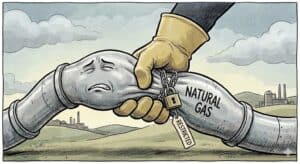 Natural gas flows along the Rover Pipeline have been cut by 387 MMcf/d (out of 3.25 – 3.4 Bcf/d) due to maintenance at the Bulger Compressor Station, which is expected to last through the end of the month, curbing Appalachian takeaway capacity to the Midwest and Canada. Additionally, the MarkWest Harmon Creek gas processing plant in Washington County, PA, is reported to be offline due to this work.
  On Monday, President Donald Trump invoked the Defense Production Act (DPA) to channel federal funding toward domestic energy projects, specifically targeting liquefied natural gas (LNG), petroleum, coal power, and grid infrastructure. Empowering the Energy Department to bypass regulatory and financial hurdles, the move aims to curb rising electricity and gasoline costs ahead of the midterm elections while meeting surging power demands from the AI industry.
  Oberlin, Ohio, officials are weighing a proposal to amend the city’s Community Bill of Rights to allow Dominion Energy Ohio to build a gas pipeline connection to a planned eco-industrial park, unlocking possible state support. Environmental groups and students at Oberlin College (neither of which pay any property or income taxes in Ohio, meaning they don’t have a say) argue the change would weaken Oberlin’s anti-fossil-fuel commitments and revive ties to Enbridge, whose NEXUS pipeline previously “divided” the city. City officials and utility experts counter that renewables alone are not yet feasible, citing constraints on electric capacity and on wind, solar, and geothermal options.
  Connecticut gubernatorial candidate Betsy McCaughey (Republican) has sued New York Governor Kathy Hochul (Democrat), alleging a violation of the Interstate Commerce Clause for blocking the Constitution Pipeline. McCaughey claims Hochul’s actions prevent cheaper Marcellus Shale natural gas from reaching New England, thereby increasing Connecticut’s electricity rates. McCaughey, who lives in Greenwich, claims legal standing to sue as a consumer and ratepayer. The lawsuit, filed in U.S. District Court, aims to force New York to allow construction of the pipeline, which she argues would provide Connecticut residents with more affordable energy. Do-nothing Governor Ned Lamont (lifer Democrat, running for a third term) dismissed the suit as a political stunt.
 As we report in today’s lead story, Williams held a groundbreaking ceremony for the Transco Northeast Supply Enhancement (NESE) project in New York City yesterday (see Groundbreaking Ceremony for NESE Pipe in NYC an All-Star Event). One of the speakers at the event, the master of ceremonies, was Williams CEO Chad Zamarin. One of the comments he made at the event that deserves its own post here on MDN was news about the Constitution Pipeline project, a 124-mile greenfield pipeline from the Marcellus gas fields of Susquehanna County, PA, to Schoharie County, NY, to move Marcellus gas into New York State and New England.
  As we reported last week, anti-fossil fuel fanatics haven’t given up on trying to block construction of the Williams Northeast Supply Enhancement (NESE) pipeline, a $1 billion+ project designed to increase Transco pipeline capacity and flows of Marcellus gas heading into New York City and other northeastern markets (see
  We spotted an interesting article that posits Williams’ strategy is to expand its mighty Transco natural gas pipeline system by increasing the capacity of existing infrastructure rather than building new pipelines. The Transcontinental Gas Pipe Line (Transco) is the largest-volume, highest-capacity interstate natural gas transmission system in the U.S. It spans roughly 10,000 miles (with 60+ compressor stations) from the Gulf Coast (Texas/Louisiana) to New York City. The Williams strategy of expanding Transco rather than building new pipes minimizes disruption to communities and the environment while meeting growing demand from residential, commercial, industrial, and power generation sectors.
  Williams Companies is breaking ground tomorrow on the Northeast Supply Enhancement (NESE) pipeline in Brooklyn — the first new pipeline in New York in over a decade — signaling a broader national natural gas infrastructure boom. Driven by AI data center power demand, LNG export growth, and population expansion, the U.S. is tracking over 150 pipeline projects representing roughly 150 Bcf (billion cubic feet) of daily capacity.
  Here’s something you don’t hear about often: A Democrat who supports fossil energy and pipelines. It’s especially noteworthy when the Democrat is the former head of the Democratic Party in Pennsylvania. In an eloquent guest editorial published in the Harrisburg Patriot-News, T.J. Rooney, former Chairman of the PA Democratic Party and a former member of the PA House, discusses (bemoans the fact) that it’s next to impossible to build a new natural gas pipeline in the Keystone State. He makes a full-throated plea for permitting reform to change that.
  Fervo Energy and Youngstown, OH-based Vallourec announced a five-year supply agreement, potentially worth up to $800 million, to scale domestic geothermal infrastructure in the United States. Vallourec will exclusively supply Fervo with U.S.-manufactured tubular solutions (pipelines) and pipeline connectors, creating a fully domestic supply chain for critical geothermal well infrastructure. This collaboration aims to reduce supply chain risks, improve project timelines, and ensure cost certainty for Fervo’s deployment of standardized 50 MW geothermal units, leveraging Vallourec’s expertise in tubular solutions. Here’s the cool part: the pipelines and connectors Vallourec will manufacture for Fervo’s geothermal work were originally developed for shale energy applications.
  In July 2024, EQT Corporation closed on a $5.4 billion deal to buy back the midstream division it had spun off in 2018 (see