
Williams: Winter Storm Fern Underscores Need for Constitution Pipe
 Pipeline giant Williams is going on a PR offensive to pressure New York State to approve the 125-mile (99 miles in NY) Constitution Pipeline from the prolific gas fields of Susquehanna County, PA, into and through New York State, to Schoharie County, where it would connect with two other interstate pipeline systems to flow molecules to New York City and New England. On its blog site, Williams recently published a post titled “Winter storms underscore why infrastructure is needed,” with the subtitle “Severe cold underscores need for Constitution Pipeline.” Read More “Williams: Winter Storm Fern Underscores Need for Constitution Pipe”
 Last September, MDN told you that two major Kinder Morgan pipeline projects that will flow Marcellus/Utica molecules in the southeastern U.S. took a big step forward at the Federal Energy Regulatory Commission (FERC) with FERC actively working on an environmental impact statement (EIS) for both projects (see
  About six years ago, Dominion Energy announced the River Neck to Kingsburg project, a short 15-mile 16-inch natural gas transmission main line that would run in an existing right-of-way alongside another pipeline along Old River Road near Pamplico in Florence County, SC. It was supposed to be built and flowing in 2022. Dominion still hasn’t built a square inch, thanks to the lawfare launched by the anti-fossil fuelers of the Blue Ridge Environmental Defense League (see
  Reverting back to true form by obsequiously bowing to environmental extremists, New York Governor Kathy Hochul ordered her lapdogs at the state Department of Environmental Conservation (DEC) to log an objection with the Federal Energy Regulatory Commission (FERC) to a request by Williams to resurrect the Constitution Pipeline project. Even though Hochul bartered a deal with President Trump to allow this pipeline (see
  Winter Storm Fern triggered a sharp decline in U.S. LNG feedgas demand, which plummeted to 11.5 Bcf/d on Sunday from a previous weekly average of 17.2 Bcf/d. The storm caused production freeze-offs and price spikes, forcing Elba Island to shut down, and Cove Point inflows fell below 0.2 Bcf/d. Sabine Pass and Freeport (along the Gulf Coast) were down 50% and 30%, respectively.
 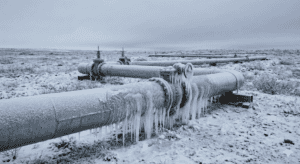 We’ve recently begun to highlight flow restrictions along pipelines that carry Marcellus/Utica molecules. When flows slow or stop (can’t reach other markets), the price typically falls because supply exceeds demand. But sometimes, the opposite happens. If pipelines are restricted due to outages and freeze-offs (as is happening right now with Winter Storm Fern), the supply of natural gas is diminished, leaving insufficient supply to meet increased demand due to the cold weather. When that happens, spot prices for natural gas soar. Wood Mackenzie reported that natural gas freeze-offs across the country reached a single-day high of 17 billion cubic feet (Bcf) on January 25th, approaching the record 18 Bcf set during Winter Storm Uri, as an intense Arctic weather system sweeps across the United States. What about the situation in the M-U?
  Last November, Accomack County, Virginia, secured a $6.5 million state grant to expand piped natural gas to the Eastern Shore, a move aimed at stabilizing the local economy (see
  Gulf South Pipeline Company, a subsidiary of Boardwalk Pipelines, announced the launch of an open season for new natural gas storage capacity at its flagship Petal Gas Storage complex in Mississippi. In addition to the Petal open season, Boardwalk also highlighted significant expansion potential across two cornerstone assets: Choctaw Storage in Louisiana and the Midland Storage Complex in Kentucky. All three storage facilities are used to store Marcellus/Utica molecules.
  Last week, the EPA proposed a new rule (copy below) to restrict states’ and Native American tribes’ ability to block major projects, such as pipelines and data centers, by abusing the Clean Water Act. By narrowing Section 401 reviews to focus solely on direct water pollution, the Trump administration seeks to accelerate fossil fuel infrastructure and AI development through increased regulatory predictability. This move reverses Biden-era policies that allowed for never-ending environmental evaluations. While administration officials argue these constraints prevent unnecessary delays, environmental radicals contend the proposal undermines local authority to protect drinking water and ecosystems. A final rule is expected this spring.
  In November of last year, both New York and New Jersey issued the required federal water permits for the Williams Transco Northeast Supply Enhancement (NESE) natural gas pipeline project (see
 Last summer, Texas Eastern Transmission Pipeline Company (aka TETCO, owned by Enbridge) filed to build the Appalachia to Market III Project, abbreviated A2M III (see
 Iroquois Gas Transmission’s Enhancement by Compression (ExC) project would increase horsepower at three compressor stations — two in New York and one in Connecticut — by an extra 125 MMcf/d, to flow more Marcellus/Utica gas into New York City and New England. The two NY compressors are in Dover and Athens. The CT compressor is located in Brookfield. In September, we told you that the Sierra Club paid for a fake study bashing the Connecticut portion of the project (see
  Another new (to us) pipeline project in the Southeast with the potential to flow Marcellus/Utica molecules. We recently became aware of Enbridge’s Texas Eastern Line 31 Expansion Project. The project is designed to expand the capacity of the Texas Eastern (TETCO) interstate natural gas system in Madison County, Mississippi. The current proposal (not yet officially filed with FERC) includes approximately 10.2 to 11.5 miles of 36-inch-diameter pipeline looping, a 1.7-mile delivery lateral, and the construction of the new Ridgeland Compressor Station. The project is expected to provide between 125,000 and 160,000 dekatherms per day (Dth/d) of additional natural gas transportation capacity, primarily intended to serve Entergy’s proposed Ridgeland Advanced Power Station (gas-fired power station) in Madison County.