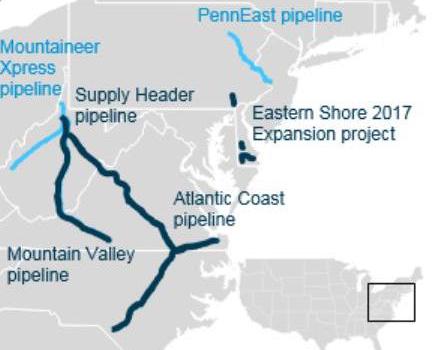
Franklin County, VA Interconnect with MV Pipe “One Step Closer”
 Earlier this week the Franklin County (VA) Planning Commission voted 5-0 to allow Roanoke Gas Co. to build and operate a “gate station”–a connection to the under-construction Mountain Valley Pipeline (MVP). Roanoke Gas is laying new pipelines in the area and needs natgas to feed its new customers. Antis showed up at the meeting (what’s new?) to complain and threaten and moan and whine. They actually tried to say there is no “public benefit” for MVP, and that this gate station is simply a ruse to give the appearance of a public benefit.
Read More “Franklin County, VA Interconnect with MV Pipe “One Step Closer””

 On Tuesday, Enbridge, owner of the Texas Eastern Transmission Company (Tetco) Pipeline, announced it has put part of its Texas Eastern Appalachian Lease (TEAL) natural gas pipeline project in Ohio into service. TEAL boosts capacity along Tetco by 950 million cubic feet per day (MMcf/d), to flow Marcellus/Utica gas to the recently-completed-but-not-yet-online NEXUS pipeline (see
  Our country sacrifices a lot on the altar of so-called safety. Crises are often used as an excuse for “the government” to use a heavy hand in controlling people and actions they (“the government”) deem a threat. Usually it’s a threat to their power. But the justification offered by the government is to protect the well-being of the citizenry. And the citizenry, convinced they are in mortal peril, is only too happy to yield their hard-won rights as free citizens–in the name of “safety.” It’s happening again–this time in the People’s Republic of Massachusetts, where unelected regulators have ordered a private business, National Grid, to cease all work on its natural gas pipeline system following a minor incident of too much pressure.
 More bad news for EQT Midstream’s Mountain Valley Pipeline (MVP). Last week the U.S. Court of Appeals for the Fourth Circuit overturned a permit issued by the U.S. Army Corps of Engineers for MVP in West Virginia (see
  Williams is expanding its mighty, 10,500-mile Transcontinental Gas Pipe Line Co (Transco), again. Sometime this month Williams will prefile a request with the Federal Energy Regulatory Commission for the Leidy South expansion project. The new project will bump up “compression” (either build new compressors or refit existing compressors) and build new “looping” pipeline in Pennsylvania, in order to increase capacity of Transco in the northeast Marcellus region by another 580 million cubic feet per day (MMcf/d).
 The actions of political leaders have consequences. Sometimes dire consequences. People like New York Gov. Andrew Cuomo believe they can wave a magic wand and proclaim, “No more fossil fuels, we’ll just use solar and wind instead.” But proclaiming it doesn’t make it so. Proclaiming it doesn’t exempt you from the consequences of your actions. In recent years Cuomo has blocked new natural gas pipeline projects that would deliver Marcellus gas from Pennsylvania, claiming we need to move to so-called renewable energy. Now the chickens have come home to roost.
 We’re feeling better and better that President Trump is ready to take action to overrule states like New York that abuse the federal Clean Water Act in order to block interstate pipeline projects. We first picked up on comments by Energy Secretary Rick Perry back in May (see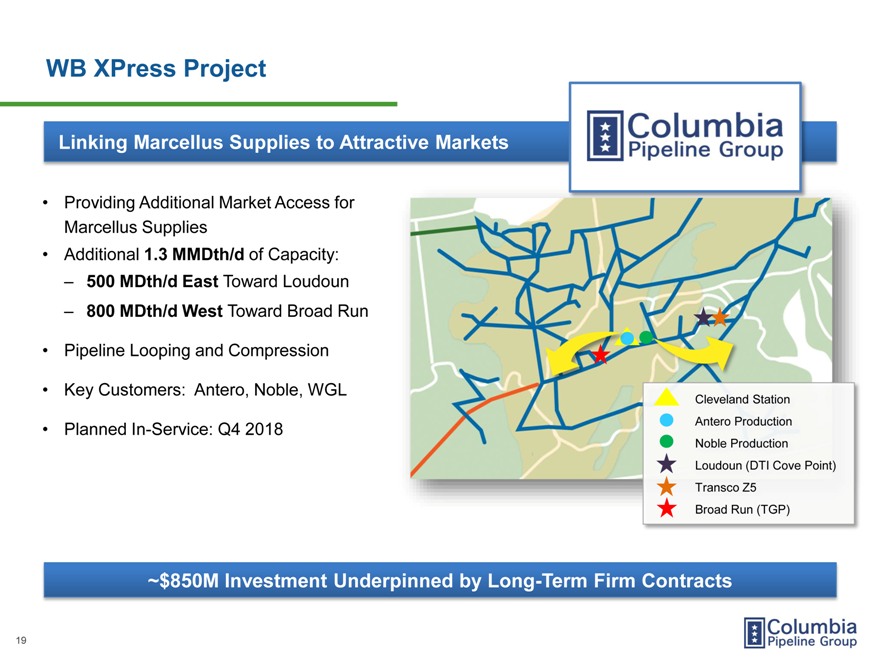
 We’ve seen this movie before. The U.S. Court of Appeals for the Fourth Circuit (quickly becoming the Fourth Circus) has once again listened to the arguments of anti-fossil fuel groups including the Sierra Club and Chesapeake Climate Action Network and has overturned a recently re-issued permit that allows Mountain Valley Pipeline (MVP) to use certain methods to build the pipeline across streams and rivers in West Virginia. The court action pretty much shuts down all work on MVP in WV.
 It seems like we’ve been waiting forever for new pipelines to get built to flow Marcellus/Utica gas to new markets where our gas can fetch higher prices. Finally, with projects like Rover, NEXUS, Atlantic Sunrise and others, forever is here. Our gas is now flowing, or soon will, to markets in the Midwest, South, Gulf Coast, and even via exports to other countries. The experts at RBN Energy have an ongoing series that covers M-U pipelines and how our gas is heading to new markets. RBN says in their most recent post in this series, “in some ways the Northeast really is just getting started.” There are plans for another 10 billion cubic feet per day (Bcf/d) to flow out of here and to other markets by 2023. Where and how?
 We’ve lost track of how many lawsuits have been filed by anti-fossil fuel groups against EQT Midstream’s Mountain Valley Pipeline (MVP), and Dominion Energy’s Atlantic Coast Pipeline (ACP). Among the flood of never-ending lawsuits was a lawsuit against both pipelines from a group of 50 or so landowners who tried to overturn the constitutional use of eminent domain to force hold-out landowners to accept the pipeline. The landowners tried to court-shop and find a court to aide them in their cause. Last Friday the U.S. District Court for the District of Columbia rejected that effort.
 Environmentalists who buy into the fairy tale of man-made global warming have a new tool to force their will on the American people: Get liberal governors to abuse state review authority granted to them under the federal Clean Water Act (CWA) in order to block federal pipeline projects. NY Gov. Cuomo was one of the first to bastardize the intent of the CWA in this fashion. It is a hijacking of the CWA and its intended purpose–and it must stop.