
Rover Pipeline Loses Ohio Supreme Court Decision to Lower Tax Bill
 Rover Pipeline, a 713-mile natural gas pipeline, was designed to carry up to 3.25 billion cubic feet per day (Bcf/d) of Marcellus and Utica gas from Pennsylvania, West Virginia, and Ohio to destinations in Ohio, Michigan, West Virginia, and Canada. The project was completed and came online in late 2018 (see FERC OKs Final 2 Rover Pipeline Laterals – Now 100% Online). Rover’s original estimated cost to build the project was $4.08 billion. It ultimately cost $6.3 billion, as historically high rainfall led to additional unforeseen expenses, delays, and inspections. Most of the pipeline runs through Ohio, which assesses a property tax on such projects. Rover and Ohio disagree over the value to be assigned to the pipeline for annual taxation purposes. After several appeals, the case headed to the Ohio Supreme Court in May (see Rover Pipeline Heads to Ohio Supreme Court to Lower Tax Assessment). The Supremes issued their ruling yesterday, and it didn’t go Rover’s way. Read More “Rover Pipeline Loses Ohio Supreme Court Decision to Lower Tax Bill”
 In 2018, Equitrans Midstream, the builder of the 303-mile Mountain Valley Pipeline (MVP), proposed to extend MVP by an extra 75 miles from the current terminus in Pittsylvania County, VA, to Alamance County, NC, to provide natural gas for heating and electric generation. The 75-mile extension is called MVP Southgate. In December 2023, MVP changed the Southgate plan by cutting the distance by more than half and bumping up the size (diameter) of the pipeline (see
  In April, MDN told you about a new greenfield expansion of the Elba Express pipeline into South Carolina to serve growing demand for natural gas in the state (see
  We first told you about a frac sand company called Smart Sand some 13 years ago (see
 Last week, the Baker Hughes U.S. rig count continued its downward trend, losing another rig to end at 539 active rigs nationwide. The count has been down 14 of the last 15 weeks, with the only slight increase happening a month ago. The Marcellus/Utica count remained the same (after gaining one rig three weeks ago) at a combined 36 active rigs. PA is running 18 active rigs. OH is running 11 rigs. And WV is operating 7 rigs. There were 24 rigs targeting the Marcellus and 12 rigs targeting the Utica last week.
  George Soros-backed Big Green groups are not happy with New York Governor Kathy Hochul and her concession to Donald Trump to allow new pipeline projects to proceed in the state (see
  The two U.S. companies that export ethane, Energy Transfer and Enterprise Products Partners, are both saying that the Trump administration’s temporary block on shipping ethane to China in June gave our export industry a black eye, and China is much less likely to contract for more of our ethane shipments. (Cue the violins.) However, when you consider that China buys half (50%) of our ethane exports, and that ethane exports represent a good chunk of revenue for both companies (both with operations in the Marcellus/Utica), it’s not nothing.
  The parents of four children under the age of 18 (from three families) filed a lawsuit on their kids’ behalf against EQT subsidiaries EQT Production Company and EQT XL Midstream Operating, claiming that emissions from a nearby compressor station and nearby shale wells operated by EQT have led to severe health-related problems for the kids. The families used to live in the rural hamlet of Knob Fork in Wetzel County, WV. They all have since moved. The lawsuit seeks unspecified damages and money for ongoing monitoring of the kids’ health.
 Pipeline giant Williams issued its second quarter 2025 update yesterday. Williams is a huge company with many fingers in many pies. Of greatest concern to us are those projects that will flow Marcellus/Utica molecules. The big news of the day was that Williams has officially signed up customers for the Northeast Supply Enhancement (NESE) project, which triggers a series of next actions. Primarily, the company expects a reissued certificate for the project from the Federal Energy Regulatory Commission (FERC). CEO Chad Zamarin answered a question about timing and stated that he expects a water permit from New York State to be issued “in the next few months.” That’s sure to spark protest from antis! Also of note: the Transco pipeline hit a new all-time flow rate on July 29 of 16.1 Bcf/d.
  As we mentioned in two different posts today (about the 2Q updates from Coterra and Williams), the Constitution Pipeline project is currently not a top priority for Williams. In fact, Williams’ management didn’t even mention the project during their update. Coterra management did mention it as one of the “top-of-mind” projects for them, but acknowledged that another project, the Northeast Supply Enhancement (NESE) pipeline project, is currently the focus for Williams. Coterra and Williams *might* want to talk to President Trump, because the Constitution project is a big, fat priority for him. Yesterday, Trump’s EPA Administrator, Lee Zeldin, published a major “we need the Constitution Pipeline and we need it now” op-ed in the Boston Globe.
  Leatherstocking Gas Company, a subsidiary of Corning Energy Corporation, runs gas mains to residents and businesses in small, mainly rural communities in northeastern Pennsylvania (see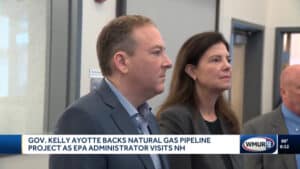
 National Fuel Gas Company (NFG), headquartered in Buffalo, NY, is the parent company for Marcellus/Utica driller Seneca Resources and the parent of midstream company NFG Midstream (and subsidiary Empire Pipeline). Last week, NFG issued its latest quarterly update, which is the company’s fiscal 3rd quarter (but everyone else’s 2nd quarter). The update was loaded with good news for Seneca and NFG’s midstream sector. We learned that the company has been retained to build a 7-mile pipeline expansion off the company’s Line N system in Western PA, called the Shippingport Lateral Project, to feed natural gas to the Shippingport Power Station, announced in July (see