
New Fortress Energy Exits Restructuring; What Now for Wyalusing?
 Back in March, MDN told you that New Fortress Energy (NFE) had entered a voluntary UK Restructuring Plan — the British cousin of a U.S. prepackaged bankruptcy (see New Fortress Energy Enters UK Equivalent of Prepackaged Bankruptcy). Six months later, it’s done. NFE announced last Friday that the restructuring is complete, the Brazilian business has been cut loose, and roughly $5.7 billion of debt has been wiped off the books. The company that walks out the other side is a much smaller animal than the one that walked in. And here’s the part that ought to interest Marcellus watchers: when CEO Wes Edens listed off what “New NFE” actually owns now, Pennsylvania didn’t make the list. Read More “New Fortress Energy Exits Restructuring; What Now for Wyalusing?”
 Pittsburgh-based Alcoa says it’s “very close” to selling its shuttered Massena East aluminum smelter in New York’s North Country to a data center developer. Here’s the part that other reporting left out: the buyer has been sitting on that site since 2017, wants to build a 635-megawatt (MW) computing campus there — and Gov. Kathy Hochul froze the whole thing two months ago with her data center moratorium (see
  National Fuel Gas Company (NYSE: NFG) released its 2025 Corporate Responsibility Report last Wednesday, and the most newsworthy part never made the press release. Buried on page 22 — and repeated on page 25 — is NFG’s announcement that it has discontinued its consolidated absolute greenhouse gas emissions reduction target. The company is keeping its segment-level methane intensity targets and will keep publishing absolute emissions numbers. But the corporate-wide “cut total tons” pledge is gone.
 Eastern Gas Transmission and Storage (EGTS), a wholly owned subsidiary of Berkshire Hathaway Energy (Warren Buffett’s company), got the last piece of paper it needed yesterday for an important new pipeline project. FERC’s Office of Energy Projects issued a notice to proceed (NTP) on Sept. 10, authorizing EGTS to start building the Appalachian Reliability Project (ARP) — the 550,000 dekatherms/day expansion that will push more Marcellus and Utica gas from western Pennsylvania into Ohio. Even better, the approval comes in roughly six months ahead of the company’s own published timeline.
 Duke Energy just handed Marcellus/Utica producers something more useful than another press release. It handed us a calendar. Back in July we told you Duke had picked its sites: two 1,360-megawatt (MW) combined-cycle gas plants on its Davie County, North Carolina parcel, and the largest liquefied natural gas (LNG) storage facility in company history directly across the Yadkin River in Davidson County (see
  Round and round she goes. Yesterday Shell Energy North America (SENA) announced it is doing two deals at once: selling the 609-megawatt (MW) Rhode Island State Energy Center (RISEC) near Providence to Constellation Energy for $715 million, and buying the 169-MW Hunlock Creek Energy Center in Luzerne County, Pennsylvania, from Castleton Commodities International (CCI). Shell has owned the Rhode Island plant for all of about 20 months. CCI has owned Hunlock Creek for two years. Both deals are expected to close in the first quarter of 2027, pending the usual regulatory blessings.
  A month ago, we took a press release that pointedly refused to name a county, did some division on a tax-assessment number buried in the fine print, and concluded that Alpha Compute Corp.’s (Nasdaq: ALP) proposed 200-megawatt gas-fired AI data center was headed for Tioga County (see
  The U.S. Energy Information Administration (EIA) dropped its September Short-Term Energy Outlook (STEO) yesterday, and for once the natural gas headline numbers barely budged. Henry Hub is forecast at $3.43/MMBtu for 2026 and $3.28/MMBtu for 2027 — a penny and three cents below last month. After August’s 23-cent haircut, that’s practically a rounding error. The interesting stuff this month isn’t in the price line. It’s in the regional production tables, where EIA lays out exactly who is growing and who isn’t. Spoiler: it’s the same story as last month, only now EIA has put hard numbers on it.
  Accounting giant Ernst & Young dropped its annual reserves benchmarking study yesterday, and while the press release leads with oil, the real story for our part of the country is buried in the tables: EQT is now the largest holder of proved natural gas reserves in the United States, and Appalachian-focused producers control roughly a third of all the gas reserves booked by America’s 30 biggest publicly traded drillers.
  Last week we told you Dominion Energy cleared its first hurdle for the monster 3,000-megawatt (3 gigawatt) Cumberland Energy Center in Cumberland County, Virginia (see
  Virginia Democrats have spent the summer hammering the proposed $67 billion NextEra-Dominion merger — letters to regulators, a 64-question interrogation, a statewide listening tour, a demand for a special session. Last week the pile-on reached the very top when House Speaker Don Scott (D-Portsmouth) filed his own letter with the State Corporation Commission (SCC). Here’s the twist: the same Democrat leaders doing the loudest complaining just refused to do the one thing that would actually slow this deal down.
 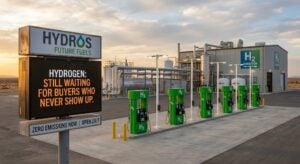 We’ve said it here more times than we can count: hydrogen has no customers. A new investigation from RealClearInvestigations, published Sept. 1, backs that up with numbers — and the picture it paints of the federal hydrogen push should worry anyone who thought ARCH2 was going to become a big new buyer of Marcellus/Utica gas. Reporter James Varney’s piece walks through what’s become of the Biden administration’s National Clean Hydrogen Strategy and Roadmap, released in June 2023. That plan promised $9.5 billion in spending would produce 100,000 jobs by 2030 and cut economy-wide emissions 10% by 2050. Three years on, the biggest single piece of it — $3 billion split between two West Coast hydrogen hubs — is frozen and tied up in court. California’s ARCHES hub says on its own website that the state has paused activities. Thirteen Democratic attorneys general sued in February to force the money out the door.
  Big Green scored a win yesterday — but not the win they’re telling you they got. On Tuesday, September 8, a three-judge panel of the U.S. Court of Appeals for the Third Circuit vacated the Clean Water Act Section 401 water quality certification (WQC) that the New Jersey Department of Environmental Protection (NJDEP) issued last November for Williams/Transco’s Northeast Supply Enhancement (NESE) project — the $1 billion, 400,000 Dth/d expansion that carries Marcellus gas from Pennsylvania, across New Jersey, under Raritan Bay, and into New York City (see