
UGI Selling Property, Partnering with Prime to Build PA Data Center
 UGI Corporation’s UGI Energy Services and Prime Data Centers yesterday announced a strategic partnership to develop natural gas supply infrastructure in Pennsylvania’s northern tier for a proposed gas-fired power facility serving future hyperscale data center operations. Under the deal, UGIES will sell Prime some of its property while retaining about 15 billion cubic feet (Bcf) of underground storage capacity and related oil and gas rights. Prime’s gas demand is expected to exceed 100,000 dekatherms per day (100 MMcf/d) within three to five years. A major new customer for PA Marcellus gas! Read More “UGI Selling Property, Partnering with Prime to Build PA Data Center”
 New research by the Commonwealth Foundation finds that Pennsylvania’s foolish pursuit of joining the Regional Greenhouse Gas Initiative (RGGI), a carbon tax scheme, led to a loss of $5 to $8 billion in energy sector investment over six years, stalling power projects and reducing electricity generation capacity. The state’s attempt to join RGGI, initiated by executive order under then-Governor Tom Wolf, was ultimately overturned by the courts and (eventually) by legislative action, citing it as an unconstitutional tax. Meanwhile, neighboring Ohio, not part of RGGI, saw an increase in energy projects, highlighting the differing regulatory environments.
  Yet another rankly hypocritical move by the Democrats in the Pennsylvania legislature. Yesterday, every single Democrat in the PA House voted in lockstep (as they typically do, under the leadership’s complete control) to pass House Bill (HB) 2076, titled “Advancing Geothermal Energy Development.” The Dems were assisted by 16 Republicans who were (charitably) hoodwinked. No matter. The bill won’t pass in the Senate. But why point out this vote? Because the “advanced” geothermal energy that the House wants to promote and regulate uses the very same drilling rigs and fracking as is used to drill in the Marcellus shale, revealing the hypocritical lies of the Democrat left in demonizing fracking. But there’s another reason we’re highlighting this news: The environmental left (including House Democrats) is seeking to increase drilling setbacks in the state from 500 feet to 3,281 feet (and, in some cases, 5,280 feet). Do the House Dems realize the new setbacks would not only ban ALL shale fracking in the state but also all geothermal fracking?
 Last week, the combined Marcellus/Utica Baker Hughes rig count remained at 37 active rigs for the sixth week in a row. The M-U’s chief competitor, the Haynesville, added two rigs and now runs 58 active rigs, some 21 more than the M-U. Clearly, drillers are choosing to put their money into the Haynesville over the M-U despite that play’s higher costs because (a) it’s closer to the Gulf Coast LNG export facilities, and (b) it’s easier to build pipelines in Louisiana and Texas than it is in the northeast. The national count added three rigs last week and now operates 547 rigs.
  The Marcellus/Utica region received 12 new drilling permits last week, Apr. 20 – 26, down 10 from the 22 permits issued two weeks ago. Pennsylvania issued all 12 of last week’s permits. Neither Ohio nor West Virginia issued any new permits. What a disappointment! The drillers who received new permits in PA last week included: Expand Energy, PennEnergy Resources, and Snyder Brothers.
 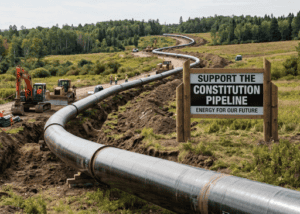 This is a critical moment for reliable, affordable energy in the Northeast, and your voice can make a difference. The Federal Energy Regulatory Commission (FERC) is currently accepting public comments on the Constitution Pipeline, representing an important step toward finally advancing this long-delayed project and a key opportunity for supporters to be heard. If you support building the Constitution Pipeline, please take a few minutes to submit a brief comment to FERC by May 4, 2026, because your input truly matters. We have instructions below on how to file a comment (it takes just a couple of minutes).
  In December, the Pennsylvania Environmental Quality Board (EQB) accepted a petition by radical green groups, including the Clean Air Council and Environmental Integrity Project, to “study” the issue of increasing setbacks for shale drilling so far that it would ban ALL new Marcellus/Utica drilling in the Keystone State, which is no exaggeration (see
  Yesterday, Pennsylvania Gov. Josh Shapiro announced $267 million in state funding for energy projects, including $31.5 million for CNX Green Ventures to capture coal mine methane at the Enlow Fork mine in Greene County. Funded through EPA Climate Pollution Reduction Grants, the RISE PA program supports industrial decarbonization. CNX plans to drill boreholes, capture methane from mine ventilation, and pipe it for processing and sale as remediated mine gas.
  Once again, Pennsylvania Governor Josh Shapiro is attacking the energy industry, this time setting his sights on utility companies that he falsely claims are “unfairly increasing their rates and needlessly raising costs for Pennsylvanians.” Shapiro has hired a radical National Resources Defense Council (NRDC) attorney to serve as his lapdog (Special Counsel for Energy Affordability) to attack utility companies, forcing them into bankruptcy, particularly by pressuring them to use unreliable renewables instead of cheaper fossil fuels.
  In March, the Trump administration announced “South Mon,” a $17 billion natural gas-fueled facility in southwestern Pennsylvania intended to expand domestic energy production (see
  The highly functional and responsible Susquehanna River Basin Commission (SRBC), unlike its dysfunctional and irresponsible counterpart, the Delaware River Basin Commission (DRBC), continues to support the shale energy industry by approving water withdrawals and consumptive use requests for responsible, safe shale drilling. The SRBC published a notice in the April 25th Pennsylvania Bulletin that the Executive Director of the SRBC approved and/or renewed 46 general water use permits in March for individual shale gas well drilling pads in Bradford, Clinton, Elk, Lycoming, Sullivan, Susquehanna, Tioga, and Wyoming counties.
  The Pennsylvania Department of Environmental Protection (DEP) is seeking public comment on an Individual Stormwater Permit for a 5.8-mile natural gas pipeline in Indiana County. Serving the proposed Homer City Generation LP 4.5 GW power plant and data center, the 30-inch pipeline will traverse Black Lick, Burrell, and Center Townships, involving several stream and wetland crossings. The DEP will host a public hearing on May 12 from 5 to 7 PM at the Indiana Theater regarding Homer City Generation’s proposed 5.8-mile natural gas pipeline in Center Township. In response to this new project, local anti-fossil fuel groups are actively mobilizing. So-called “Concerned Residents of Western PA” (CROW) is holding a preparation meeting this afternoon to help “citizens” draft their public comments and build speaking confidence.
  EQT Corporation delivered its latest quarterly update yesterday for the first quarter of 2026. EQT sees the materialization of “in-basin demand growth” improving Appalachian market conditions through the end of the decade. The company says it is positioned as a preferred partner for large-scale power, midstream, and data center projects in the region. EQT plans to continue drilling and completing a significant number of wells throughout 2026, indicating ongoing development in the Marcellus and Utica regions. However, the company is curtailing (restricting) 10-15 Bcf (billion cubic feet) of production during the second quarter due to current low prices.