
Mass. Gov. Again Changes Story re Blocking Two NatGas Pipelines
 In 2022, then-Massachusetts Attorney General (now Governor) Maura Healey bragged she had “stopped two gas pipelines from coming into this state” and that she opposes new natgas infrastructure in the state. Her claim is captured on video. A few months ago, Healey said she has “never stopped gas pipelines from entering the state” and that natural gas is an essential energy source in Massachusetts. She was roundly criticized by Democrats and Republicans alike as gaslighting the issue (see Gaslighting Mass. Governor Says She’s Never Blocked Pipelines). Healey is once again changing her story. She now admits that she *did* stop the pipeline projects, but she did so because they were a “lousy deal” for ratepayers in the Bay State. Talk about desperate. Read More “Mass. Gov. Again Changes Story re Blocking Two NatGas Pipelines”
 MDN was among the first to tell readers that so-called environmental groups were quickly morphing from anti-fracking to anti-data center. Over the past several months, we’ve observed in various posts how opposition to data centers (from the same people who oppose fracking and shale energy) has gone from local and regional anti groups (see
 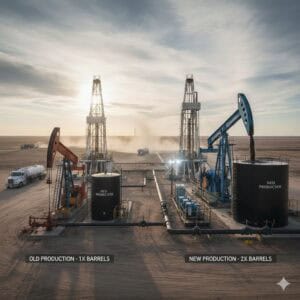 The U.S. shale industry is shifting its strategy from rapid drilling to maximizing recovery from existing wells. With the era of high-growth production ending, operators are increasingly focused on improving recovery rates, which currently average only 10% for oil. Companies like EOG Resources and Occidental Petroleum are utilizing advanced technologies, including EOR techniques like “huff ‘n’ puff” gas injection and data-driven fracking, to extract more resources from mature fields. This transition toward efficiency and capital discipline aims to extend the lifespan of inventory and boost profitability, signaling a move from “shale growth” to “shale sustainability” in a maturing market.
  MARCELLUS/UTICA REGION: Time to reconsider a NY Climate Act press release; Don’t believe Kathy Hochul’s all-too-cute claims to have U-turned on climate; OTHER U.S. REGIONS: Wisconsin Senate scrutiny highlights growing concerns over Bloomberg SAAG program; Judge rules Michigan can’t shut down Line 5 pipeline in Straits of Mackinac; Lingering pessimism, uncertainty further weigh on oil and gas activity; One state’s drive to slash GHGs slams into reality, a warning to others; NATIONAL: U.S. natural gas gains ahead of storage data; Short-covering lifts natgas prices today — is it just a pause?; Rinse & repeat research fails to link gas stoves and asthma…again; INTERNATIONAL: Crude climbs as US threatens Russian and Venezuelan flows; USA readies new Russia sanctions if Putin rejects deal; Trump orders blockade of sanctioned oil tankers in Venezuela; O’Neill leaves Woodside to become BP CEO; Netanyahu announces $34.7 billion natural gas deal with Egypt; Europe’s ‘green’ emperor is naked and cold.

 In early September, MDN told you about the news that Enbridge had made a final investment decision (FID) for the Algonquin Reliable Affordable Resilient Enhancement (AGT Enhancement) project to flow an additional 75 million cubic feet per day (MMcf/d) of Marcellus/Utica molecules through the Algonquin Gas Transmission pipeline throughout New England and the northeast (see
 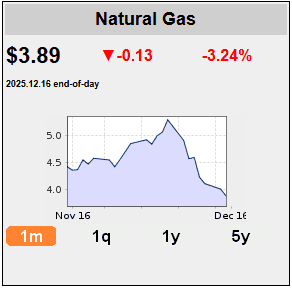 You knew it had to happen. After the meteoric rise of the NYMEX “front month” futures contract from bumping along under $3 just a couple of months ago to hitting a 52-week high of $5.289 on Friday, Dec. 5, 2025, the drop has been almost as rapid. We first crashed back into the $4 range, and as of yesterday, the price sank below $4, closing at $3.8860. The stated reason is a warm weather forecast for the rest of this month. The NOAA Climate Prediction Center (what an oxymoron that is!) shows that the vast majority of the country will experience much warmer-than-average temperatures through Dec. 30.
  In October, we told you that completion of Ohio State University’s Combined Heat and Power Plant (powered with Utica Shale gas) would be delayed until April 2026 (see
  In June, Duke Energy announced that it plans to apply to the Public Service Commission of South Carolina (PSCSC) to build a 1,400 megawatt gas-fired power plant in Anderson County (see
  U.S. Secretary of Energy Chris Wright yesterday signed an amendment order granting an additional 44 months for Woodside Energy to commence LNG exports to non-FTA countries from the Woodside Louisiana LNG Project under construction in Calcasieu Parish, LA. The project was formerly called Driftwood. Once fully constructed, the project will be capable of exporting up to 3.88 billion cubic feet per day (Bcf/d) of natural gas as LNG.
  The bidding war is heating up for those interested in buying Ascent Resources, a privately held company focused 100% on the Ohio Utica Shale. Ascent is Ohio’s largest natural gas producer and the 8th largest natural gas producer in the U.S. Kimmeridge Energy, a private investment firm focused on the energy sector (sometimes called an “activist investor” and/or corporate raider), has put an offer on the table to buy out and take over Ascent: $6 billion. This is the first hard number we’ve seen since the whole bidding war began last week.
  In early April, MDN brought you the exciting news that pipeline giant Williams, via its newly-minted subsidiary, Will-Power, is planning to build two Utica/Marcellus gas-fired power plants in the New Albany International Business Park in Licking County, Ohio, near Columbus, to power a massive new Meta (Facebook) data center complex (see
  Pipelines in West Virginia (like most other states) pay property taxes. It’s a significant revenue generator for counties. There are many pipelines in Wetzel County, including three NGL pipelines owned and operated by MarkWest (aka MPLX) that connect to the Mobley Gas Plant. In 2022, MarkWest filed a tax return for the pipelines showing a 35% reduction in value due to less-than-forecasted pipeline usage, a concept called “economic obsolescence based on inutility.” The County Assessor for Wetzel County challenged MarkWest’s claim.
 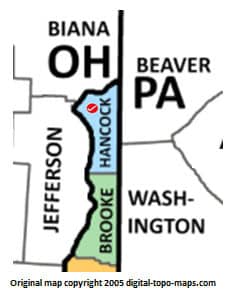 Hancock County, WV, is located in the tippy top of the northern panhandle of West Virginia, surrounded by Pennsylvania on one side and Ohio on the other. Yet somehow Hancock County has been left out of the Marcellus/Utica bonanza happening all around it. It’s not like there isn’t good rock under Hancock. Every other county that touches Hancock has drilled M-U wells within the last year. However, we can’t find any permits for a single shale well in Hancock. Ever. What gives?