
Anti-Drilling/Fossil Fuel | Coterra Energy (Cabot O&G) | Energy Companies | Industrywide Issues | Litigation | Pennsylvania | Susquehanna County
Dimock, PA Landowners Paid $5K/Mo by Green Groups to Bash Cabot
 A startling revelation came from yesterday’s court hearing in the tiny village of Montrose, PA. Some of the landowners from Dimock, PA who have traveled around the country claiming their water had been contaminated by Cabot Oil & Gas (remember the fraud “documentary” called Gasland?) were actually paid up to $5,000 *per month* by green groups to spread their lies.
Read More “Dimock, PA Landowners Paid $5K/Mo by Green Groups to Bash Cabot”

 The pressure is mounting on New York Gov. Andrew Cuomo with regard to blocking natural gas pipelines. Except now the pressure is coming from the adults in the room who see through Cuomo’s sleazy politics. None other than the editorial board of the Wall Street Journal has ripped into Cuomo, calling his blockade of new pipelines the equivalent of a “cold weather tax”–not only on New Yorkers, but also those living in New England.
 Ethane exports came from nowhere, dead zero, three years ago and took off like gangbusters until mid-last year, in no small part because of Marcellus/Utica ethane exports coming from the Marcus Hook refinery near Philadelphia. But part of the way through last year those exports began to decline–and not because of lack of ethane flowing through the Mariner East pipelines. Nope. They declined due to lack of demand.
 When people communicate, that’s a good thing. When a shale well “communicates” with nearby conventional wells, that’s a bad thing. And that’s what happened with a CNX Resources Utica well being fracked in Westmoreland County last week.
 A huge crack of sunshine has just shown through the court system with respect to pipeline projects. A case decided on Jan. 25 in the DC Circuit Court of Appeals which technically has nothing to do with either the Williams Constitution Pipeline project nor the National Fuel Gas Company Northern Access Pipeline project (both being blocked by New York State), may be the one court decision to break open the logjam and allow both projects to begin construction.
 Speaking of National Fuel Gas Company’s Northern Access Pipeline project, NFG asked the Federal Energy Regulatory Commission (FERC) last November to extend the project timeline by an extra three years, to give them more time to fight with Cuomo in court and actually get the pipeline built once lawsuits from the state are exhausted (see
  In November, Dominion Energy said that their 600-mile Atlantic Coast Pipeline (ACP) would be delayed, with a partial startup in 2019 and full startup for everything else in mid-2020 (see
  The Pennsylvania Chamber of Business and Industry (PA Chamber) recently filed a brief in Commonwealth Court opposing THE Delaware Riverkeeper in a case that still has us angry and baffled. The case brought by Riverkeeper is clear across the state, hundreds of miles from the Delaware River Basin where Riverkeeper supposedly operates, and attempts to force a local municipality to adopt zoning ordinances it doesn’t want to adopt. And it involves Martians.
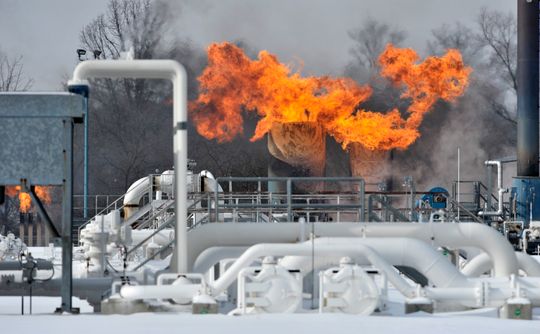 Last week a pipeline at a single Michigan compressor station caught fire and exploded (see
  Yes, we told you so. We told you that if our friends in PA were to unwisely reelect Tom Wolf for a second (and thankfully final) term as governor, he would continue to fight for a Marcellus-killing severance tax each and every year of his ignominious second term. Democrats (and some Republicans) just can’t keep their hands off other people’s money–it’s in their DNA.
 In November the Pennsylvania Supreme Court agreed to hear a case, Briggs v. Southwestern Energy, that is hands-down the most important court case to ever happen regarding the Marcellus Shale in PA. And no, we’re not exaggerating. A blizzard of briefs by Southwestern and those supporting Southwestern were filed earlier this week.
 Tallgrass Energy, builder and operator of the mighty Rockies Express (REX) pipeline which is a critical link that flows Marcellus/Utica gas to Midwestern markets, dropped a bombshell announcement yesterday. The company said that investment firm Blackstone is buying a “controlling” interest in the company. Which raises the question, will Blackstone indeed “control” the company?
 The U.S. Energy Information Administration recently published its Annual Energy Outlook for 2019. Among the numbers EIA released are predictions about how much natural gas liquids (NGLs) the U.S. will produce between 2018 and 2050. EIA says production will go up 32% over that period, to 5.8 million barrels per day (b/d). Guess where most of that increase will come?
 Here’s an interesting twist on the theme of drillers shorting leaseholders out of royalty money. Usually such cases involve drillers claiming post-production deductions from landowner royalty checks. This time the landowner/rightsholder is Columbia Gas Transmission (pipeline company owned by midstream giant TransCanada), and the claim is that Southwestern Energy (driller) is not paying royalties for gas produced but not actually sold.