
Army Corps Engineers Suspends MVP Permit for River Crossings
 The radical Sierra Club is claiming a victory in temporarily stopping construction work of the Mountain Valley Pipeline (MVP) at four river crossings in West Virginia. On Tuesday the Sierra Club and a mishmash of other radicalized groups filed a motion asking the Fourth District U.S. Circuit Court of Appeals to suspend a permit issued by the U.S. Army Corps of Engineers that allows MVP to construct the pipeline across streams and rivers in the Mountain State. The Clubbers’ tortured logic is this: When construction of the pipeline across a river, the stated standard is that construction can take no longer than 72 hours. MVP says it will need longer when constructing the pipeline across four rivers–Elk, Gauley, Greenbrier and Meadow. Therefore (say the Clubbers), MVP is in violation of the general permit issued by the Corps and that means ALL (not just those four rivers) construction should be stopped, immediately. The Fourth Circuit has not yet rendered a decision, however, the Corps itself said they had reviewed the standards and have (for now) rescinded the permit as it applies ONLY to those four rivers, NOT to any locations. So it’s a partial, and temporary, victory for the Clubbers…
Read More “Army Corps Engineers Suspends MVP Permit for River Crossings”

 A recent New Hampshire Supreme Court decision may breathe new life into a natural gas pipeline project believed to be dead–or at least on life support. Spectra Energy (now owned by Enbridge) first announced an unnamed pipeline project to shuttle gas from the Marcellus/Utica to New England in July 2014 (see
  Last week MDN told you that the U.S. Fourth Circuit Court of Appeals had invalidated (vacated) a permit issued by the U.S. Fish and Wildlife Service that allows Dominion Energy’s Atlantic Coast Pipeline (ACP) to accidentally kill a few bats and bumble bees (classified as endangered) as it builds the massive $6.5 billion, 600-mile project from West Virginia to North Carolina (see
  UGI, a large utility (and pipeline) company located in Pennsylvania, has announced they will expand a northeastern PA pipeline gathering system. UGI built what they call the Auburn Gathering System between 2011 and 2015–46 miles of pipe, two compressors stations and various other pipeline related facilities located in Susquehanna, Wyoming, and Luzerne counties (near Scranton). UGI spent $215 million to build the system, a system that currently flows 470 million cubic feet per day (MMcf/d) of natural gas. Much (most?) of that the gas comes from Cabot Oil and Gas in Susquehanna County. The new news is that UGI will build two new compressor stations, adding to the existing two, which will increase flows through the system by another 150 MMcf/d–all of the increase coming from Cabot. Here’s the good news that more Cabot gas will soon flow through the Auburn System, connecting with two of the biggest pipeline systems in the country–the Tennessee Gas Pipeline (Kinder Morgan) and the Transco Pipeline (Williams)…
 New Jersey’s Attorney General, Gurbir Grewal (Democrat), and New Jersey Senator Corey Booker (also a Democrat) continue a coordinated attack on the PennEast Pipeline in an effort to appease their radical/left base of supporters. PennEast is a $1 billion, 120-mile, 36-inch pipeline from Dallas (Luzerne County), PA to Pennington (Mercer County), NJ. The Federal Energy Regulatory Commission (FERC) granted final approval for the project in January (see
  Lately we’ve wondered what’s been going on in the years-long struggle by Crestwood to create an LPG (liquefied petroleum gas, or propane) storage facility in a depleted salt cavern along the shoreline of Seneca Lake in the Finger Lakes region of Upstate New York. Last December we brought you the news that Crestwood had won a victory when a chief administrative law judge, part of the state Dept. of Environmental Conservation (DEC), ruled against antis who are demanding ongoing, never-ending hearings about the project–a transparent tactic to continue the years-long delay in perpetuity (see
  On April 22, the LNG tanker Sakura left Dominion Energy’s Cove Point LNG export facility loaded with Marcellus molecules, heading for Japan (see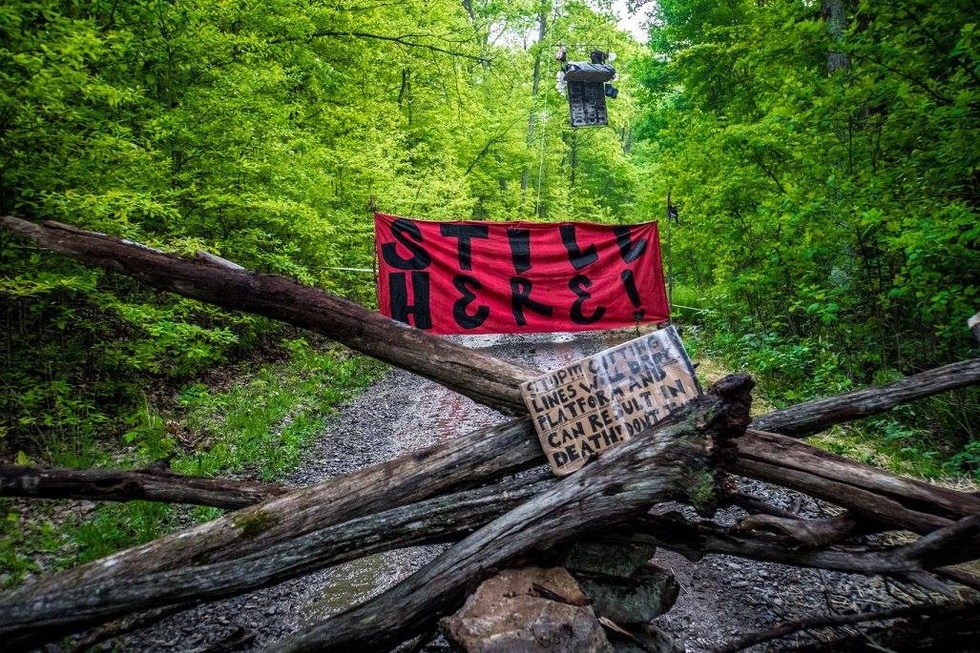
 Has someone “gotten” to FERC Commissioners Cheryl LaFleur and Richard Glick–told them, “You vote against these pipeline projects or you don’t have a future in the Democrat Party”? That’s the thought we increasingly have as we watch the two sitting Democrats on FERC repeatedly vote against projects that in some cases they previously voted to approve. What makes someone like LaFleur flip and change her vote on something that two years ago she was 100% on board with? Something has to explain it! Two and a half years ago LaFleur, then a member of FERC, voted to approve Dominion Energy’s $165 million New Market Project, a project that expands Dominion’s transmission pipeline from western New York across the state to the Capital Region of the state, near Albany (see

 Two Canadian provinces that share a border, Alberta and British Columbia (BC), are in the midst of a heated argument/conflict/civil war(?)–over a pipeline. We’ve not covered the conflict, until now. The short version is this: Alberta has a rich deposit of oil in what are called oil sands. In order to get more of the bountiful supply of oil to new markets, in Asia, Alberta needs a new pipeline. Kinder Morgan operates the Trans Mountain Pipeline system and previously proposed expanding Trans Mountain–from Alberta through British Columbia to the shore where the oil can be loaded on tankers and sailed to other continents. BC has blocked the new pipeline, and so now Alberta has passed a law that allows them to stop existing oil and gas flows into BC. If that happens, it will bring BC to its metaphorical knees from lack of energy sources. Yes, it’s getting nasty. The Canadian federal government is also involved, attempting to pressure BC to allow the pipeline. What does that have to do with the Marcellus/Utica? If we were to say “Constitution” or “Northern Access”–perhaps the light bulb will go off. You see, we have a parallel situation here in the states. New York State is blocking gas pipelines critical to PA (as supplier) and to the New England states (as demand centers). At some point, it’s not beyond the realm of possibility that PA will begin to turn off existing natgas flows into NY–and then what will we do? We New Yorkers would be royally screwed. Gov. Cuomo pay attention to our neighbors to the north. What’s happening up there is coming in your direction, if you don’t change course…
 Let’s be right up front about how we feel about the innocent-sounding Trout Unlimited (TU). Four years ago the organization was outed as a radical, far-left environmentalist group–hellbent on opposing fossil fuels (see
  Disgusting and frustrating. That’s our reaction to a decision by the U.S. Fourth Circuit Court of Appeals that invalidates (vacates) a permit issued by the U.S. Fish and Wildlife Service that allows Dominion Energy’s Atlantic Coast Pipeline (ACP) to accidentally kill a few bats and bumble bees (classified as endangered) as it builds the massive $6.5 billion, 600-mile project from West Virginia to North Carolina. The Sierra Club, Defenders of Wildlife and Virginia Wilderness Committee (all radical left organizations) previously sued in federal court asking the court to stop work on ACP until the Federal Energy Regulatory Commission makes a decision on whether or not to “rehear” their decision to approve the project in the first place. In March, the court declined to stop work on ACP (see